国有资产

Search documents
省人大常委会组成人员对省政府关于2024年度<br/>国有资产管理情况综合报告和行政事业性<br/>国有资产管理情况专项报告的审议意见
Liao Ning Ri Bao· 2025-12-06 01:05
Core Viewpoint - The provincial government has made significant progress in managing state-owned assets, with a comprehensive report presented to the provincial people's congress highlighting improvements in asset management systems and operational efficiency [2]. Group 1: Asset Management System - The provincial government and relevant departments have undertaken extensive work in standardizing asset allocation, enhancing daily management, and promoting asset revitalization [2]. - The reports presented reflect a thorough and systematic overview of the situation, identifying issues in depth and proposing targeted and actionable measures [2]. Group 2: Recommendations for Improvement - Strengthening the institutional framework is essential to solidify the foundation of asset management, ensuring clear responsibilities among departments and enhancing the supervisory management system [3]. - There is a need to standardize management behaviors and improve management capabilities by implementing strict approval processes and enhancing data management practices [4]. - Enhancing coordination and collaborative management effectiveness is crucial, particularly in integrating asset management with budget and debt management [5]. - Increasing the utilization of state-owned assets is necessary, with a focus on policy design and innovation to stimulate the active use of idle resources [6].
地方政府“盘家底”
Jing Ji Guan Cha Wang· 2025-12-01 07:45
Core Viewpoint - Hunan Province has successfully revitalized state-owned "three assets" (assets, resources, funds), generating a cumulative income of 350 billion yuan, which serves as a model for other regions in China [1][9]. Group 1: Background and Context - Hunan is one of the earliest regions in China to activate "three assets," responding to local economic pressures and declining tax revenues [2]. - The national context includes a significant total of state-owned enterprise assets amounting to 401.7 trillion yuan, indicating a shift towards balancing incremental and stock assets in economic development [5]. Group 2: Implementation Strategies - The Hunan government initiated a comprehensive action plan in 2022 to manage and revitalize state-owned assets across various sectors, including administrative units and natural resources [10][12]. - The plan includes a systematic approach with a "1+N" framework, covering eight major areas and ensuring full coverage of all state-owned assets [10][11]. Group 3: Challenges and Observations - Local governments face challenges in accurately assessing the total amount of state-owned resources and assets, which complicates the revitalization efforts [5][8]. - The revitalization of "three assets" is seen as a necessary response to fiscal constraints and the need for increased non-tax revenue [7][8]. Group 4: Broader Implications - The revitalization efforts are politically motivated, especially during transitional periods, as local governments aim to improve fiscal data for performance evaluations [7]. - The approach to revitalizing "three assets" is expected to yield social benefits, including increased employment and industrial growth, but requires sustained commitment from government bodies [8].
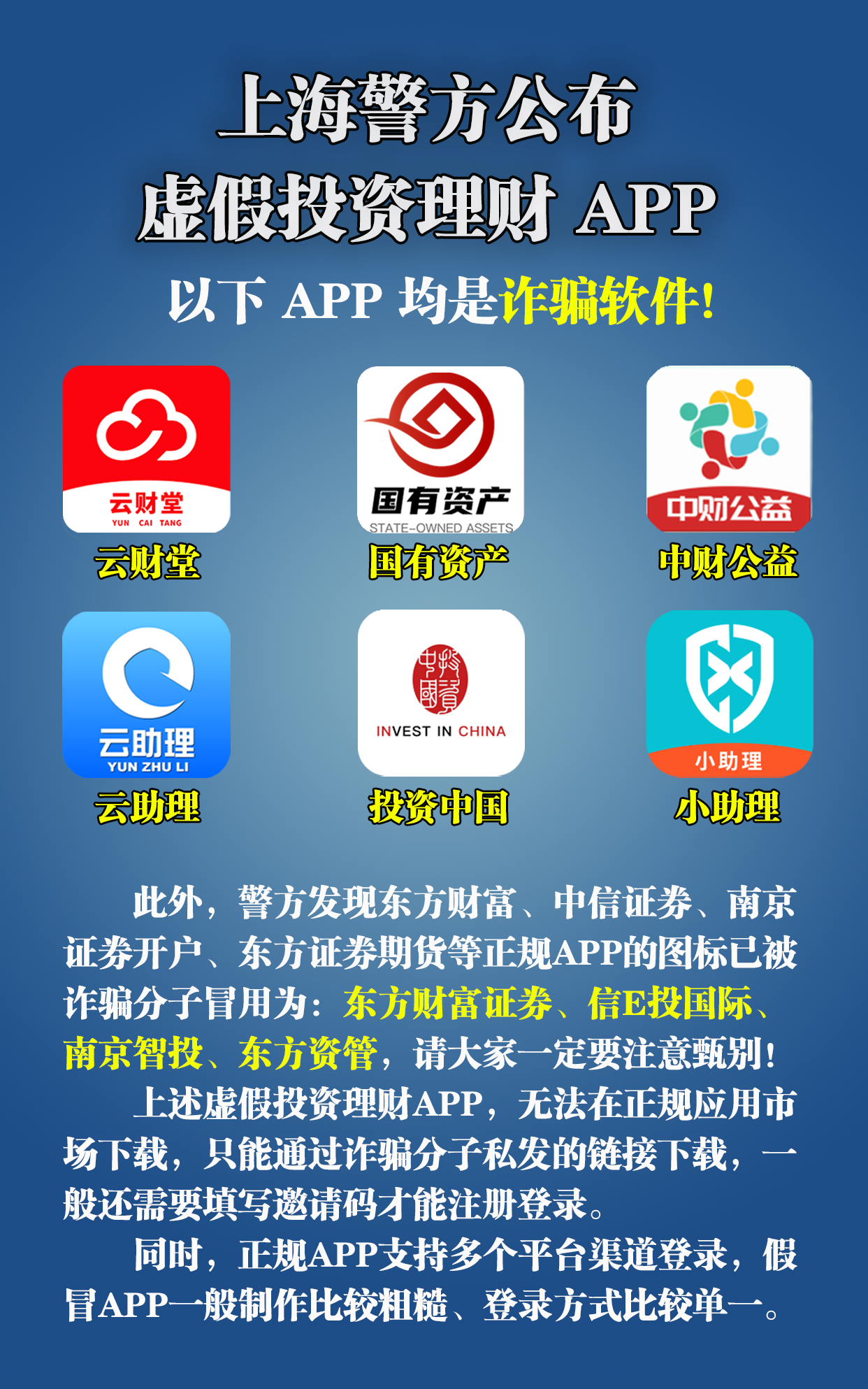
上海警方公布6款投资诈骗软件名称,上当多为老年人
Bei Ke Cai Jing· 2025-09-16 07:53
Core Viewpoint - The Shanghai police have identified six fraudulent investment apps, highlighting the prevalence of investment scams in the region, particularly in the context of online financial fraud [1]. Group 1: Fraudulent Apps - The identified fraudulent apps include "云财堂," "国有资产," "中财公益," "云助理," "投资中国," and "小助理," which are all associated with investment scams [1]. - The fraudulent investment apps are not available on legitimate app stores and can only be downloaded through links provided by scammers, often requiring an invitation code for registration [3]. Group 2: Types of Scams - The most common types of online fraud in Shanghai are false investment and financial scams, accounting for over 40% of all cases, with significant financial losses [1]. - Two typical methods of fraudulent investment scams include: 1. Luring victims with promises of following expert investors to make money, which affects nearly half of the victims [5]. 2. Creating trust through impersonation of attractive personas (e.g., "active military officers," "wealthy individuals") under the guise of romantic relationships, leading victims to invest in fraudulent platforms [5]. Group 3: Victim Demographics - The average age of victims in these scams is 49.8 years, with middle-aged individuals who have some economic foundation and investment habits being particularly vulnerable [6]. - In scams involving impersonation for romantic purposes, the victims tend to be older, primarily aged 65 and above [6].