
安信价值成长混合基金

Search documents
陈振宇卸任安信价值成长基金经理!为何业绩尚可却频繁换将?
Sou Hu Cai Jing· 2026-02-27 06:09
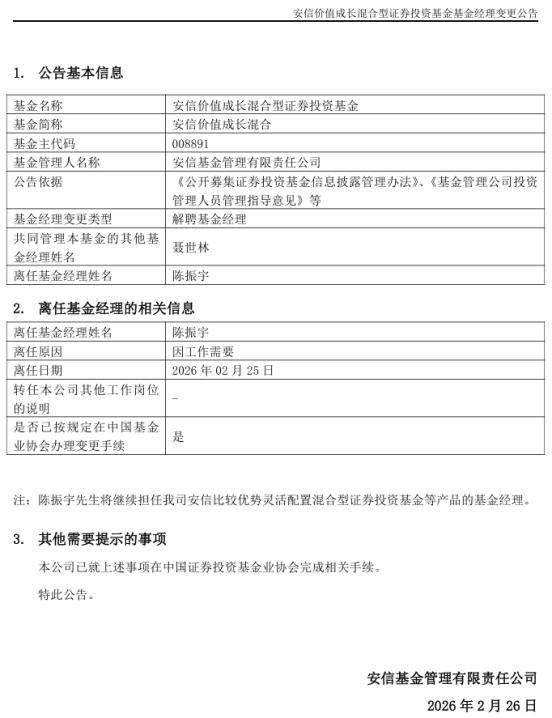
Core Viewpoint - The resignation of Chen Zhenyu, a fund manager of the Anxin Value Growth Mixed Fund, raises questions about the underlying reasons despite the fund's decent performance during his tenure [4][13]. Group 1: Fund Manager Change - Chen Zhenyu has been managing the Anxin Value Growth Mixed Fund since March 18, 2020, alongside Nie Shilin, and will leave the position on February 25, 2026, due to "work needs" [2][4]. - During Chen's management, the fund achieved a total return of 114.64% and an annualized return of 13.71%, ranking in the top 25% among its peers [4][6]. Group 2: Fund Performance and Structure - The Anxin Value Growth Mixed Fund has shown satisfactory performance, with a fund size of 4.24 billion yuan and a ranking of 205 out of 915 in its category [6]. - Chen Zhenyu's management style involved a dual-manager structure, which has led to a low correlation in performance among the funds he manages, indicating a diversified investment strategy [7][8]. Group 3: Market Reactions and Trends - The frequent changes in fund managers at Anxin Fund, with 42 products experiencing manager changes since 2025, suggest a trend of instability within the firm [9]. - Institutional investors have shown a keen sensitivity to changes, as evidenced by the high redemption rates following cash distributions, indicating a potential lack of confidence in the fund's management [10][13].

基金跷跷板效应 股基备受追捧债基屡遭赎回
Shang Hai Zheng Quan Bao· 2025-10-12 17:17
Group 1 - The core viewpoint of the articles highlights a contrasting trend between equity funds and bond funds, with equity funds experiencing significant inflows while bond funds face large redemptions [1][4] - Recent months have shown a "seesaw effect" in the market, where investors are increasingly focused on short-term performance amid rising market uncertainties [1][4] - The issuance of equity funds has been robust, with several funds reaching their fundraising limits and closing early, indicating strong investor demand [2][3] Group 2 - The performance of equity funds has been notably strong, with mixed-asset funds returning over 35% year-to-date, while long-term pure bond funds have seen minimal gains of less than 0.5% [4] - Major bond funds have announced adjustments to their net asset value precision due to significant redemptions, reflecting the pressure on bond fund performance [4] - Industry experts suggest that the current environment may lead to a shift in asset allocation towards equities, particularly as low-risk products see diminishing returns [4][6] Group 3 - Despite recent market adjustments, several fund companies maintain an optimistic outlook on the long-term value of equity assets, anticipating a favorable window for investment in late October due to upcoming policy catalysts [6][7] - Key investment themes include technology growth driven by liquidity and innovation, as well as manufacturing upgrades influenced by policy changes aimed at enhancing capital returns [6][7]