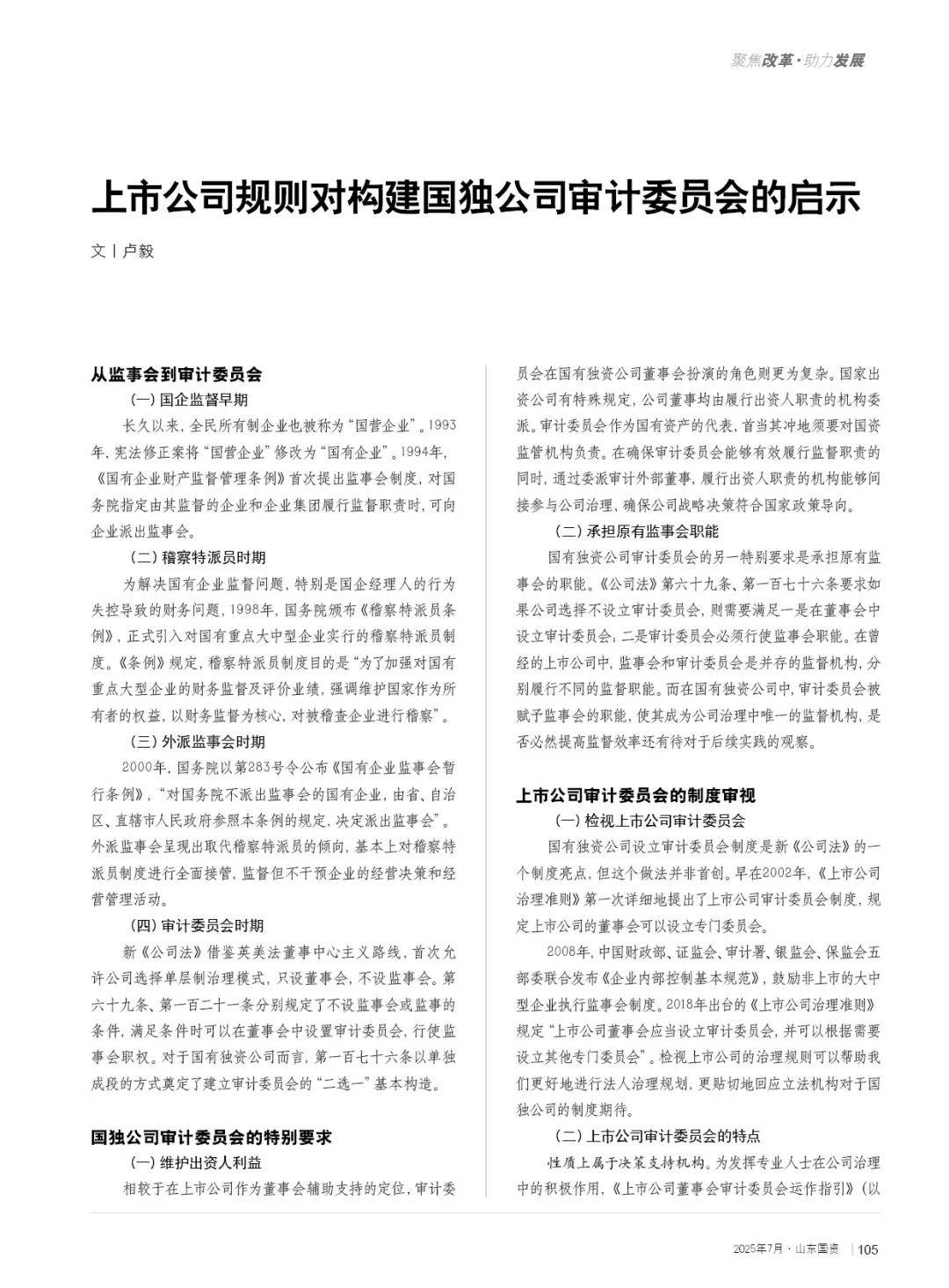
审计委员会制度

Search documents
上市公司规则对构建国独公司审计委员会的启示
Sou Hu Cai Jing· 2025-08-17 01:02
Group 1 - The article discusses the evolution of corporate governance in state-owned enterprises in China, transitioning from a supervisory board system to an audit committee system [1][4][20] - The introduction of the audit committee in state-owned enterprises is a significant development in the new Company Law, allowing for a single-tier governance structure [4][20][21] Group 2 - The audit committee in state-owned companies has a complex role, primarily responsible for representing state assets and ensuring compliance with national policies [5][21] - The audit committee is required to assume the functions of the previous supervisory board, making it the sole supervisory body within state-owned enterprises [6][22] Group 3 - The establishment of the audit committee is not a new concept, as it has been part of the governance framework for listed companies since 2002 [7][23] - The audit committee is characterized as a decision-supporting body, primarily composed of independent directors to maintain its independence [8][25] Group 4 - Members of the audit committee must possess strong financial expertise to enhance the decision-making process of the board [9][25] - The audit committee is expected to operate through regular meetings, with a minimum of four meetings per year, including at least one meeting without management present [15][26] Group 5 - Recommendations for the audit committee include having members primarily composed of external directors and ensuring at least one member has a financial or risk management background [27][28] - The inclusion of employee representatives in the audit committee is suggested to enhance the representation and fairness of the supervisory process [29]