小猫补光灯APP

Search documents
为“手搓经济”搭把手
Xin Lang Cai Jing· 2026-02-11 01:13
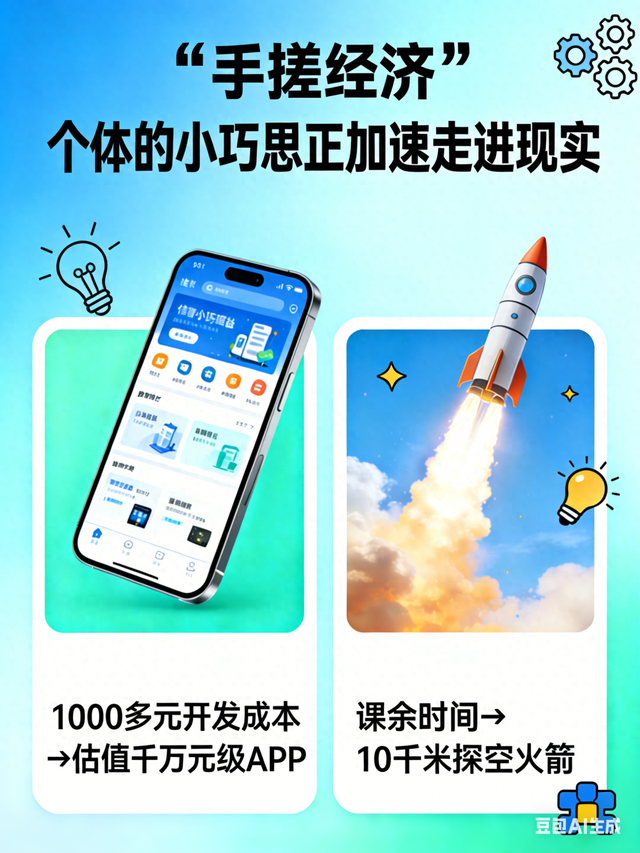
Core Viewpoint - The "handmade economy" is a new economic phenomenon where individuals or small teams leverage AI and other tools to quickly transform ideas into products or services, achieving market returns without relying on traditional production lines or large teams [3][4]. Group 1: Definition and Characteristics - The "handmade economy" allows for rapid product development with minimal costs, exemplified by an app developed for over 1,000 yuan that achieved a valuation of tens of millions [1]. - This economy is characterized by the use of digital tools, such as AI, which lower the technical barriers for innovation and entrepreneurship, enabling ordinary individuals to create software and products [4]. Group 2: Impact and Significance - The handmade economy fosters innovation among the public, leading to unique and appealing products that can outperform standardized offerings from large companies [5]. - Historical examples, such as the Wright brothers and Marconi, illustrate that many groundbreaking innovations began as small, individual projects, highlighting the potential of the handmade economy to drive significant industry changes [4]. Group 3: Challenges and Future Outlook - The rise of the handmade economy presents challenges for traditional regulatory frameworks, including product quality assurance and intellectual property protection [5]. - Future growth in this sector will depend on creating a supportive environment for innovation, including flexible regulations, comprehensive intellectual property services, and a culture that encourages experimentation and creativity [6].

中国手搓党,重塑创业
吴晓波频道· 2026-01-11 03:45
Core Insights - The article discusses the rise of "handmade" or "DIY" culture, particularly in the context of app development and hardware creation, highlighting how low barriers to entry and technological advancements have led to a surge in individual creativity and entrepreneurship [2][51]. Group 1: Rise of DIY Culture - A new app called "Are You Dead?" gained popularity quickly, reaching the top of the paid app charts within 48 hours, showcasing the potential for simple, creative ideas to capture market interest [3][21]. - The term "handmade" has evolved from a gaming slang to represent a culture where individuals use personal creativity and skills to turn imaginative ideas into reality [10][11]. - The popularity of "handmade" has been fueled by the COVID-19 pandemic, leading to a surge in creativity among individuals who began to create projects without relying on existing tools [14][15]. Group 2: Technological and Market Trends - The emergence of generative AI has broadened the definition of "handmade," allowing individuals with no coding experience to create applications through natural language descriptions [19][50]. - The hardware supply chain has become more accessible, enabling creators to source components easily, thus lowering the entry barriers for DIY projects [23][30]. - The "handmade economy" is generating significant revenue, with many creators monetizing their projects through social media or by developing commercially viable products [24][25]. Group 3: Impact on Industry and Investment - Companies like Jialichuang have benefited from the "handmade economy," reporting substantial revenue growth, with projected revenues of nearly 8 billion yuan and a net profit of approximately 1 billion yuan in 2024 [36]. - The trend of "handmade" is not just a hobby but is evolving into a new economic model, with many young entrepreneurs gaining attention from investors due to their innovative ideas and technical skills [31][32]. - The article suggests that the current phase of "handmade" represents a transitional period before industrialization, where individual creativity is being recognized as a valuable asset in the market [51][52].