小鹏汽车VLA2.0

Search documents
自动驾驶又火了,离完全替代司机还有多久?
3 6 Ke· 2025-12-29 00:31
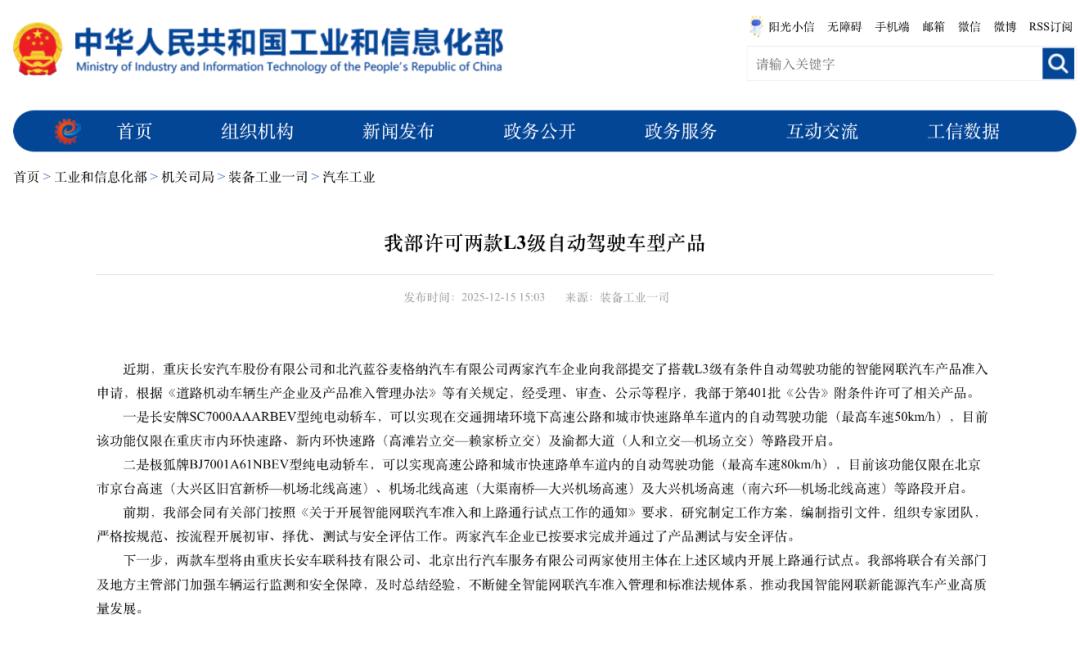
Core Viewpoint - The recent developments in L3 level autonomous driving, including the approval of vehicles from BAIC and Changan, indicate a significant step towards practical implementation of autonomous driving technology in China [3][5][6]. Group 1: Regulatory Approvals - BAIC and Changan have received official approval from the Ministry of Industry and Information Technology for their L3 level conditional autonomous driving vehicles, which can operate at speeds of up to 80 km/h and 50 km/h in designated areas of Beijing and Chongqing respectively [3]. - This approval marks a transition from testing to real-world application, suggesting that L3 level autonomous driving is moving closer to practical use [5]. Group 2: Industry Developments - He Xiaopeng, CEO of XPeng Motors, has expressed confidence in the advancements of autonomous driving, stating that XPeng's upcoming VLA 2.0 will match Tesla's FSD V14.2, potentially allowing users to skip L3 and access L4 capabilities directly [7]. - The competition in the autonomous driving sector is intensifying, with companies like Tesla and Waymo showcasing different technological approaches, highlighting the ongoing evolution of the industry [19]. Group 3: Levels of Automation - The classification of driving automation ranges from L0 to L5, with L2 being the current mainstream level that requires driver supervision, while L3 allows for conditional automation where the driver can disengage under certain circumstances [9][11]. - Higher levels, L4 and L5, promise complete automation in specific environments, which could significantly enhance user experience and convenience [13][14]. Group 4: Safety and Technology - The transition to higher levels of automation raises questions about safety and responsibility, with L2 placing responsibility on the driver, while L3 shares it with manufacturers, and L4 and L5 shift it entirely to manufacturers [16]. - Recent incidents, such as the power outage affecting Waymo's autonomous taxis, underscore the vulnerabilities of different autonomous systems and the importance of robust safety measures [18][19]. Group 5: Market Trends and Collaborations - The market is seeing a trend towards collaboration with third-party suppliers like Huawei, which could enhance efficiency and reduce costs in the development of autonomous driving technologies [21][23]. - By the end of 2025, it is projected that vehicles equipped with Huawei's intelligent driving systems will account for a significant market share, indicating a shift towards more accessible L3 level vehicles for consumers [23].