
工业人形机器人WalkerS系列

Search documents
优必选获天奇股份3000万元机器人采购订单,港股通科技ETF嘉实(520670)盘中一度涨超1%
Xin Lang Cai Jing· 2025-09-29 05:15
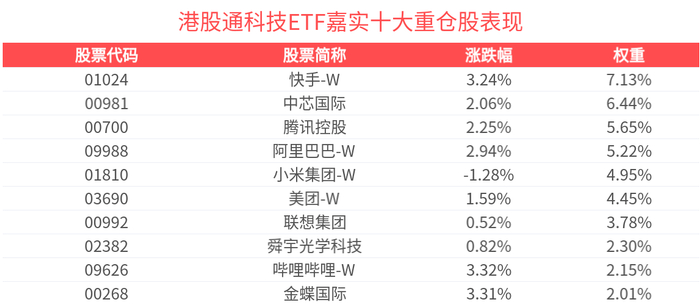
Group 1 - The Hong Kong Stock Connect Technology ETF managed by Jiashi has seen a 0.71% increase as of September 29, 2025, with a peak increase of over 1% during the trading session [1] - Key component stocks such as SenseTime-W, UBTECH, and Hua Hong Semiconductor have all risen by over 4% [1] - The ETF has recorded a weekly increase of 0.99% as of September 26, 2025, indicating positive market momentum [1] Group 2 - The liquidity of the Jiashi Technology ETF is robust, with a turnover rate of 11.19% and a trading volume of 28.2415 million yuan during the session [1] - The average daily trading volume over the past year is 57.2401 million yuan, reflecting active market participation [1] Group 3 - The Jiashi Technology ETF closely tracks the Hang Seng Stock Connect Technology Index (HSSCITI), which aims to reflect the performance of Hong Kong-listed companies related to technology that can be traded through the Stock Connect [1] - As of September 26, 2025, the top ten weighted stocks in the HSSCITI include Alibaba-W, Tencent Holdings, and Xiaomi Group-W, collectively accounting for 78.8% of the index [4] Group 4 - According to Dongfang Securities, the production of humanoid robots is accelerating, with significant orders being received by companies like UBTECH and ZhiYuan [2] - The industry is at a pivotal point of transitioning from research and development to mass production, indicating a rise in industry prosperity [2] Group 5 - On September 29, UBTECH's subsidiary UQI signed a procurement contract with Tianqi Automation Engineering Co., Ltd. for a total price of 30 million yuan for the WalkerS series industrial humanoid robots, with delivery expected by December 31, 2025 [1]


国产机器人在制造业多场景应用中脱颖而出
Zheng Quan Ri Bao Zhi Sheng· 2025-09-21 15:41
Group 1 - The core viewpoint of the articles highlights the significant growth and advancements in the robotics industry in China, driven by the increasing demand for automation in manufacturing and the successful development of key technologies [1][4]. - The manufacturing sector's output of digital products increased by 8.6% year-on-year, with the robot industry showing strong momentum, particularly in the production of robot reducers and industrial robots, which grew by 28.6% and 14.4% respectively [1]. - The density of manufacturing robots in China reached 470 units per 10,000 people, surpassing the global average, indicating a robust integration of robotics in various sectors such as photovoltaic, power batteries, and new energy vehicles [1]. Group 2 - Shenzhen Youbixun Technology Co., Ltd. secured a procurement contract worth 250 million yuan for humanoid robot products, setting a record for the largest single contract in the global humanoid robot field [2]. - The company has established partnerships with notable enterprises across various industries, including BYD, Geely, and SF Express, showcasing the widespread application of its Walker series humanoid robots [2]. - The technological breakthroughs in robotics are expanding application boundaries, exemplified by Zhejiang Jitai Intelligent Technology Co., Ltd.'s wall-climbing inspection robot, which addresses traditional inspection challenges in the wind energy sector [2][3]. Group 3 - The acceleration of robotics in manufacturing is attributed to collaborative efforts across the entire industry, with significant advancements in core components such as servo motors, reducers, and controllers, which were previously limiting factors [4]. - Shenzhen Race Intelligent Control Co., Ltd. launched the third-generation FM3 series frameless motor, enhancing torque density by 20% while meeting the precision requirements of robotics [4]. - Companies are actively building ecosystems by creating open platforms and gathering resources from the industry chain, as demonstrated by Shenzhen Cyborg Robotics Co., Ltd., which has developed a modular open platform with over 20 core component suppliers [4][5]. Group 4 - The Chinese government is intensifying efforts to strengthen the entire robotics industry chain by identifying weak links, promoting core technology breakthroughs, and fostering collaboration between academia and industry [5]. - Initiatives include launching talent recruitment for cutting-edge technologies and supporting the development of technology incubators to enhance the industry's overall competitiveness [5].
