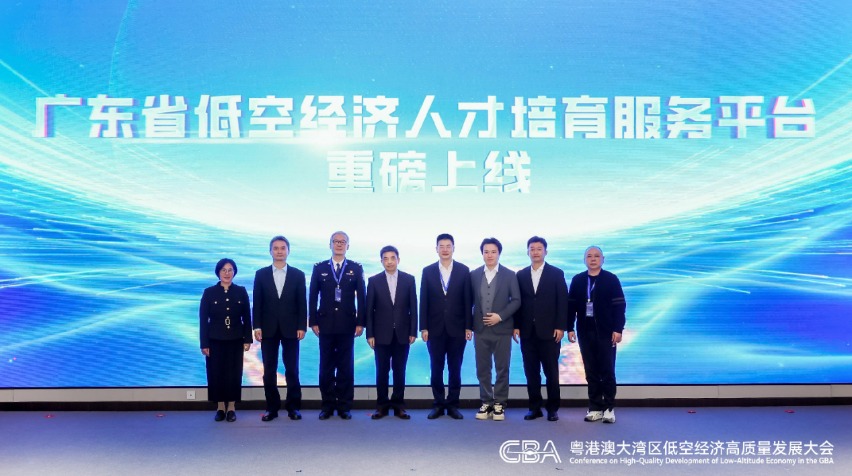
广东省低空经济人才培育服务平台

Search documents
广东为低空经济人才培育搭建服务平台
Xin Lang Cai Jing· 2026-01-15 18:26
Core Insights - Guangdong Province has launched the first provincial-level low-altitude economy talent service platform in China, which aims to support the development of the low-altitude economy as part of its strategic emerging industries [1][2] - The platform is designed to address the mismatch between talent supply and demand in the low-altitude economy sector, contributing to high-quality development in Guangdong [1] Group 1: Platform Overview - The low-altitude economy talent service platform has been operational for three weeks as of January 15, with guidance from various provincial departments [1] - The platform is built through collaboration between Southern News Network and Guangdong Low-altitude Economic Development Co., Ltd [1] Group 2: Strategic Importance - The "14th Five-Year Plan" emphasizes the acceleration of strategic emerging industries, including low-altitude economy, as a key driver for high-quality development in Guangdong [1] - The low-altitude economy is positioned as a crucial element for cultivating new productive forces and achieving high-quality growth [1] Group 3: Service Model - The platform employs a "1+2+5" service model that focuses on industry and talent needs, facilitating participation from enterprises, universities, training institutions, and talent [2] - It aims to create a comprehensive talent service system that includes planning consultation, skills training, employment matching, personal branding, and resource expansion [2] Group 4: Talent and Enterprise Database - The platform will establish a technical and skilled talent database along with an enterprise database to gather and record local talent and industry resources [2] - It will monitor the dynamics of talent supply and demand, providing five key services: research consulting, training, precise employment, brand promotion, and event operation [2]
产业人才供需错配?广东上线全国首个低空人才培育服务平台
Nan Fang Du Shi Bao· 2025-12-25 15:09
Core Viewpoint - The Guangdong Province has launched a dedicated talent cultivation service platform for the low-altitude economy, aiming to address the mismatch between talent supply and demand in the industry, thereby supporting high-quality development in the low-altitude economy [1][3]. Group 1: Platform Overview - The platform is the first provincial-level dedicated talent service hub for the low-altitude economy in China, developed with guidance from various provincial departments and built in collaboration with Southern News Network and Guangdong Low-altitude Economy Industry Development Co., Ltd [1]. - The service model is structured as "1+2+5," which includes the establishment of a talent cultivation service platform, two resource databases, and five specialized talent services [3]. Group 2: Talent Service Model - The "1" in the model refers to the creation of a talent cultivation service platform that focuses on the entire career growth pathway, from career planning and skills training to employment matching and personal brand development [3]. - The "2" represents the establishment of two major resource databases: a technical and skilled talent database and an enterprise database, which will collect and catalog local talent and industry resources [3]. - The "5" encompasses five specialized talent services, including research consulting, training, precise employment, brand promotion, and event operation, aimed at meeting the needs of government, enterprises, schools, and individuals [3]. Group 3: Industry Impact - The platform addresses the pain points of supply and demand mismatch between educational institutions and enterprises, facilitating the training of "plug-and-play" low-altitude skilled talents [4]. - Educational institutions are encouraged to join the platform to align their courses and training bases with industry needs, while low-altitude enterprises are invited to publish job requirements and participate in course design [4]. - The platform will continuously evolve and initiate a "benchmark" research project to identify leading institutions and enterprises, thereby guiding industry development through exemplary cases [4].