广深港高铁运输服务

Search documents
调图后单日最高开行415列 广深港高铁开行密度跃居全国第一
Yang Shi Wang· 2026-01-26 22:30
Core Viewpoint - The new train operation schedule implemented on January 26 enhances both passenger and freight transport capabilities by optimizing the transportation structure and utilizing newly opened railway lines [1] Group 1: Train Operation Enhancements - The new schedule increases the frequency of trains on the Guangzhou-Shenzhen-Hong Kong Express Rail Link, making it the highest in terms of train density and station stops in the country [1][5] - The "Gao 386" train departed from Hong Kong West Kowloon Station, marking the start of the new schedule [1] Group 2: Expanded Connectivity - The new schedule adds three stations—Nanjing South, Wuxi East, and Hefei South—filling the gap for direct high-speed rail connections between key cities in the Yangtze River Delta and Hong Kong [3] - A total of 16 new direct stations have been added from Hong Kong West Kowloon, increasing the total to 110 stations [3] Group 3: Increased Capacity and Service Improvements - The maximum number of trains operating daily has reached 415, with an average of one train every two minutes during peak hours, significantly increasing operational capacity [5] - The enhancements are timely for the upcoming Spring Festival, providing substantial support to alleviate passenger flow pressure between the Guangdong-Hong Kong-Macau Greater Bay Area and the mainland [5] Group 4: Cross-Border Passenger Services - The average expected daily cross-border passenger flow for the period from February 2 to 8 is projected to reach 14,000 people [7] - Shenzhen Railway is promoting a "Four Connections" service to ensure seamless communication for cross-border travelers during ticket purchasing, waiting, and transfer processes [7]


广深港高铁客流破纪录:3000万人次双向奔赴,香港加速融入大湾区
Xin Lang Cai Jing· 2025-12-21 12:29
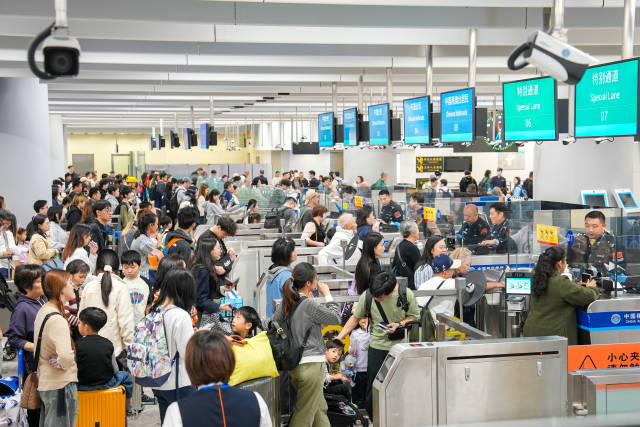
Core Insights - The G6541 train from Guangzhou to Hong Kong has successfully completed a three-day educational trip for nearly a hundred students, highlighting the robust cross-border activities between Shenzhen and Hong Kong, with the West Kowloon border checkpoint surpassing 30 million passenger inspections for the first time, reflecting a 16.8% year-on-year increase [1][2] Group 1: Cross-Border Travel - The West Kowloon Station serves as a key high-speed rail hub in the Guangdong-Hong Kong-Macao Greater Bay Area, connecting to 96 destinations across 19 provinces, municipalities, and autonomous regions, with a maximum of 110 pairs of trains operating daily [1] - The high-speed rail network facilitates seamless travel, enabling a 14-minute journey to the core area of Shenzhen and a one-hour reach to cities within the Bay Area, promoting regional integration and collaboration [1] Group 2: Passenger Demographics - Mainland residents constitute 66% of the passenger flow at the West Kowloon checkpoint, primarily driven by family and parent-child travel, which significantly supports the growth in passenger numbers [2] - The checkpoint has also seen a notable increase in foreign travelers, with over 1.4 million foreign passengers recorded this year, marking a 24% year-on-year growth, and more than 45% of these travelers benefiting from visa exemption policies, which is 1.7 times the previous year [2] Group 3: Operational Efficiency - To manage the rapid increase in passenger flow, the West Kowloon border checkpoint has implemented a self-developed "Passenger Flow Prediction and Diversion System" to optimize operations and enhance the efficiency of customs clearance [3] - The checkpoint aims to create a model for smooth, efficient, and secure customs processes, further promoting infrastructure connectivity and cultural exchanges between Hong Kong and the mainland [3]