控释包膜尿素

Search documents
新股覆盖研究:农大科技
Huajin Securities· 2026-01-20 10:24
Investment Rating - The investment rating for the company is "Buy," indicating an expected relative increase of over 15% in the next 6-12 months compared to the relevant market index [34]. Core Insights - The company, Nongda Technology, specializes in the research, production, and sales of new fertilizers and their intermediates, leveraging proprietary technologies such as humic acid activation and controlled-release technology [7][16]. - The company has shown significant revenue growth in recent years, with projected revenues of 2.676 billion CNY in 2022, 2.637 billion CNY in 2023, and 2.363 billion CNY in 2024, reflecting a year-over-year growth of 50.56%, -1.43%, and -10.40% respectively [8][4]. - The net profit attributable to the parent company is expected to increase from 101 million CNY in 2022 to 145 million CNY in 2024, with a year-over-year growth of -20.75%, 0.06%, and 43.53% respectively [8][4]. - The company is positioned to benefit from the increasing demand for new fertilizers, which are essential for sustainable agricultural practices, as the composite fertilizer usage rate in China is only 47.81%, significantly lower than the 80% in developed agricultural countries [25][27]. Summary by Sections Basic Financial Status - The company achieved revenues of 2.676 billion CNY in 2022, 2.637 billion CNY in 2023, and 2.363 billion CNY in 2024, with corresponding year-over-year growth rates of 50.56%, -1.43%, and -10.40% [8][4]. - The net profit attributable to the parent company was 101 million CNY in 2022, remaining the same in 2023, and increasing to 145 million CNY in 2024, with year-over-year growth rates of -20.75%, 0.06%, and 43.53% [8][4]. Industry Situation - The new fertilizer industry is crucial for agricultural production, with the market size in China expected to grow from 3,072.32 billion CNY in 2023 to 3,191 billion CNY by 2025, reflecting a compound annual growth rate of 1.8% [17][19]. - The demand for new fertilizers is projected to increase due to the rising population and the need for sustainable agricultural practices, with the consumption of new fertilizers expected to grow at an annual rate of 9% over the next five years [20][24]. Company Highlights - The company has developed a strong market position in humic acid-based fertilizers and controlled-release urea, with production volumes ranking first in the industry for the years 2020-2022 [28]. - The company benefits from its strategic location in the Huanghuaihai region, which is vital for national food security and has a large user base due to its proximity to major agricultural provinces [28]. - The company plans to invest in three projects through its IPO, including a 300,000-ton intelligent high-tower compound fertilizer project, a 150,000-ton bio-fertilizer production line, and an environmental low-carbon biological research center [29][30].
农大科技(920159):新股覆盖研究
Huajin Securities· 2026-01-20 09:50
Investment Rating - The investment rating for the company is "Buy," indicating an expected relative increase of over 15% in the next 6-12 months compared to the relevant market index [34]. Core Insights - The company, Nongda Technology, specializes in the research, production, and sales of new fertilizers and their intermediates, leveraging proprietary technologies such as humic acid activation and controlled-release technology [7][16]. - The market for new fertilizers in China is projected to grow significantly, with the demand for high-quality, environmentally friendly fertilizers increasing due to government policies promoting sustainable agriculture [25][20]. - The company has established itself as a core supplier of new fertilizers in China, with its products ranking highly in terms of production and sales within the industry [28]. Summary by Sections Basic Financial Status - The company achieved revenues of 2.676 billion CNY, 2.637 billion CNY, and 2.363 billion CNY for the years 2022, 2023, and 2024, respectively, with year-over-year growth rates of 50.56%, -1.43%, and -10.40% [8][4]. - The net profit attributable to the parent company was 101.2 million CNY, 101.2 million CNY, and 145.3 million CNY for the same years, with year-over-year growth rates of -20.75%, 0.06%, and 43.53% [8][4]. Industry Situation - The new fertilizer industry in China is experiencing steady growth, with the market size expected to reach approximately 3.191 trillion CNY by 2025, reflecting a compound annual growth rate of 1.8% from 2021 to 2025 [17][19]. - The demand for new fertilizers is anticipated to rise due to increasing agricultural production needs and government initiatives aimed at enhancing fertilizer efficiency and environmental sustainability [20][19]. Company Highlights - The company benefits from a strong position in the market due to the increasing composite rate of fertilizers and nutrient content requirements, indicating significant growth potential for new fertilizers [25][27]. - The company has developed a diverse product line that includes humic acid-enhanced fertilizers and controlled-release fertilizers, which are essential for improving soil quality and nutrient utilization [28][7]. Fundraising Project Investment - The company plans to invest in three projects through its IPO, including a 300,000-ton annual production project for humic acid smart high-tower compound fertilizers, which is expected to generate an average annual revenue of 894 million CNY [29][30]. Comparison with Peers - Compared to peer companies, Nongda Technology's revenue scale is below the average, but its sales gross margin is positioned in the mid-to-high range within the industry [31][32].
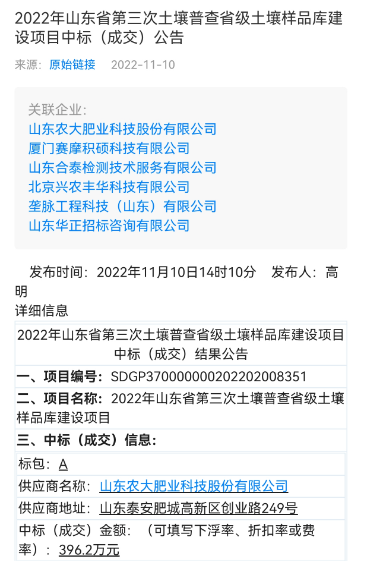
农大科技大额分红后提出募集资金补充流动性,曾与关联方同场竞标
Huan Qiu Wang· 2025-11-12 03:20
Core Viewpoint - Shandong Agricultural University Fertilizer Technology Co., Ltd. is preparing for an IPO while highlighting its dividend distribution and funding needs, raising questions about its financial management and operational sustainability [1][2]. Group 1: Company Overview - The company specializes in fertilizer production, utilizing proprietary technologies such as humic acid activation and controlled-release techniques, with products including humic acid-enhanced fertilizers and controlled-release urea [1]. - The company has distributed a total of 180 million yuan in dividends over the reporting period, with a cumulative net profit of 347.67 million yuan, indicating a dividend payout ratio of 51.77% [1]. Group 2: Financial Management - The company plans to raise 413 million yuan through its IPO, with 40 million yuan allocated for working capital, which is intended to alleviate daily operational financial pressures and enhance risk resilience [1]. - There is a contradiction in the company's statements regarding dividend payments and the need for additional working capital, as it claims that dividends do not significantly impact operations while simultaneously seeking funds to ease financial strain [1]. Group 3: Market Context - Several IPO candidates have successfully passed listings after removing working capital supplementation from their proposals, indicating a trend in the market where such funding requests are scrutinized [2]. - The company has engaged in procurement of fertilizer testing services from a related entity, highlighting inter-company relationships and potential conflicts of interest in bidding processes [2][3]. Group 4: Procurement and Equipment - Potash fertilizer is a major procurement item for the company, with a reported purchase price of 2,298.95 yuan per ton, which is lower than the market price of 2,506.57 yuan per ton reported by its supplier [4]. - The company has shown an increase in production equipment, with a notable rise in the number of distribution devices and air compressors, although the asset value increase remains minimal, raising questions about capital efficiency [4].