提钱花

Search documents
创立近9年总资产超420亿,中原消费金融换帅,资产质量存隐忧?
Xin Lang Cai Jing· 2025-12-10 02:44
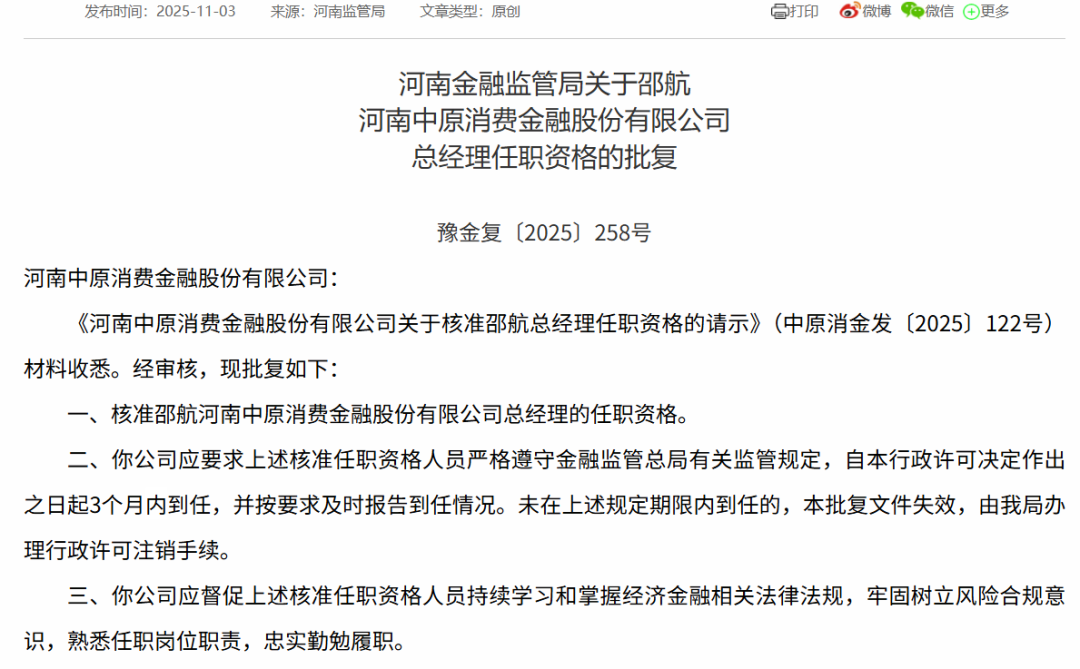
Core Viewpoint - The appointment of Shao Hang as the new general manager of Zhongyuan Consumer Finance has attracted industry attention, marking a significant leadership change in the only licensed consumer finance company in Henan Province [1][2]. Group 1: Leadership Change - Shao Hang has been approved as the general manager of Zhongyuan Consumer Finance, succeeding Zhou Wenlong, who has moved to Haier Consumer Finance [2][7]. - Shao Hang is an internal promotion and has been with the company since its inception, holding various key positions, including assistant general manager [8][10]. - The leadership transition raises questions about maintaining growth and balancing compliance and internal controls under the new management [7][11]. Group 2: Financial Performance - Zhongyuan Consumer Finance reported a significant increase in profitability, with operating income and net profit growing by 29.52% and 30.4% year-on-year, respectively, in the first half of 2025 [6][15]. - The company’s total assets reached 424.79 billion yuan by the end of 2024, ranking 12th in the industry, while its net profit ranked 8th [7][16]. - The company has seen a steady increase in revenue from 26.52 billion yuan in 2022 to 35.27 billion yuan in 2024, with net profits rising from 3.28 billion yuan to 5.03 billion yuan during the same period [12][15]. Group 3: Asset Quality and Risks - The non-performing loan (NPL) ratio for Zhongyuan Consumer Finance was reported at 2.09% at the end of 2024, with a rising trend in credit impairment loans [7][26]. - The company has faced challenges in asset quality management, with a significant increase in credit impairment losses, which reached 17.56 billion yuan in 2024, a 43.65% increase year-on-year [30][26]. - Regulatory scrutiny has intensified, particularly regarding the management of cooperative institutions, as evidenced by a fine imposed for inadequate oversight [33][30]. Group 4: Strategic Initiatives - Zhongyuan Consumer Finance has launched a product experience officer program aimed at enhancing user experience and operational efficiency, resulting in 85 app upgrades [34][25]. - The company is focusing on expanding its customer base, particularly targeting younger demographics, and enhancing its self-operated capabilities through data analysis and customer segmentation [34][25]. - The firm has also upgraded its brand and product offerings, including the rebranding of its app to improve market recognition and user engagement [20][25].

左手甩卖不良、右手发行ABS,消金公司加速自救
Di Yi Cai Jing· 2025-05-29 12:35
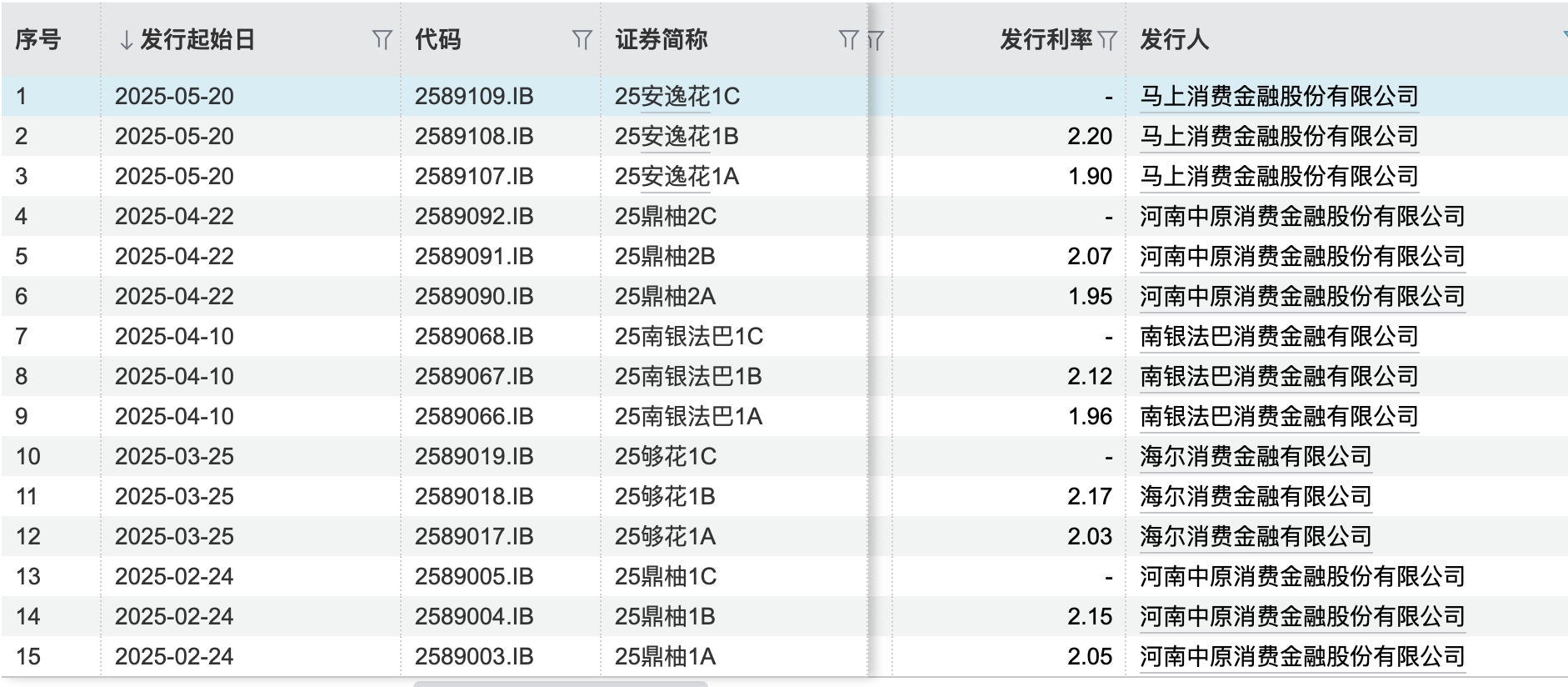
Core Viewpoint - The consumer finance industry is accelerating the disposal of non-performing assets and issuing asset-backed securities (ABS) to replenish capital, driven by intensified competition, slowing economic growth, and declining asset quality [1][6]. Group 1: Non-Performing Asset Disposal - Consumer finance institutions are rapidly clearing non-performing assets, with a trend of "quick clearance and quick transfer" becoming the norm [2]. - Ant Financial recently listed a personal non-performing loan asset package with a total unpaid principal and interest of 600 million yuan, starting at a price of only 72.1 million yuan, reflecting a discount rate as low as 12% [2]. - The average overdue days for this asset package is 335.8 days, and it has been fully classified as a "loss" category [2]. - The average unpaid principal and interest balance for borrowers in a non-performing asset package is over 5,000 yuan, with an average of 2.62 loans per person [3]. - Institutions like Zhaolian Consumer Finance are adopting a "write-off and sell, all non-litigation" approach, transferring 464,693 non-performing assets with an average overdue period exceeding 600 days [3][4]. - The trend of low-price transfers of non-performing assets has become a common practice among consumer finance companies, with transfer volumes reaching historical highs [4]. Group 2: Asset-Backed Securities (ABS) Issuance - Consumer finance companies are accelerating ABS issuance to broaden financing channels, with a total of 15 ABS products issued by May 29, amounting to 7.458 billion yuan, a 45% increase compared to the same period in 2024 [6][10]. - The majority of ABS issued are personal consumption loan ABS, accounting for 72.4% of the total [6]. - The issuance rates for ABS have reached new lows, with some products like "25 Nanyin Fabai 1A" having a ticket rate of only 3.15% [6][9]. - Regulatory support is a significant factor driving ABS issuance, with the People's Bank of China encouraging consumer finance companies to issue financial bonds and expand the scope of securitizable assets [10][11]. - ABS issuance is seen as a cost-effective financing method, helping consumer finance companies optimize their liability structure and enhance capital resilience against risks [11].