攒金类APP

Search documents
每日互动大数据:“攒金青年”女性占比近7成 整体消费能力较强
Feng Huang Wang· 2026-01-26 10:09
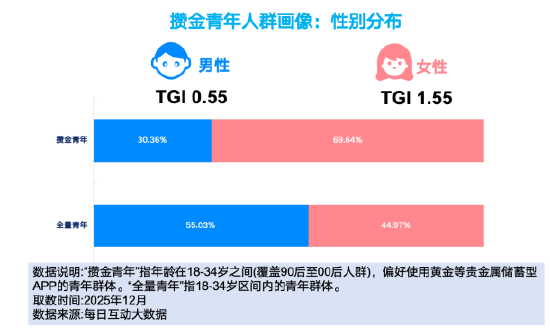
Core Insights - The report from Meiri Interactive highlights the user profile of the "Zan Jin Youth" (young individuals aged 18-34 who prefer using precious metal savings apps) [1] - Female users in this demographic have a TGI preference index of 1.55, significantly higher than that of male users [1] - The overall consumption capacity of this group is strong, with high-spending individuals making up approximately 1.92 times the proportion of the total youth population [1] Group 1: User Demographics - The preference for precious metal savings apps is more pronounced among youth in first-tier cities, with a TGI of 1.4 [1] - The top five cities showing preference for these apps are Shenzhen, Beijing, Hangzhou, Shanghai, and Guangzhou [1] Group 2: Interests and Engagement - This demographic shows a strong interest in ticketing and podcast applications, as well as a high focus on product discounts and quality shopping (e.g., Sam's Club) [1] - There is also a notable emphasis on health management and quality of life [1] Group 3: App Activity and Market Sensitivity - The weekly activity of precious metal savings apps shows a high correlation with gold price trends [2] - For instance, during the high volatility period of gold prices in April 2025, the weekly activity increased by 37.05% compared to the beginning of the month [2] - In the period from October to November of the same year, the activity surged by 82.57% due to rising gold prices and promotional activities on e-commerce platforms [2] - New user numbers peaked in April and October, indicating sensitivity to gold price fluctuations and marketing events [2]



搞金子、听播客、精打细算买买买:每日互动大数据为您打开这届“攒金青年”画像
Xin Lang Cai Jing· 2026-01-26 07:02
Core Insights - The article highlights the growing trend of "gold saving" among young people aged 18 to 34, who contribute over one-third of gold jewelry sales, indicating a shift towards using gold as a means of both consumption and asset risk management [1][23]. Group 1: Demographics and Preferences - "Gold saving youth" refers to individuals aged 18-34 who prefer using gold and precious metal savings apps, while "total youth" encompasses all individuals in the same age range [2][24]. - Among the gold saving youth, there is a higher proportion of female users, with a TGI (Target Group Index) of 1.55, indicating a stronger preference for gold accumulation compared to male users [3][27]. - The overall consumption level of gold saving youth is higher, with those in the high consumption segment being 1.92 times more prevalent than in the total youth group [5][29]. Group 2: Geographic Distribution - Preference for gold saving apps is notably higher among youth in first-tier cities, with a TGI of 1.4, particularly in cities like Shenzhen, Beijing, Hangzhou, Shanghai, and Guangzhou, which are economically vibrant and have significant gold jewelry wholesale markets [8][31]. - Shenzhen is identified as the largest and most complete gold jewelry wholesale distribution center in China, holding over 50% of the domestic market share, which supports the interest of gold saving youth in precious metals [8][31]. Group 3: Interests and Lifestyle - Gold saving youth exhibit diverse interests, showing a strong preference for ticketing apps (TGI close to 4) and podcast apps (TGI of 5.44) [11][33]. - They also enjoy sharing and beautifying their experiences, with significant preferences for photo editing apps, showing TGI values ranging from 3.03 to 6.52 [12][34]. - This demographic is highly focused on product quality and discounts, with TGI values for shopping apps like Yitao and Shénme Zhídé Mǎi reaching 8.83 and 4.2, respectively [14][37]. - Health management and quality of life are also priorities, with TGI values for health management apps at 5.21 and for food recipe apps at 2.81 [16][38]. Group 4: User Engagement and Market Trends - The weekly activity of gold saving app users correlates closely with gold price movements, with a notable 37.05% increase in app activity following a rise in gold prices from $2150 to $2350 per ounce in April 2025 [17][40]. - Significant peaks in monthly new user numbers for gold saving apps were observed in April and October, driven by gold price fluctuations and marketing activities [19][44]. - The user growth of gold saving apps shows clear seasonality and sensitivity to gold price changes, indicating a responsive market [20][44]. Conclusion - The insights reveal a rational yet passionate lifestyle emerging among gold saving youth, reflecting their desire for both material wealth and life management as they enter the new year [22][47].