体重管理类APP

Search documents
搞金子、听播客、精打细算买买买:每日互动大数据为您打开这届“攒金青年”画像
Xin Lang Cai Jing· 2026-01-26 07:02
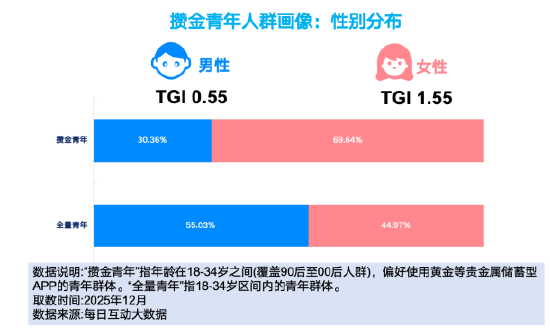
Core Insights - The article highlights the growing trend of "gold saving" among young people aged 18 to 34, who contribute over one-third of gold jewelry sales, indicating a shift towards using gold as a means of both consumption and asset risk management [1][23]. Group 1: Demographics and Preferences - "Gold saving youth" refers to individuals aged 18-34 who prefer using gold and precious metal savings apps, while "total youth" encompasses all individuals in the same age range [2][24]. - Among the gold saving youth, there is a higher proportion of female users, with a TGI (Target Group Index) of 1.55, indicating a stronger preference for gold accumulation compared to male users [3][27]. - The overall consumption level of gold saving youth is higher, with those in the high consumption segment being 1.92 times more prevalent than in the total youth group [5][29]. Group 2: Geographic Distribution - Preference for gold saving apps is notably higher among youth in first-tier cities, with a TGI of 1.4, particularly in cities like Shenzhen, Beijing, Hangzhou, Shanghai, and Guangzhou, which are economically vibrant and have significant gold jewelry wholesale markets [8][31]. - Shenzhen is identified as the largest and most complete gold jewelry wholesale distribution center in China, holding over 50% of the domestic market share, which supports the interest of gold saving youth in precious metals [8][31]. Group 3: Interests and Lifestyle - Gold saving youth exhibit diverse interests, showing a strong preference for ticketing apps (TGI close to 4) and podcast apps (TGI of 5.44) [11][33]. - They also enjoy sharing and beautifying their experiences, with significant preferences for photo editing apps, showing TGI values ranging from 3.03 to 6.52 [12][34]. - This demographic is highly focused on product quality and discounts, with TGI values for shopping apps like Yitao and Shénme Zhídé Mǎi reaching 8.83 and 4.2, respectively [14][37]. - Health management and quality of life are also priorities, with TGI values for health management apps at 5.21 and for food recipe apps at 2.81 [16][38]. Group 4: User Engagement and Market Trends - The weekly activity of gold saving app users correlates closely with gold price movements, with a notable 37.05% increase in app activity following a rise in gold prices from $2150 to $2350 per ounce in April 2025 [17][40]. - Significant peaks in monthly new user numbers for gold saving apps were observed in April and October, driven by gold price fluctuations and marketing activities [19][44]. - The user growth of gold saving apps shows clear seasonality and sensitivity to gold price changes, indicating a responsive market [20][44]. Conclusion - The insights reveal a rational yet passionate lifestyle emerging among gold saving youth, reflecting their desire for both material wealth and life management as they enter the new year [22][47].


国家吹响减肥号角,这次为何动真格?科学瘦身背后隐藏哪些健康布局
GLP1减重宝典· 2025-06-16 02:55
Core Viewpoint - The article emphasizes the importance of weight management as a public health initiative in China, highlighting the alarming obesity rates and the government's proactive measures to address this issue through the "Weight Management Year" campaign [3][4]. Group 1: Obesity as a Public Health Crisis - The overweight rate among Chinese adults has reached 34.3%, with an obesity rate of 16.4%. If no effective measures are taken, it is projected that by 2030, the rates of overweight and obesity among adults could exceed 70% [3]. - Obesity is linked to over 200 diseases, including diabetes, cardiovascular diseases, and cancer, with chronic diseases accounting for over 80% of total deaths in China [3]. Group 2: Economic and Social Implications - Obesity not only shortens individual lifespans but also increases healthcare costs and reduces overall workforce efficiency. Chronic diseases account for over 70% of the total disease burden in China, with annual medical expenses related to obesity-related diseases reaching several hundred billion yuan [4]. Group 3: National Health Strategy - The "Healthy China 2030" initiative aims to shift from a disease-centered approach to a health-centered one, with weight management identified as a key breakthrough to prevent chronic diseases [5]. - The National Health Commission, in collaboration with 16 departments, has launched the "Weight Management Year" implementation plan, addressing health needs across different age groups, including children, working adults, and the elderly [6]. Group 4: Guidelines and Tools for Weight Management - A dual standard for assessing weight is proposed, using both BMI and waist circumference. A BMI of 24 or higher indicates overweight, while a BMI of 28 or higher indicates obesity. For abdominal obesity, a waist circumference of 90 cm or more for men and 85 cm or more for women is a warning sign [7]. - It is recommended to set realistic weight loss goals of 5%-15% over 3-6 months, achieved through nutritional adjustments, exercise prescriptions, and medical interventions [8]. - The government is creating a "weight loss toolbox," which includes community health facilities, weight management clinics in hospitals, and the development of weight management apps for personalized monitoring and advice [9]. Group 5: Community and Individual Responsibility - Families are encouraged to adopt the "three knows and one management" concept, which involves understanding health standards, monitoring body changes, mastering scientific methods, and managing health collectively [10]. - In workplaces, promoting physical activities and healthy meal options can help combat "overwork obesity" [11]. - A societal effort is needed to support healthy food industries, ensure safe school meals, and engage in community fitness activities, fostering a culture of collective weight management [12].