文心5.0 Preview

Search documents
反转!80%美国AI初创企业弃用本土模型,转头扎进中国大模型怀抱
Sou Hu Cai Jing· 2025-12-31 10:12
Core Insights - 80% of AI startups in the US are now opting for Chinese general models instead of OpenAI's models, indicating a significant shift in preference due to the practicality and effectiveness of Chinese models [1][11][13] Group 1: Performance of Chinese AI Models - Chinese models, particularly in image generation, have established themselves at the forefront globally, with Alibaba's Image series and Tencent's Hunyuan Image models achieving top rankings [5][7] - In the image editing sector, Chinese companies hold 6 out of the top 16 positions, representing approximately one-third of the global market share [5] - ByteDance's models have notably secured the second, third, and fifth positions globally, showcasing China's strong presence in the top tier of AI models [7] - In the video model category, Chinese firms dominate with 7 out of the top 16 models, indicating a robust ecosystem outside of the US [9] Group 2: Comparison with US AI Development - The US is focusing on three core areas: advancing AI chip technology, building large-scale AI infrastructure, and developing closed-source models, aiming for high-tech breakthroughs [15][17] - In contrast, China is pursuing a more application-oriented approach, leveraging its status as the largest manufacturing and hardware nation to integrate AI across the entire industrial chain [21][23] - China's open-source model strategy encourages broader participation from enterprises and developers, facilitating rapid technological iteration and application across various industries [25] Group 3: Market Dynamics and Future Implications - The shift in preference among US startups reflects a broader trend where Chinese models are seen as more practical and adaptable to specific business needs [13][15] - The differing paths of AI development in China and the US are not a zero-sum game; rather, they may drive innovation and transformation in the global AI landscape [25][27]




2.4万亿参数原生全模态,文心5.0一手实测来了
量子位· 2025-11-13 09:25
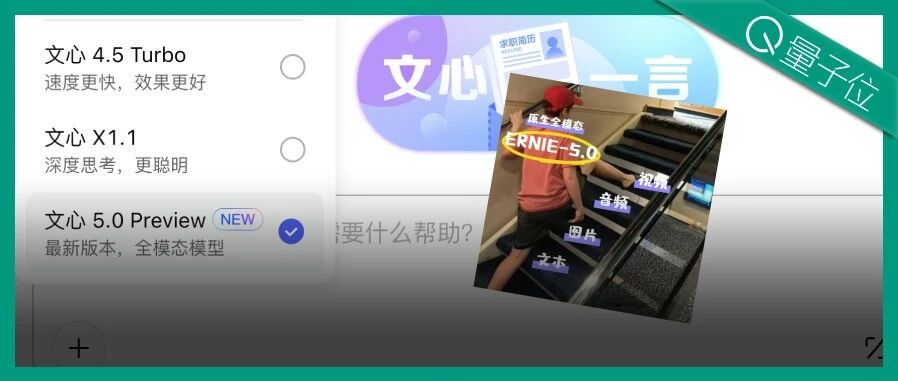
Core Viewpoint - The article announces the official release of Wenxin 5.0, a new generation model that supports unified understanding and generation across multiple modalities, including text, images, audio, and video, enhancing creative writing, instruction following, and intelligent planning capabilities [1][15]. Group 1: Model Capabilities - Wenxin 5.0 supports full-modal input (text, images, audio, video) and multi-modal output (text, images), with a fully functional version currently being optimized for user experience [15][13]. - The model can analyze video content in detail, identifying specific moments of tension and correlating audio with video elements [3][7]. - Wenxin 5.0 has demonstrated superior performance in language, visual understanding, audio understanding, and visual generation, ranking second globally in the LMArena text leaderboard [9][7]. Group 2: Technical Innovations - The model employs a "native unified" approach, integrating various modalities from the training phase to create inherent cross-modal associations, unlike traditional models that rely on post-training feature fusion [63][64]. - It utilizes a large-scale mixed expert architecture to balance knowledge capacity and operational efficiency, activating only relevant expert modules during inference to reduce computational load [67][69]. - The model's total parameter scale exceeds 2.4 trillion, with an activation ratio below 3%, optimizing both performance and efficiency [69][70]. Group 3: User Experience and Applications - Users can upload multiple file types simultaneously, including documents, images, audio, and video, enhancing interaction flexibility [18][19]. - The model can summarize core content from videos and audio efficiently, allowing users to upload up to 10 videos at once for multi-task content organization [56][57]. - Wenxin 5.0 can also generate new images from mixed text and image inputs, showcasing its versatility in creative applications [52][53]. Group 4: Industry Context and Development - The competitive landscape in the large model sector has shifted towards innovations in underlying architecture, training efficiency, and cost-effectiveness, with companies seeking differentiated breakthroughs [71][72]. - Baidu has accelerated its model iteration pace, with recent releases enhancing multi-modal capabilities and reasoning abilities, culminating in the launch of Wenxin 5.0 [73][75].
全球第二、国内第一!最强文本的文心5.0 Preview一手实测来了
机器之心· 2025-11-09 11:48
Core Viewpoint - Baidu's ERNIE-5.0-Preview-1022 model has achieved a significant milestone by ranking second globally and first domestically in the latest LMArena Text Arena rankings, scoring 1432, which is on par with leading models from OpenAI and Anthropic [2][4][43]. Model Performance - ERNIE-5.0 Preview excels in creative writing, complex long question understanding, and instruction following, outperforming many mainstream models including GPT-5-High [5][41]. - In creative writing tasks, it ranks first, indicating a substantial improvement in content generation speed and quality [5][41]. - For complex long question understanding, it ranks second, showcasing its capability in academic Q&A and knowledge reasoning [5][41]. - In instruction following tasks, it ranks third, enhancing its applicability in smart assistant and business automation scenarios [5][41]. Competitive Landscape - The LMArena platform, created by researchers from UC Berkeley, allows real user preference voting, providing a dynamic ranking mechanism that reflects real-world performance [4][5]. - Baidu's model is positioned in the first tier of global general-purpose intelligent models, reinforcing its competitive standing in the AI landscape [4][41]. Technological Infrastructure - Baidu's success is supported by a comprehensive "chip-framework-model-application" stack, which includes the PaddlePaddle deep learning platform and self-developed Kunlun chips for AI model training and inference [41][42]. - The PaddlePaddle framework has been updated to version 3.2, enhancing model performance through optimizations in distributed training and hardware communication [41][42]. Industry Implications - The advancements in ERNIE-5.0 Preview reflect a broader transition in China's AI technology from "technological catch-up" to "capability leadership" [43][44]. - Baidu aims to leverage its model capabilities across various applications, including content generation, search, and office automation, to drive industry adoption [42][43].