智能光伏产品

Search documents
关于征集智能光伏典型案例的通知
国家能源局· 2025-12-19 07:21
Core Viewpoint - The article outlines a notification from various government departments in China regarding the collection of typical cases of smart photovoltaic applications, aiming to accelerate technological advancements and industry applications in the photovoltaic sector [2][3][4]. Group 1: Typical Case Content - The notification specifies that typical cases should involve the application of smart photovoltaic products integrated with advanced technologies such as 5G, big data, and artificial intelligence to provide smart photovoltaic services [2]. - Various application areas are highlighted, including: 1. **Photovoltaic and Storage Integration**: Utilizing new storage technologies to enhance the stability and consumption capacity of photovoltaic power [2]. 2. **Building Photovoltaics**: Integrating photovoltaic systems into building structures, ensuring compatibility with electrical loads [3]. 3. **Transportation Applications**: Developing distributed photovoltaic and storage systems in transportation hubs and service areas [3]. 4. **Agricultural Applications**: Promoting ecological models that combine agriculture with photovoltaic systems [3]. 5. **Photovoltaic Hydrogen/Ammonia/Alcohol Production**: Establishing integrated bases for green hydrogen and ammonia production [4]. 6. **Floating Photovoltaics**: Implementing floating photovoltaic systems in various water bodies [4]. 7. **Photovoltaic Greenization**: Focusing on green design, manufacturing, and recycling of photovoltaic products [4]. 8. **Key Information Technologies**: Enhancing smart operation and communication systems for photovoltaic systems [4]. 9. **Advanced Photovoltaic Products**: Developing high-efficiency solar cells and related equipment [4]. 10. **New Facilities and Testing**: Creating smart photovoltaic systems for new infrastructure and extreme environments [4]. Group 2: Application Conditions - The notification outlines specific conditions for case applications, including: 1. The case must be a completed smart photovoltaic application or service system that aligns with local development needs [5]. 2. It should utilize at least three types of smart photovoltaic products, with a minimum capacity of 10MW for centralized systems and 1MW for distributed systems [5]. 3. Systems installed on buildings must have emergency power cut-off features and ensure structural safety [5]. 4. The case should demonstrate innovative service capabilities and a sustainable operational model [5]. Group 3: Implementation Organization - The notification details the process for submitting applications, including: 1. Applicants must follow specified formats and submit materials to local industrial and information departments [6]. 2. Local departments will conduct evaluations and recommend cases, with a limit on the number of recommendations [6]. 3. The final evaluation will be conducted by a collaboration of various government departments, with results publicly announced [6]. Group 4: Management and Incentives - The notification emphasizes the promotion of typical cases to enhance their influence and drive industry standards [7]. - It encourages government and societal support for typical case development through policies and resources [7]. - Typical cases are expected to align with the "Smart Photovoltaic Industry Innovation Development Action Plan (2021-2025)" to set industry benchmarks [7].


五部门通知!
Zhong Guo Dian Li Bao· 2025-12-19 06:01
Core Viewpoint - The notice from multiple government departments aims to accelerate the advancement and application of smart photovoltaic technology, promoting the integration of energy technology with AI, new materials, and advanced manufacturing to enhance the quality and upgrade of China's photovoltaic industry [1]. Summary by Sections Typical Case Content - The initiative seeks to collect typical cases that utilize smart photovoltaic products integrated with new information technologies such as 5G, big data, and AI to provide smart photovoltaic services. Key areas include: - **Energy Storage Integration**: Enhancing photovoltaic power stability and consumption capacity through new energy storage technologies [2]. - **Building Photovoltaics**: Integrating photovoltaic systems into building structures like rooftops and facades [2]. - **Transportation Applications**: Developing distributed photovoltaic and energy storage systems in transportation hubs and service areas [2]. - **Agricultural Applications**: Promoting eco-friendly models in agricultural production through photovoltaic integration [2]. - **Photovoltaic Hydrogen/Amonia/Alcohol Production**: Establishing integrated bases for green hydrogen and ammonia production [2]. - **Floating Photovoltaics**: Implementing floating photovoltaic systems in various water bodies [2]. - **Photovoltaic Greenization**: Focusing on green design, manufacturing, and recycling of photovoltaic products [2]. - **Key Information Technologies**: Smart scheduling and operation of photovoltaic systems [2]. - **Advanced Photovoltaic Products**: Development of high-efficiency solar cells and related equipment [3]. - **New Facilities and Testing**: Smart photovoltaic systems for new infrastructures like data centers [3]. Application Conditions - The application must meet specific criteria, including: - Completion of distinctive smart photovoltaic applications or service systems [4]. - Use of at least three types of smart photovoltaic products, with a minimum capacity of 10MW for centralized and 1MW for distributed systems [4]. - Safety features for systems installed on buildings [4]. - Capability for service expansion and long-term operation with innovative business models [4]. Submission Process - Applications must be submitted in a specified format to provincial industrial and information departments, which will conduct evaluations and recommend cases [4]. - Each province can recommend a limited number of cases, ensuring a controlled selection process [4]. Management and Incentives - The government will enhance the promotion of typical cases to increase their influence and drive the adoption of advanced products and technologies [5]. - Support from various levels of government and society is encouraged to facilitate the development and application of these cases [5].
五部门征集!
中国能源报· 2025-12-19 03:40
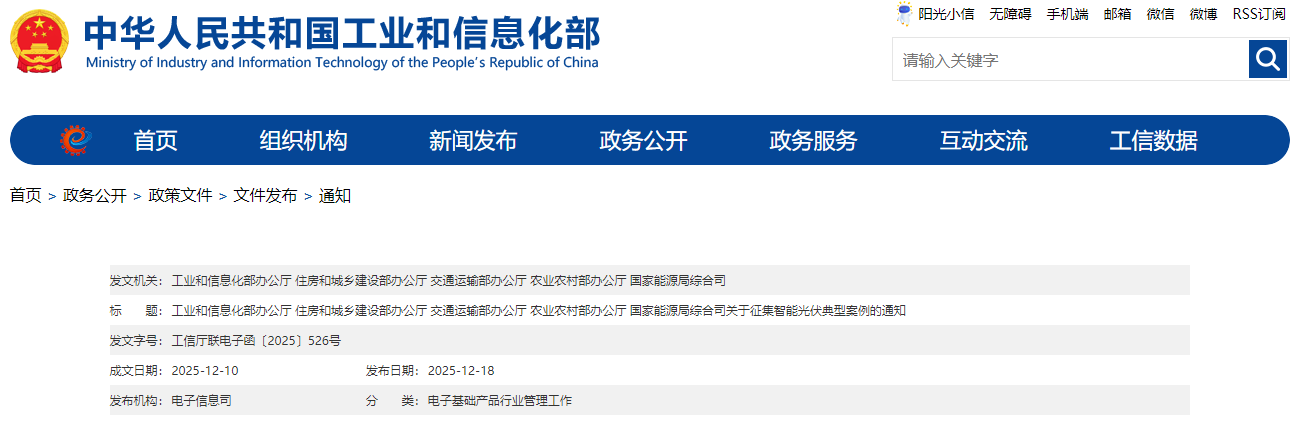
Core Viewpoint - The Ministry of Industry and Information Technology, along with four other departments, has issued a notice to collect typical cases of smart photovoltaic applications, aiming to accelerate technological advancements and industry applications in the photovoltaic sector, integrating new information technologies such as 5G, big data, and artificial intelligence [1][3]. Group 1: Typical Case Content - The notice outlines various project categories for smart photovoltaic applications, including but not limited to: 1. **Energy Storage Integration**: Enhancing the stability and capacity of photovoltaic power generation through new energy storage technologies [3]. 2. **Building Photovoltaics**: Integrating photovoltaic systems into building structures, such as rooftops and facades, to match electricity generation with building loads [4]. 3. **Transportation Applications**: Developing distributed photovoltaic systems combined with energy storage and microgrids at transportation hubs and service areas [4]. 4. **Agricultural Applications**: Promoting ecological models that combine agriculture with photovoltaic systems, particularly in large-scale farming and initial processing [4]. 5. **Photovoltaic Hydrogen/Amonia/Alcohol Production**: Establishing integrated bases for producing green hydrogen, ammonia, and alcohol in various industrial applications [4]. 6. **Floating Photovoltaics**: Implementing floating photovoltaic systems in areas like nuclear power plant discharge zones and salt ponds [5]. 7. **Green Photovoltaics**: Focusing on the green design and manufacturing of photovoltaic products, including recycling and reusing retired components [5]. 8. **Key Information Technologies**: Incorporating intelligent scheduling and operation for photovoltaic systems, along with advanced communication and information systems [5]. 9. **Advanced Photovoltaic Products**: Developing high-efficiency solar cells and related high-quality, reliable, and cost-effective equipment [5]. 10. **New Facilities and Testing**: Creating smart photovoltaic systems for new infrastructure and conducting tests in extreme environmental conditions [5]. Group 2: Application Conditions - The notice specifies that the applicants for the typical cases must meet certain criteria, including: 1. Completion of distinctive smart photovoltaic applications or service systems that align with local development needs [6]. 2. Utilization of at least three types of smart photovoltaic products, with a minimum scale of 10MW for centralized systems and 1MW for distributed systems [6]. 3. Safety features for photovoltaic systems installed on buildings, ensuring structural integrity and fire safety [7]. 4. Capacity for flexible service expansion and long-term operational sustainability, with innovative and profitable business models [7]. Group 3: Implementation and Management - The implementation process involves: 1. Strict adherence to the notification requirements for submitting applications to provincial industrial and information departments [8]. 2. On-site evaluations and expert reviews conducted by provincial departments to recommend projects [8]. 3. Limiting the number of recommended cases to a maximum of eight for provinces and five for specific municipalities [8]. 4. Promotion and support for typical cases by government departments to enhance their influence and application [9]. 5. Continuous assessment and dynamic adjustment of the typical case list to ensure relevance and effectiveness [9].