末梢采血针

Search documents
普昂医疗(920069):北交所新股申购策略报告之一百六十七:专精糖尿病护理与微创介入类医疗器械-20260317
Shenwan Hongyuan Securities· 2026-03-17 11:41
Investment Rating - The report recommends an active participation in the company's IPO, indicating a favorable investment outlook with a PE (TTM) of 10.83, which is significantly lower than the industry average [24]. Core Insights - The company specializes in diabetes care and minimally invasive medical devices, with a strong market position in insulin pen needles and a successful expansion into high-growth minimally invasive intervention sectors [4][24]. - The company has shown steady revenue growth, with projected revenue of 318 million yuan in 2024, reflecting a CAGR of +14.74% over the past three years [10][24]. - The global demand for diabetes treatment is expected to continue growing, with the number of adult diabetes patients projected to reach 783 million by 2045 [16][17]. Summary by Sections 1. Company Overview - Established in 2013, the company focuses on the research, production, and sales of diabetes care and minimally invasive medical devices, with products sold in over 70 countries [4][9]. - The core product, insulin pen needles, has a notable market share, with projected sales of 1.175 billion units in 2024, increasing from 7.52% to 11.78% market share from 2022 to 2024 [4][9]. 2. Issuance Plan - The IPO will utilize a direct pricing method, with an issue price of 18.38 yuan per share and an initial issuance scale of 10.5828 million shares, representing 20% of the total post-issue share capital [14][15]. - The expected circulation ratio post-issue is 27.93%, with a moderate threshold for online subscription [14][15]. 3. Industry Situation - The demand for diabetes treatment is on the rise, with the prevalence of diabetes in China increasing from 8.8% in 2011 to 10.6% in 2021, and projected to reach 11.8% by 2030 [16][17]. - The industry is witnessing a trend towards high-end and intelligent product upgrades in minimally invasive medical devices [16][17]. 4. Competitive Advantages - The company has a strong R&D advantage, being one of the first domestic firms to introduce safety automatic self-destroying injection needles [18]. - It also boasts intelligent production capabilities, ensuring rapid industrialization of new products through advanced manufacturing technologies [18]. - The company has established a broad customer base across multiple continents, enhancing its market reputation and ability to respond to global demand [18]. 5. Comparable Companies - The company has a higher gross margin of 49.44% compared to its peers, indicating superior profitability [23].
普昂医疗(920069):胰岛素笔针全球份额领先,积极开拓微创介入类新产品
Hua Yuan Zheng Quan· 2026-03-17 06:11
Investment Rating - The report suggests to "pay attention" to the company, highlighting the increasing global recognition of its core product, the insulin pen needle [3][57]. Core Insights - The company, Puan Medical, specializes in the research, production, and sales of medical devices for diabetes care, general drug infusion, and minimally invasive interventions, with a focus on chronic disease treatment [3][12]. - The company is recognized as a national-level specialized and innovative "little giant" enterprise, with its insulin pen needle being a core product that has gained significant market share [3][12]. - The company plans to use the funds raised from its IPO to enhance production capacity for minimally invasive medical devices and to support research and development [3][10]. Summary by Sections Initial Offering - The company is issuing 10.5828 million shares at a price of 18.38 yuan per share, with an earnings ratio of 10.83X, and the subscription date is set for March 18, 2026 [3][6]. - The total number of shares after the offering will be 52.914 million, with the offering representing 20% of the total shares [3][6]. Business Overview - The company’s diabetes care products are projected to generate revenue of 2.625 billion yuan in 2024, accounting for 82.92% of total revenue, with a year-on-year growth of 29.62% [3][14]. - The company has a diverse product matrix, including insulin pen needles, insulin syringes, and minimally invasive intervention products, with a strong focus on innovation and quality [3][12][14]. Financial Performance - The company expects to achieve revenue of 382 million yuan in 2025, representing a 20.07% year-on-year growth, and a net profit of 89.78 million yuan, with a growth rate of 38.37% [3][25]. - The gross profit margin is projected to increase from 44.56% in 2022 to 52.03% in 2025 [3][25]. Industry Insights - The low-value medical consumables market is steadily growing, with the global insulin syringe market expected to reach 1.751 billion USD in 2024 [3][32]. - The demand for insulin pen needles and syringes is anticipated to grow due to the increasing prevalence of diabetes and an aging population [3][40]. - The global market for blood collection needles is projected to reach 1.674 billion USD in 2024, reflecting a growing trend in healthcare spending and self-monitoring awareness among residents [3][44].
给美国子公司员工发百万年薪,普昂医疗销售费用率高于同行遭问询
Xin Lang Cai Jing· 2026-01-09 06:25
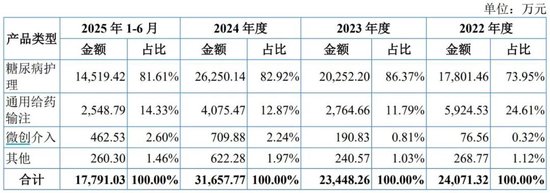
Core Viewpoint - Puang Medical is a key player in the diabetes care market, primarily producing insulin pen needles, with significant international sales, accounting for nearly 80% of its revenue. The company is preparing for an IPO to fund new manufacturing and R&D projects [2][14]. Group 1: Company Overview - Puang Medical specializes in diabetes care, general drug infusion, and minimally invasive medical devices, providing high-quality products for various applications [3][25]. - The company has established a strong international presence, exporting to over 70 countries, with notable clients including Walmart and Yifeng Pharmacy [2][12]. Group 2: Financial Performance - The company's revenue from diabetes care products has shown significant growth, with revenues of 1.78 billion, 2.03 billion, 2.63 billion, and 1.45 billion yuan for the years 2022 to 2025 H1, representing 73.95%, 86.37%, 82.92%, and 81.61% of total revenue respectively [4][27]. - The overall revenue for Puang Medical from 2022 to 2025 H1 was 2.42 billion, 2.36 billion, 3.18 billion, and 1.78 billion yuan, with net profits of 571.5 million, 459.04 million, 648.79 million, and 443.3 million yuan respectively [11][33]. Group 3: Product Details - The main product line includes insulin pen needles, insulin syringes, and blood collection devices, with insulin pen needles being the highest revenue-generating product, contributing 61.38%, 66.89%, 65.8%, and 65.8% of total revenue in respective years [5][27]. - The average selling price of the IPN product has decreased over the years, with prices dropping from 16.94 yuan per hundred units in 2022 to 13.95 yuan in 2025 H1 [6][29]. Group 4: Market Position and Competition - Puang Medical's insulin pen needles have a global market share of 7.52%, 7.98%, and 11.78% from 2022 to 2024, indicating a growing presence in the international market [5][27]. - The company faces challenges in maintaining competitive pricing due to increasing competition in the domestic market, which has led to a decline in average selling prices [6][30]. Group 5: Sales and Marketing Strategy - The company has a high sales expense ratio compared to peers, attributed to a larger sales team and increased operational costs in the U.S. market [15][37]. - Approximately half of the sales expenses are attributed to employee compensation, with significant increases noted following the establishment of its U.S. subsidiary [37][39].

全球与中国采血针市场现状及未来发展趋势
QYResearch· 2025-11-27 02:08
Core Viewpoint - The blood collection needle industry is experiencing steady growth driven by chronic disease management, home testing, and blood testing demands from medical institutions. The market is characterized by a dual-track development trend with stable hospital demand and rapid growth in home testing [6]. Industry Current Status - **Market Size and Growth**: The Chinese blood collection needle market has maintained robust growth, with a projected market size of USD 181.17 million in 2024, expected to reach USD 316.39 million by 2031, increasing its global market share from 10.83% to 15.38% [15]. - **Competitive Landscape**: The industry is fragmented with many small to medium enterprises dominating, while a few large companies hold significant brand influence. Domestic firms excel in cost control and production capacity but lag in high-end products and safety designs compared to international brands [6]. - **Technological Level and Product Structure**: The technology primarily focuses on standard and low-pain needles, with advancements in miniaturization and automation. However, high-end safety products still fall short of international standards [6]. - **Regulatory Environment**: Stricter regulations on disposable medical supplies are emerging, with requirements for NMPA registration, ISO certification, and environmental considerations becoming entry barriers for companies [6]. - **Downstream Customer Structure**: Hospitals and primary healthcare institutions are the main customers, emphasizing safety and consistency. The rapid growth of home testing users demands convenience and low pain, leading to diverse customer needs [6]. - **Supply Chain and Raw Material Status**: Key raw materials include medical-grade stainless steel, PP, and silicone. While domestic supply is sufficient for low-end materials, high-precision components still rely on imports, affecting production stability and cost control [6]. Development Trends - **Low Pain and Minimally Invasive Trends**: There is a growing demand for low-pain and minimally invasive designs, particularly for home testing and among vulnerable populations like children and the elderly. Innovations in needle tip technology are enhancing user comfort [9]. - **Automation and Safety Product Proliferation**: Safety needles with features like automatic retraction are becoming mainstream, driven by increased demand from healthcare institutions and regulatory support [9]. - **Home Testing and Health Management Market Expansion**: The market for home testing is rapidly growing, with blood collection needles being central to diabetes and chronic disease management. Integration with wearable devices and smart health solutions is anticipated [9]. - **High-End Product Technology Upgrades**: Companies are focusing on developing differentiated and high-end products, including smart blood collection devices with traceability and data management features, to meet the evolving needs of healthcare providers [9]. Future Outlook - The future of blood collection needles is expected to be more intelligent, safe, and personalized, aligning with the global healthcare system's emphasis on preventive medicine and home testing. The industry will likely see innovations in needle design and automation to enhance patient comfort and reduce infection risks [18][21]. - Regulatory trends will push for innovations in material selection and sterilization processes, with a growing emphasis on environmentally friendly practices [22]. - Competitive dynamics will shift towards technological innovation, product safety, and sustainability, with leading companies leveraging mergers and collaborations to enhance their market position [23].