
柔性直流技术

Search documents
内蒙古电力集团与南方电网签署“柔性直流技术”合作协议
Zhong Guo Dian Li Bao· 2025-11-18 03:27
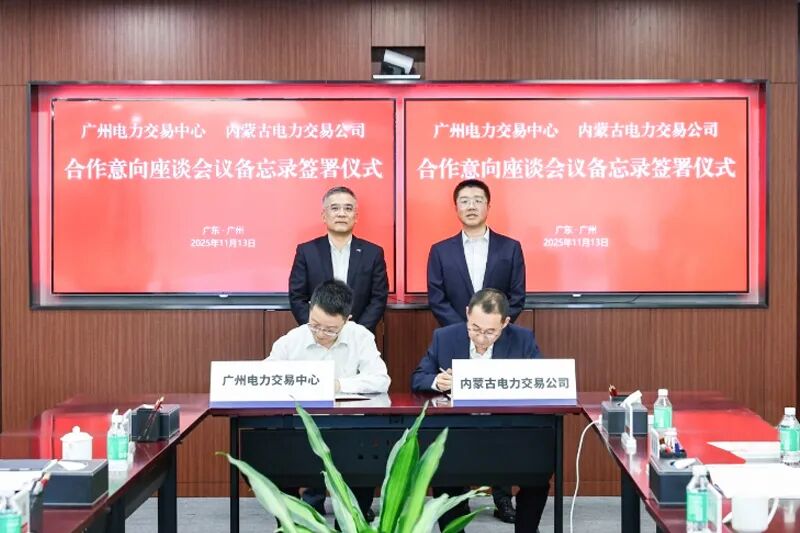
Group 1 - The core viewpoint of the article highlights the strategic cooperation between Inner Mongolia Power Group and China Southern Power Grid, focusing on enhancing collaboration in energy systems and market integration [1][2] - Zhang Xiaohu, the General Manager of Inner Mongolia Power Group, expressed gratitude for the support from China Southern Power Grid and outlined the group's commitment to national strategic goals and major projects during the 14th Five-Year Plan [2][4] - Both companies aim to deepen cooperation in areas such as market alignment, DC transmission, energy storage, digital transformation, and carbon integration to support high-quality development and contribute to China's modernization [2][4] Group 2 - During the visit, Zhang Xiaohu and his team conducted discussions and on-site research at various Southern Power Grid units, focusing on energy policy research, grid planning, power trading, and emerging industries [4] - A cooperation memorandum was signed between Inner Mongolia Power Trading Company and Guangzhou Power Trading Center regarding green electricity trading and market system development [4] - Inner Mongolia Power Research Institute and Guangdong Grid Planning Research Center signed a cooperation agreement on flexible DC technology [4]

十五五特高压展望专家交流
2025-07-25 00:52
Summary of Key Points from the Conference Call Industry Overview - The conference call discusses the **Ultra-High Voltage (UHV) transmission industry** in China, focusing on the challenges and future plans for UHV projects, particularly in the context of renewable energy integration and grid stability. Core Insights and Arguments 1. **Low Utilization Rates**: UHV lines are generally underperforming, with many DC channels operating below 50% utilization, significantly lower than the expected 4,500 hours, which limits investment motivation for grid companies and restricts transmission price increases [1][3][7]. 2. **Future Tender Plans**: Three UHV lines are expected to be tendered in the second half of 2025, including routes from southeastern Tibet to the Guangdong-Hong Kong-Macao Greater Bay Area and from Inner Mongolia to Beijing-Tianjin-Hebei [1][3]. 3. **Flexible DC Technology**: The increasing application of flexible DC technology in large-scale wind and solar bases enhances the share of clean energy and improves system stability, addressing the mismatch between supply and demand for clean energy [1][4][10]. 4. **Coal Power Construction**: The rapid construction of coal power plants in regions like Sichuan and Yunnan is a response to the limitations in renewable energy absorption, with Yunnan's coal power plant utilization hours significantly increasing [1][7]. 5. **Interconnection Projects**: Future projects will focus on asynchronous interconnections between regions, enhancing overall network stability and reliability, with notable projects like the Fujian-Jiangxi and Hunan-Guangdong interconnections [5][6]. 6. **Cost and Emission Challenges**: Offshore wind power faces high costs and carbon emission challenges, with deep-sea development being particularly expensive, potentially slowing down future offshore wind projects [2][9]. 7. **Energy Dispatch and Market Reform**: The transition from main grid construction to distribution network construction is anticipated, with a focus on improving existing channel utilization and promoting market-oriented reforms [20][21]. Other Important but Potentially Overlooked Content 1. **Investment in Existing Infrastructure**: There is a need to improve the utilization of existing UHV channels before approving new projects, as many current projects have low utilization rates despite high initial investments [7][20]. 2. **Water and Renewable Energy Integration**: The integration of hydroelectric power with renewable energy sources is crucial, with plans to utilize existing channels effectively while considering the capacity of wind and solar bases for future energy dispatch [8][10]. 3. **Market Dynamics**: The ongoing marketization of electricity trading is expected to influence UHV transmission and back-to-back DC projects, with adjustments in pricing structures for high and low voltage levels [22][23]. 4. **Technological Considerations**: The application of Gas Insulated Lines (GIL) in specific scenarios, such as in steep terrains or where overhead lines are impractical, is highlighted as a potential area for future development [24][26]. This summary encapsulates the key points discussed in the conference call, providing insights into the current state and future direction of the UHV transmission industry in China.