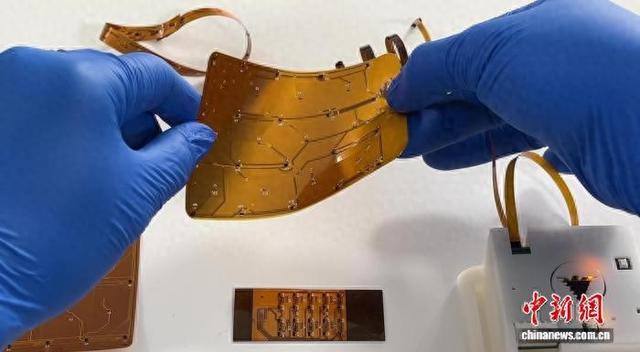
柔性磁定位贴片系统

Search documents
【中国新闻网】科研团队开发柔性磁定位贴片系统 助微创手术“精准导航”
Zhong Guo Xin Wen Wang· 2026-02-05 02:45
Core Insights - A collaborative research team from Shenzhen Institute of Advanced Technology and Zhejiang University has developed a flexible magnetic positioning patch system that offers high precision and real-time tracking for medical devices in minimally invasive surgeries [1][2]. Group 1: Technology Development - The research team created a customizable, attachable flexible magnetic positioning patch based on flexible printed circuit boards, which is lightweight and can be designed in various shapes and sizes to meet specific needs [2]. - The developed dual-stage positioning algorithm functions similarly to satellite navigation systems, first determining the patch's position in a global coordinate system and then using it as a local reference for locating small magnetic targets within the body [2]. Group 2: Application and Validation - Systematic validation of the magnetic positioning method showed high precision in specific locations during simulated brain artery interventions and ERCP guidewire placement experiments [3]. - Successful continuous tracking of guidewires in the femoral artery of pigs and the collection of gastrointestinal motility signal parameters in New Zealand rabbits demonstrated the method's stability and versatility across various clinical scenarios [3].

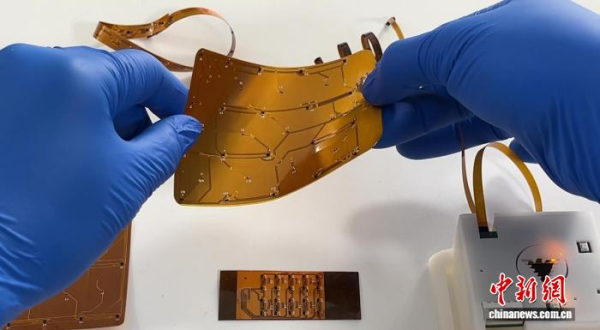
科研团队开发柔性磁定位贴片系统 助微创手术“精准导航”
Xin Lang Cai Jing· 2026-02-04 13:19
Core Viewpoint - A research team from the Shenzhen Institute of Advanced Technology and Zhejiang University has developed a flexible magnetic positioning patch system that offers high-precision, real-time tracking for medical instruments during minimally invasive surgeries, potentially enhancing surgical safety and efficiency [1][3]. Group 1: Technology Development - The research team created a customizable, attachable flexible magnetic positioning patch based on flexible printed circuit boards, which can be designed in various shapes and sizes to suit specific needs [3]. - This patch can be applied directly to the skin or integrated into medical instruments like endoscopes, providing immediate usability akin to a "flexible GPS" for precise guidance during medical procedures [3]. Group 2: Methodology and Validation - The team developed a dual-stage positioning algorithm that functions similarly to satellite navigation systems, first determining the patch's position in a global coordinate system using an external magnetic field, and then using the patch as a local reference for locating small magnetic targets within the body [3][5]. - Systematic validation of this method showed high-precision positioning capabilities in simulated experiments for brain artery interventions and ERCP guidewire placements, demonstrating its effectiveness in specific medical applications [5]. Group 3: Application Potential - The magnetic positioning strategy has shown good stability and versatility in various clinical scenarios, including surgical navigation and external physiological monitoring, indicating its broad application potential in the medical field [5].