桥介引擎(BridgeDP Engine)

Search documents
机器人从苏州走到上海 106公里没摔跤 但卡在“规则”与“补给”
Di Yi Cai Jing· 2025-11-21 11:30
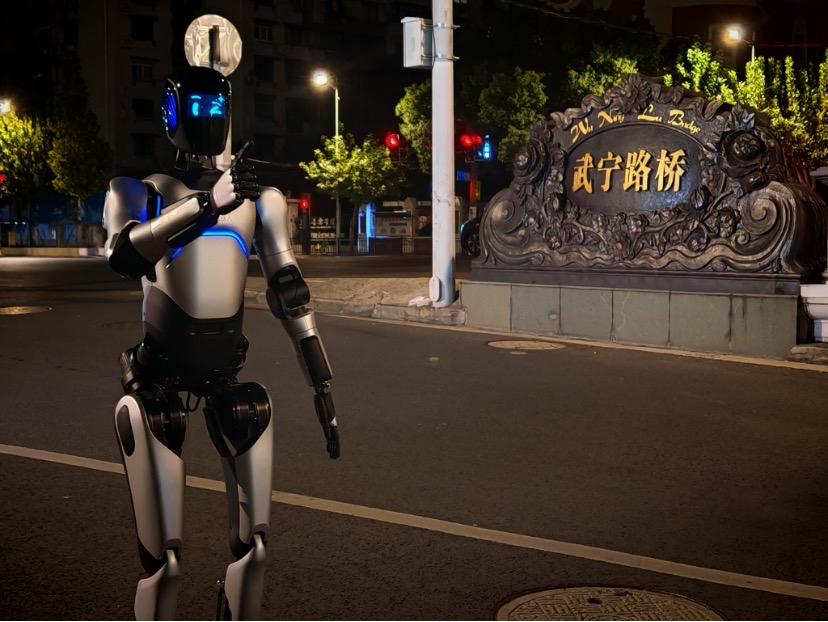
Core Insights - The A2 humanoid robot from Zhiyuan has set a Guinness World Record for the longest distance walked by a humanoid robot, covering 106.286 kilometers from Suzhou Jinji Lake to Shanghai Bund, highlighting its integration into real-world scenarios [1] - The journey faced challenges such as battery replacement logistics and navigating human environments, emphasizing the need for a robust engineering system to support real-world deployment [1][2] Group 1: Technical Challenges - The A2 robot has a battery life of approximately 3 hours when stationary and 2 hours while walking, necessitating a support vehicle for battery replacement during its journey [2] - The robot operates in a "semi-autonomous" mode, equipped with dual GPS for navigation, but still faces challenges in adhering to traffic rules and avoiding obstacles like pedestrians and vehicles [2][3] - The ability to walk steadily in various conditions is a significant engineering challenge, as the robot must perform reliably in non-standard environments [3][5] Group 2: Industry Insights - The development of smaller humanoid robots is progressing, with platforms like BridgeDP Engine enabling rapid learning of movements, thus lowering the barrier for secondary development [4] - Full-sized humanoid robots present greater challenges compared to smaller models, including stability, structural strength, and energy efficiency, which are critical for successful deployment [5] - The industry faces a high maintenance rate for delivered robots, indicating systemic issues that go beyond supply chain problems, necessitating improvements in delivery processes and after-sales support [5] Group 3: Future Considerations - For robots to integrate successfully into outdoor environments, societal infrastructure and regulations, such as designated charging stations and identification systems, will be essential [6] - As robots become more prevalent in commercial applications, the establishment of these infrastructures and rules is expected to evolve over time [6]

机器人从苏州走到上海,106公里没摔跤,但卡在“规则”与“补给”
Di Yi Cai Jing· 2025-11-21 10:00
Core Insights - The article discusses the challenges faced by humanoid robots, specifically the A2 model from Zhiyuan, during its record-setting journey of 106.286 kilometers, highlighting the need for stability, robustness, and technological boundaries in real-world applications [2][6]. Group 1: Robot Performance and Challenges - The A2 robot completed a Guinness World Record for the longest distance walked by a humanoid robot, but faced significant challenges in real-world environments, such as navigating pedestrian and non-motorized lanes and dealing with human interactions [2][3]. - The A2's battery life allows for approximately 2 hours of walking, necessitating a supplementary power supply method, as outdoor charging stations are not available [3][6]. - The robot operates in a "semi-autonomous" mode due to safety concerns, as it must navigate unpredictable human and vehicle interactions while adhering to traffic rules [4][6]. Group 2: Engineering and Technical Considerations - The A2 underwent over 3,500 hours of reliability testing in various conditions, emphasizing that the challenge lies in maintaining stability and reliability in non-standard situations rather than just achieving mobility [6][7]. - The complexity of full-sized humanoid robots is significantly higher than smaller models, requiring greater attention to stability, structural strength, energy consumption, and safety [6][7]. - The current delivery rate of robots shows a maintenance rate exceeding 50%, indicating systemic issues in stability and consistency that cannot be solely attributed to supply chain factors [7]. Group 3: Future Considerations and Infrastructure - For robots to integrate successfully into outdoor environments, societal infrastructure and regulations, such as designated charging points and identification systems, will be necessary [7].