氨基硅烷

Search documents
宏柏新材(605366):含硫硅烷领先企业,牵手迈图丰富硅烷产品矩阵
环球富盛理财· 2025-12-28 11:13
Investment Rating - The report does not explicitly state the investment rating for Jiangxi Hungpai New Material (605366.SH) Core Insights - Jiangxi Hungpai New Material is a leading enterprise in sulfur-containing silanes, having ranked first in both global and domestic markets for six consecutive years, establishing itself as the largest producer of sulfur-containing silanes worldwide [2] - The company has expanded its product matrix significantly by launching new functional silane products, including amino silanes, epoxy silanes, phenyl silanes, mercapto silanes, acyloxy silanes, high-temperature silicone rubber, and silica aerogels [2] - A joint venture with Maitu has been established to enhance collaboration and accelerate the development of new products and technologies, with Jiangxi Hungpai holding a 51% stake in the new entity [4] - The company has also expanded into the Thai market by forming a subsidiary, aiming to enhance its overseas market presence and functional silane supply chain [4] Summary by Sections Company Overview - Jiangxi Hungpai New Material focuses on the research, production, and sales of functional silanes, nano-silicon materials, and other chemical additives [2] Recent Developments - The establishment of a joint venture with Maitu and the formation of a subsidiary in Thailand are key strategic moves to enhance product offerings and market reach [4] Financial Insights - The cost structure indicates that direct materials account for 65.13% of operating costs, with major raw materials including silicon blocks, chloropropene, anhydrous ethanol, and carbon black [4]

财说丨上市以来半年报首亏,晨光新材的“硅烷寒冬”有多冷?
Xin Lang Cai Jing· 2025-07-20 23:10
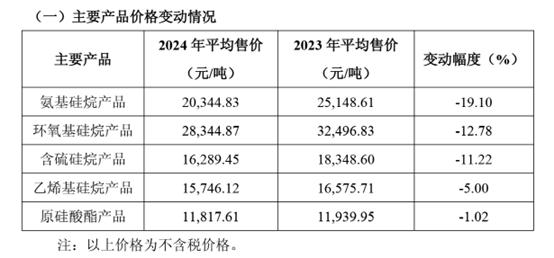
Core Viewpoint - Morning Light New Materials (605399.SH) has issued a profit warning, predicting a net loss of 3.5 to 5.1 million yuan for the first half of 2025, marking a year-on-year decline of 108.35% to 112.16% [1][2]. Group 1: Financial Performance - The company's non-recurring net profit is expected to decline sharply by 228.87% to 273.31%, with losses projected between 29 to 39 million yuan, reaching a new low since its listing [1][2]. - Morning Light's stock price peaked at 18.44 yuan per share on the announcement day, following three consecutive days of trading at the upper limit [2]. - The gross profit margin has plummeted from a high of 42.56% in 2021 to 14.84% in 2024, with a net profit margin turning negative at -2.04% in the first quarter of 2025 [10][15]. Group 2: Industry Context - The functional silane industry is facing an oversupply crisis, with production capacity expected to reach 70.25 million tons in 2024, while demand is only projected at 27.25 million tons, indicating a significant supply-demand imbalance [3][4]. - The average selling prices of key products are declining, with amino silane prices dropping by 19.1% from 25,148.61 yuan/ton in 2023 to 20,344.83 yuan/ton in 2024 [6][7]. - The overall market size for the functional silane industry is only 5.773 billion yuan, slightly above Morning Light's market capitalization [5]. Group 3: Operational Challenges - The company is experiencing increased construction costs and a decline in product prices due to oversupply, which has led to a significant drop in profitability [2][13]. - Morning Light's debt levels have surged, with the debt-to-asset ratio rising from 10.36% in 2022 to 33.75% in the first quarter of 2025 [15]. - Cash flow from operating activities has drastically decreased, with a projected cash flow of 40.36 million yuan in 2024, down 80% year-on-year, and a net outflow of 16.36 million yuan in the first quarter of 2025 [18]. Group 4: Future Outlook - Despite the challenging market conditions, the company is continuing to expand its production capacity, which may further strain its financial resources [14][19]. - The risk of inventory devaluation is significant, with a reported inventory balance of 210 million yuan as of the end of 2024, representing 13% of current assets [18]. - Analysts suggest that the ongoing price wars and increased competition from larger firms may further exacerbate the company's financial difficulties [9][19].