
水果西红柿

Search documents
密云智慧技术赋能 长治番茄增产丰收
Xin Lang Cai Jing· 2025-12-20 23:09
Core Insights - The article highlights the successful implementation of a soilless cultivation base for fruit tomatoes in Xihan Village, Huguan County, leveraging technology from Beijing's Jixing Agriculture to enhance production and sales efficiency [1][2] Group 1: Technology and Innovation - The soilless cultivation base covers 100 acres and includes 31 smart greenhouses, utilizing coconut coir for cultivation, integrated water and fertilizer systems, and comprehensive pest control techniques to improve yield and quality [1][2] - The water-fertilizer integration system allows for precise control of nutrient delivery, ensuring optimal growth conditions for each tomato plant [2] Group 2: Economic Impact - The project has created job opportunities for over 30 local villagers, addressing employment challenges and increasing household incomes [4] - The expected annual production per greenhouse is 7,000 kilograms, with a total projected yield of over 217 tons from all greenhouses, translating to an estimated annual sales revenue of 2.17 million yuan at a minimum purchase price of 10 yuan per kilogram [4] Group 3: Market Strategy - The cultivation model combines village collective efforts with dual enterprise collaboration, directly supplying high-end markets in Beijing, which stabilizes product sales and supports local economic growth [2][4] - Future plans include expanding the cultivation area and introducing more high-quality fruit and vegetable varieties to further enhance income opportunities for villagers [4]


“智慧”赋能,长治西红柿直销北京市场
Bei Jing Ri Bao Ke Hu Duan· 2025-12-12 11:14
Core Insights - The article highlights the successful implementation of a soilless cultivation base for fruit tomatoes in Xihan Village, Huoguan County, which is supported by advanced agricultural technology from Beijing's Jixing Agriculture [1][2][4] Group 1: Technology and Innovation - The soilless cultivation base covers an area of 100 acres and includes 31 smart agricultural greenhouses, utilizing coconut coir and integrated water and fertilizer systems to enhance growth and reduce disease [2][4] - The "custom soil" used in the cultivation process consists of various components such as peat soil, coconut coir, perlite, and decomposed rice husks, providing both a loose texture and nutritional value for the tomatoes [2][4] Group 2: Economic Impact - The project is expected to yield approximately 7,000 kilograms per greenhouse annually, with a total projected output of over 217 tons from all greenhouses, leading to an estimated annual sales revenue of 2.17 million yuan [5] - The initiative has created job opportunities for over 30 local villagers, addressing employment challenges and increasing their income [5] Group 3: Market and Collaboration - The tomatoes are set to be harvested and supplied directly to major supermarkets in Beijing during the Spring Festival, indicating a strong market demand [2] - The project adopts a collaborative model involving village collectives and enterprises, ensuring stable sales channels and contributing to the economic uplift of local residents [4][5]
甘肃民勤:科技赋能沙漠寒旱农业
Zhong Guo Xin Wen Wang· 2025-11-14 06:40
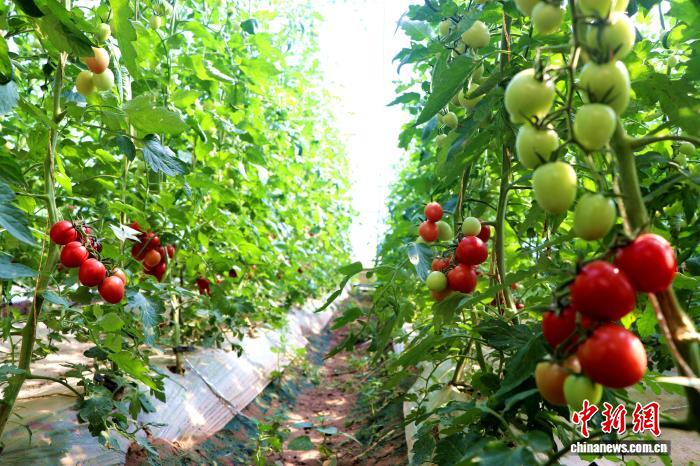
Core Viewpoint - Gansu's Minqin County is leveraging technology to transform its arid desert agriculture into a sustainable and productive industry, focusing on high-quality produce and innovative agricultural practices [1][4][7]. Group 1: Agricultural Innovation - Minqin County is utilizing organic fertilizers and soil improvement techniques to enhance the quality of its agricultural products, such as the "desert ruby" tomatoes, which are in high demand due to their superior quality [1][4]. - The county has developed a multifunctional protective system that integrates windbreaks, soil conservation, and ecological restoration, significantly improving agricultural production conditions [4][7]. Group 2: Technological Empowerment - The local industry is adopting advanced technologies like automated production lines and low-temperature purification processes to enhance the quality of products such as fennel, which is becoming a key driver of local income [2][6]. - A comprehensive technical system has been established, combining information, knowledge, and smart equipment, to support the modernization of agriculture and improve production efficiency [4][5]. Group 3: Sustainable Development - Minqin County is focusing on ecological governance and sustainable development, aiming to combat desertification and ensure long-term agricultural viability [4][5]. - The county's agricultural strategy includes the development of a complete industrial chain from production to processing, ensuring the sustainable growth of its cold-resistant vegetable industry [7]. Group 4: Brand Building and Market Strategy - The county is enhancing the reputation of its agricultural products through systematic brand development and diversified promotional strategies, aiming to boost the recognition and quality of "Minqin-produced" goods [5]. - A strategic approach is being implemented to optimize the agricultural layout based on regional advantages, focusing on high-value crops and ecological practices [5][7].
江苏省第十批援藏工作圆满收官——山海同频共振 共育格桑芬芳
Xin Hua Ri Bao· 2025-06-16 23:16
Core Viewpoint - The collaboration between Jiangsu and Tibet has significantly transformed the region through targeted aid, focusing on sustainable development, cultural integration, and improved living standards over the past three years [1][2][4]. Financial Investment and Project Implementation - Jiangsu has invested a total of 1.536 billion yuan in aid to Tibet, completing 165 aid projects, which has positioned it first in the national "14th Five-Year Plan" aid assessment for Tibet [1]. - The aid has shifted from "blood transfusion" to "blood production," emphasizing self-sustaining development [1][4]. Industrial Development - Jiangsu's aid has led to the establishment of modern agricultural and livestock demonstration parks, such as the 150 million yuan investment in the first comprehensive agricultural demonstration park in Tibet [2]. - The introduction of superior yak breeds has reduced the time to market from 7-8 years to 5 years, significantly increasing farmers' incomes [2][3]. - A total of 312 aid investment projects have been implemented, with an agreed investment amount of 59.3 billion yuan and actual funds reaching 33.7 billion yuan, ranking first among 17 aid provinces [5] [4]. Social Welfare and Living Standards - The aid has resulted in significant improvements in local infrastructure, including the construction of over 50 "heart bridges" and 32.3 kilometers of "happy roads" [6]. - Medical facilities have been upgraded with advanced equipment and training, leading to the establishment of the first second-level hospital in a county in Tibet [7]. - Educational initiatives have led to a high school entrance rate of 94.69% in 2024, with a notable increase in the number of students achieving top scores [8]. Cultural Exchange and Integration - Jiangsu has facilitated cultural exchanges through various initiatives, including the donation of 100,000 books and educational materials to local libraries [11]. - The promotion of tourism and cultural events has enhanced the visibility of both regions, with projects like the "Jasmine and Galsang" high-speed train and the Qinhuai Lantern Festival in Lhasa [10][11]. - The original musical film "Heaven·Dream" showcases the stories of Jiangsu's aid efforts and the social changes in Tibet, fostering a sense of unity among different ethnic groups [11].