
沉积物捕获器

Search documents
在南大洋收回“深海串珠”
Zhong Guo Zi Ran Zi Yuan Bao· 2026-02-13 06:26
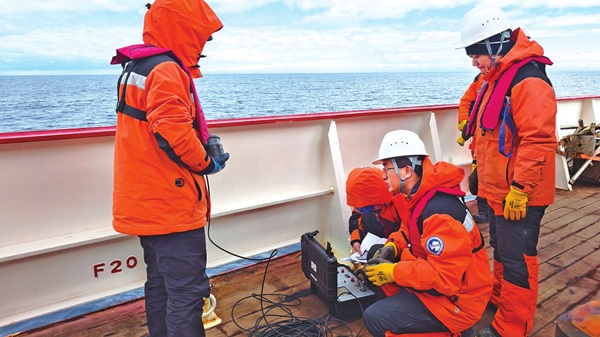
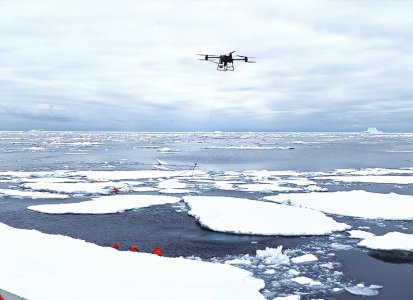
Core Viewpoint - The successful recovery of a deep-sea buoy system by the "Xuelong 2" polar research vessel marks a significant achievement in the 42nd Antarctic expedition, providing valuable long-term oceanographic data for scientific research [1][8]. Group 1: Recovery Process - The first buoy being recovered is located at a depth of approximately 4240 meters, with the entire buoy system measuring about 3930 meters in length and consisting of three groups of floats connected by observation equipment [2]. - The recovery operation involved multiple strategies, including using the ship's side or bow to approach the buoy, deploying a small boat, or utilizing a drone to hook the buoy's cable [2][3]. - The drone successfully hooked the buoy's cable on the first attempt, demonstrating effective use of technology in the recovery process [4]. Group 2: Equipment and Data Collection - The recovered equipment includes hydrophones, temperature-salinity-depth sensors, and sediment traps, which will provide continuous data on temperature, salinity, and sediment distribution in the target marine area [7]. - The data collected will enhance understanding of the physical and chemical processes in polar regions and their potential impacts on the ecosystem [7]. Group 3: Team Effort and Celebration - The recovery process required coordinated efforts from the team, with members working together to haul the buoys and equipment onto the ship, showcasing teamwork and dedication [6][8]. - The successful recovery was celebrated by the team, who viewed the data collected as a significant achievement, akin to a "New Year gift" as they prepared to return home [8].

探秘南极冰间湖 为地球气候档案添新知
Xin Lang Cai Jing· 2026-02-01 19:22
Core Viewpoint - The article discusses the ongoing research conducted by China's 42nd Antarctic Expedition team aboard the "Snow Dragon" vessel, focusing on the study of ice-covered lakes in the Amundsen Sea and their role in global ocean circulation and climate regulation. Group 1: Research Activities - The "Snow Dragon" team successfully deployed and retrieved an "anchor-type buoy observation system" to conduct multidisciplinary research on ocean chemistry and biology in the ice-covered lakes [6][8]. - The team observed the generation process of Antarctic Bottom Water, which is crucial for global ocean circulation, as cold, high-salinity water sinks from the surface [6][10]. Group 2: Ecological Insights - Ice-covered lakes provide favorable conditions for marine phytoplankton growth during spring, which in turn supports a rich ecosystem including krill, fish, penguins, and whales [7]. - The research highlights the unique ecological system in the Antarctic, driven by the seasonal dynamics of ice and sunlight [7]. Group 3: Technological Innovations - The deployed buoy system, which can conduct continuous observations for up to a year, collects data on temperature, salinity, and flow rates, acting as a "sentinel" for deep-sea monitoring [8]. - The 2900-meter-long buoy system integrates domestically developed biological acoustic and optical detection modules, providing valuable long-term monitoring data [8]. Group 4: Carbon Sequestration Research - The ice-covered lakes are described as significant "ocean carbon pumps," effectively capturing and transporting atmospheric CO2 to the deep sea [10]. - Research since 2003 has focused on the carbon sink mechanisms of these lakes, contributing to a better understanding of their role in climate change and carbon cycling [10].
科学与健康 | 探秘南极冰间湖!为地球气候档案添新知
Xin Hua She· 2026-01-28 08:17
Group 1 - The article discusses the significance of Antarctic ice lakes, which are key areas for polar ocean science research, particularly in the Amundsen Sea [1] - Ice lakes are crucial for global ocean circulation, as they generate Antarctic Bottom Water, which transports carbon and other materials from the atmosphere and surface ocean to the deep sea, thus regulating global climate and marine ecosystems [2] - The Chinese 41st Antarctic Expedition successfully captured strong vertical convection signals in the ice lake area, observing key processes in the formation of bottom water [2] Group 2 - The article highlights the use of a specialized mooring system, known as a "subsurface mooring," which allows for continuous observation of various water layers, collecting data on temperature, salinity, and flow speed [3] - The deployment of sediment traps since 2003 has focused on studying the carbon sink mechanisms of ice lakes, revealing the contribution of algae to carbon output and providing important references for assessing the Southern Ocean's carbon sink capacity [5] - The research aims to enhance understanding of the carbon pump mechanism of the ocean, which plays a significant role in absorbing carbon dioxide from the atmosphere [4][5]