
洗护机器人

Search documents
人形机器人卖出手机价,可以买回家做保姆吗?
Xin Lang Cai Jing· 2025-11-18 09:22
Core Viewpoint - The price of humanoid robots has significantly decreased, making them more accessible to consumers, with some models now priced similarly to smartphones, indicating a revolution in "Chinese manufacturing" [3][5]. Group 1: Price Trends - Several new humanoid robots from Chinese companies are now priced at around 29,900 yuan (approximately 4,200 USD), with some models like "Little Bumi" priced as low as 9,998 yuan (approximately 1,400 USD) [3][5]. - The evolution of robot pricing has shifted from the cost of a house to that of a car, and now to that of a smartphone, reflecting a broader trend in affordability [3][5]. Group 2: Application Scenarios - Humanoid robots are currently being deployed in various settings, starting from industrial applications to commercial and eventually household scenarios, with initial implementations in nursing homes, scenic spots, and hotels [3][5]. - The current capabilities of domestic robots are limited to simpler tasks, with ongoing improvements needed in autonomous decision-making, environmental perception, and human-robot interaction [3][5]. Group 3: Future Prospects - The integration of humanoid robots into family settings is expected to occur in two phases: first focusing on companionship, followed by service functionalities [7]. - Companies are optimistic about the gradual introduction of household robots over the next 3 to 5 years, particularly in specific tasks like cleaning and laundry, emphasizing the need for cost reduction through mass production [7][11]. Group 4: Industry Innovations - Companies are exploring various paths in the household robot sector, with Haier developing laundry robots and Shenzhen Woan focusing on modular robots for specific tasks [11]. - The introduction of general-purpose robotic models is enhancing robots' learning capabilities, allowing them to adapt to new tasks and skills more efficiently [9]. Group 5: Cost Challenges - The high development costs of service robots, combined with limited production scales, have kept prices in the tens of thousands of yuan range, which restricts access for average households [13]. - However, the entry of new companies and improvements in product quality are leading to a significant reduction in costs, marking the beginning of a mass production era for service robots [13].


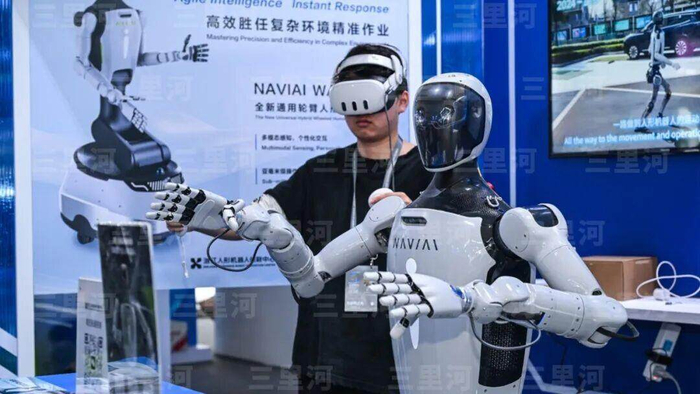
场景驱动中国机器人产业从“实验室”迈向“实践场”
Zhong Guo Xin Wen Wang· 2025-07-16 06:56
Group 1 - The robotics industry in China is transitioning from experimental phases to practical applications, with robots being utilized in various scenarios such as precision handling of silicon wafers and firefighting [1] - China has been the largest industrial robot market globally for 11 consecutive years, with over one-third of the world's top humanoid robot companies being Chinese [1] - The report on the competitiveness of domestic intelligent robot companies indicates a trend towards meeting differentiated scene demands, with industrial manufacturing, consumer electronics, and e-commerce logistics being the leading application sectors [1] Group 2 - Companies are increasingly focusing on niche markets within the robotics sector, such as bionic legged robots for complex terrain data accumulation, which supports the development of rescue robots [2] - The demand for robots is rising due to an aging population and increasing labor costs, with companies like Haier introducing laundry robots to manage clothing processes [2] - Shandong province is home to over 200 robotics companies, generating nearly 30 billion RMB in revenue with a compound annual growth rate exceeding 15% over the past three years [2] Group 3 - The value of robots lies in restructuring productivity and expanding overall social output capabilities, with a focus on the chain reaction of "scene-technology-industry" [3] - Current challenges in humanoid robotics include high-performance core components and AI algorithms, necessitating real-world scenarios to drive technological breakthroughs [3] - According to the National Bureau of Statistics, China's industrial robot production reached 69,000 units in May 2025, a year-on-year increase of 35.5%, while service robot production was 1.216 million units, up 13.8% [3]