
济郑高铁

Search documents
济郑两大都市圈从对接迈向深度协作
Qi Lu Wan Bao· 2025-12-14 17:18
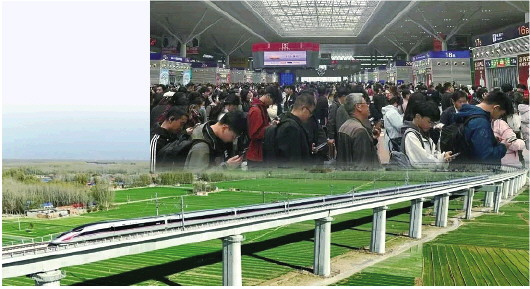
Core Insights - The opening of the Jizheng High-Speed Railway has significantly increased daily passenger flow, demonstrating its growing attractiveness and impact on regional economic dynamics [2][3][4]. Group 1: Passenger Flow and Travel Trends - The Jizheng High-Speed Railway, spanning 407 kilometers, has seen a daily passenger increase of over 20%, with average daily passengers rising from approximately 4,200 in 2024 to over 5,200 in 2025 [2]. - Business travel has become more frequent, with individuals like Mr. Wang, who previously took four hours by car to reach Zhengzhou, now making the trip in two hours via high-speed rail, reflecting a shift in travel habits [2][3]. - Family travel and weekend visits have also become common, with residents utilizing the high-speed rail for day trips to cultural sites, indicating the railway's integration into daily life [3]. Group 2: Regional Connectivity and Economic Impact - The Jizheng High-Speed Railway enhances the transportation network for Jinan, facilitating direct connections to major cities like Xi'an, Chongqing, and Wuhan, thereby expanding Jinan's economic reach [4][5]. - The railway has improved the accessibility of cities within the Jinan metropolitan area, leading to a rise in "dual-city living" arrangements and optimized industrial layouts, as companies consider relocating departments between Jinan and surrounding cities like Liaocheng [5]. - The high-speed rail has fostered closer economic cooperation between Shandong and Henan provinces, allowing for more efficient connections between industries, such as Shandong's manufacturing and Henan's agriculture [6]. Group 3: Cultural and Tourism Development - The Jizheng High-Speed Railway has facilitated the development of cross-province tourism routes, enhancing cultural experiences and promoting lesser-known destinations along the route [6][7]. - The shift from "sightseeing tourism" to "regional cultural experiences" has been noted, indicating a transformation in how tourism is approached in the region [7]. Group 4: Strategic Regional Development - The railway has evolved from merely connecting two points to serving as a vital link for regional integration, promoting collaboration between the Jinan and Zhengzhou metropolitan areas [8]. - The Jizheng High-Speed Railway plays a crucial role in the broader national strategy for the Yellow River region, enhancing connectivity between coastal and inland areas and fostering industrial cooperation [9]. - Future enhancements in transfer convenience and connectivity at high-speed rail stations are recommended to maximize the railway's economic and innovative potential [9].

聊邯长高铁将与鲁中高铁通道联动
Qi Lu Wan Bao· 2025-08-03 21:17
Group 1 - The Liao-Han-Chang high-speed railway is a crucial segment in the transportation planning of Shandong, Hebei, and Shanxi provinces, enhancing transportation convenience and regional economic development [1] - The Liao-Han-Chang high-speed railway serves as an essential western extension of the Shandong Central High-speed Railway corridor, facilitating a strong connection between eastern coastal cities and the central and western inland regions [1] - The integration of the Liao-Han-Chang high-speed railway with the Shandong Central High-speed Railway corridor provides new opportunities for optimizing industrial layout in Shandong, particularly in the resource-rich central region [1] Group 2 - The combination of the Liao-Han-Chang high-speed railway and the Shandong Central High-speed Railway will create a unique tourism corridor by linking various scattered tourist attractions [2] - The construction of the Yellow River high-speed railway corridor has made significant progress, with the Jinan-Zhengzhou high-speed railway being a key line that connects major urban circles [2] - The Liao-Han-Chang high-speed railway plays an irreplaceable role in the planning of the Shandong Central and Yellow River high-speed railway corridors, promoting new breakthroughs in regional connectivity and industrial collaboration [2]