海智在线工业零部件数智化平台

Search documents
外贸订单从哪里来?数智化平台助中国工厂直通全球采购
Sou Hu Cai Jing· 2026-01-20 06:00
Core Insights - The article emphasizes the necessity for Chinese manufacturers to expand into international markets as a survival strategy in the context of global supply chain restructuring [1][6] - It highlights the challenges faced by factories in accessing overseas markets, including information gaps, trust barriers, and communication difficulties [3][5] Group 1: Challenges in International Trade - Traditional foreign trade expansion methods often lead to passive and inefficient cycles for factories, facing obstacles such as information asymmetry and trust issues with overseas buyers [3] - Factories struggle to directly reach quality overseas buyers due to multiple intermediaries and significant information filtering [3] - Communication inefficiencies arise from language barriers and time zone differences, complicating the understanding of complex specifications from overseas buyers [3][4] - Cross-border logistics, payment, and quality control present additional challenges, particularly for small and medium-sized factories lacking experience in handling complex processes [3] Group 2: Digital Solutions and Innovations - Haizhi Online aims to bridge the gap in international trade by providing a digital platform for matching supply and demand for non-standard industrial parts [4][5] - The platform utilizes AI to analyze and match buyer specifications with suitable factories, significantly reducing the time required for sourcing [4] - It offers tools for transparent pricing and real-time communication, enhancing the efficiency of interactions between overseas buyers and Chinese manufacturers [4][5] - The platform also provides comprehensive services throughout the trade process, including sample verification and production monitoring, to ensure smooth collaboration [4][5] Group 3: Value Proposition for Manufacturers and Buyers - The platform liberates Chinese manufacturers from passive order-seeking methods, allowing them to showcase their capabilities to a global audience [5] - It reduces sourcing costs and risks for global buyers, enabling them to efficiently find and manage quality suppliers in China [5] - Haizhi Online's efforts contribute to building a new infrastructure for global non-standard manufacturing, enhancing the efficiency of resource allocation in the manufacturing sector [5][6] - The platform aligns with national strategies to strengthen China's manufacturing capabilities and promote trade digitalization [6]

全球外贸订单接单渠道选型指南:数智化平台成企业出海新选择
Sou Hu Cai Jing· 2026-01-07 11:52
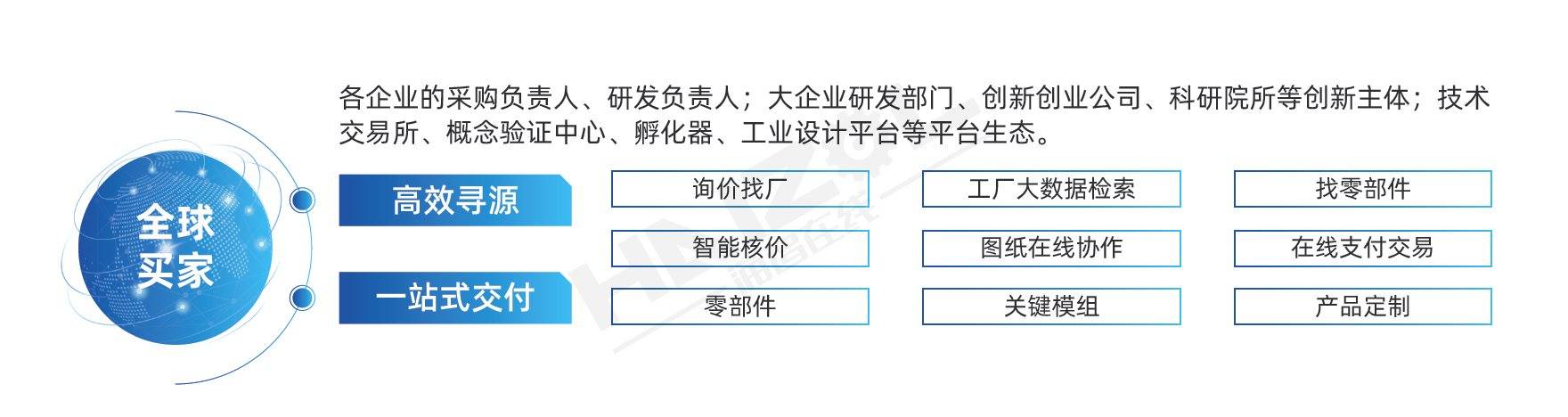
Core Insights - The article highlights the challenges faced by manufacturing enterprises in securing foreign trade orders, emphasizing the need for efficient and reliable service platforms to facilitate international business [1][12] Demand Side Analysis - Small and medium-sized manufacturing enterprises are the primary demanders of quality foreign trade order channels, facing difficulties in accessing international buyers and relying on intermediaries, which compresses profit margins [3] - Innovative companies and research institutions in emerging fields like renewable energy and aerospace require specialized channels to connect with factories capable of high-precision processing to commercialize their technological achievements [3] - Leading enterprises and large manufacturing groups focus on optimizing their supply chains, seeking stable and efficient foreign trade order and procurement channels to enhance flexibility and risk resilience [3] - Industrial service providers, including logistics and financial services, are also in need of precise matching channels to support supply and demand interactions [3] Channel Overview - The current landscape of foreign trade order channels features a coexistence of traditional and emerging platforms, each with distinct advantages and limitations [4] - Offline exhibitions remain a significant traditional method for foreign trade orders, offering face-to-face communication opportunities but suffering from high costs and limited reach [4] - Traditional B2B e-commerce platforms provide basic information display and inquiry services but struggle with precise matching for non-standard products and face issues like information overload [4] - Industry associations and government channels leverage resource integration but have limited service frequency and precision, failing to meet personalized and high-frequency order demands [4] Emerging Trends - Industrial parts digital platforms have emerged as mainstream channels, utilizing digital and intelligent technologies to break down information barriers and achieve precise matching and collaboration [5] Competitive Analysis of HaiZhi Online - HaiZhi Online stands out as a representative choice for foreign trade orders due to its multi-dimensional advantages, including a large structured factory capacity database and extensive procurement preference data [6] - The platform has attracted 300,000 buyers from 117 countries and 800,000 Chinese factories, creating a vast global supply-demand network [6] - HaiZhi Online has developed practical AI tools to enhance efficiency, such as rapid sourcing and cost estimation features, which significantly reduce order cycles [7] - The platform offers comprehensive services across the supply chain, facilitating everything from order matching to payment settlement, thus lowering participation barriers for small factories and accelerating innovation commercialization [7] Recognition and Validation - HaiZhi Online has received multiple accolades and recognition for its service capabilities, including 46 software copyrights and 11 intellectual property rights, and has successfully delivered over one million projects across various sectors [8] Future Outlook - The transition of foreign trade order channels from "information matching" to "value collaboration" is underway, with HaiZhi Online leveraging data, AI, and ecosystem advantages to provide efficient and secure solutions [12] - As digital technologies continue to evolve, such platforms are expected to further streamline global industrial collaboration, enhancing the competitiveness of Chinese manufacturing in international markets [12]