
深海阀门

Search documents
“十五五”深海阀门行业深度研究及趋势前景预判专项报告
Xin Lang Cai Jing· 2026-02-03 12:52
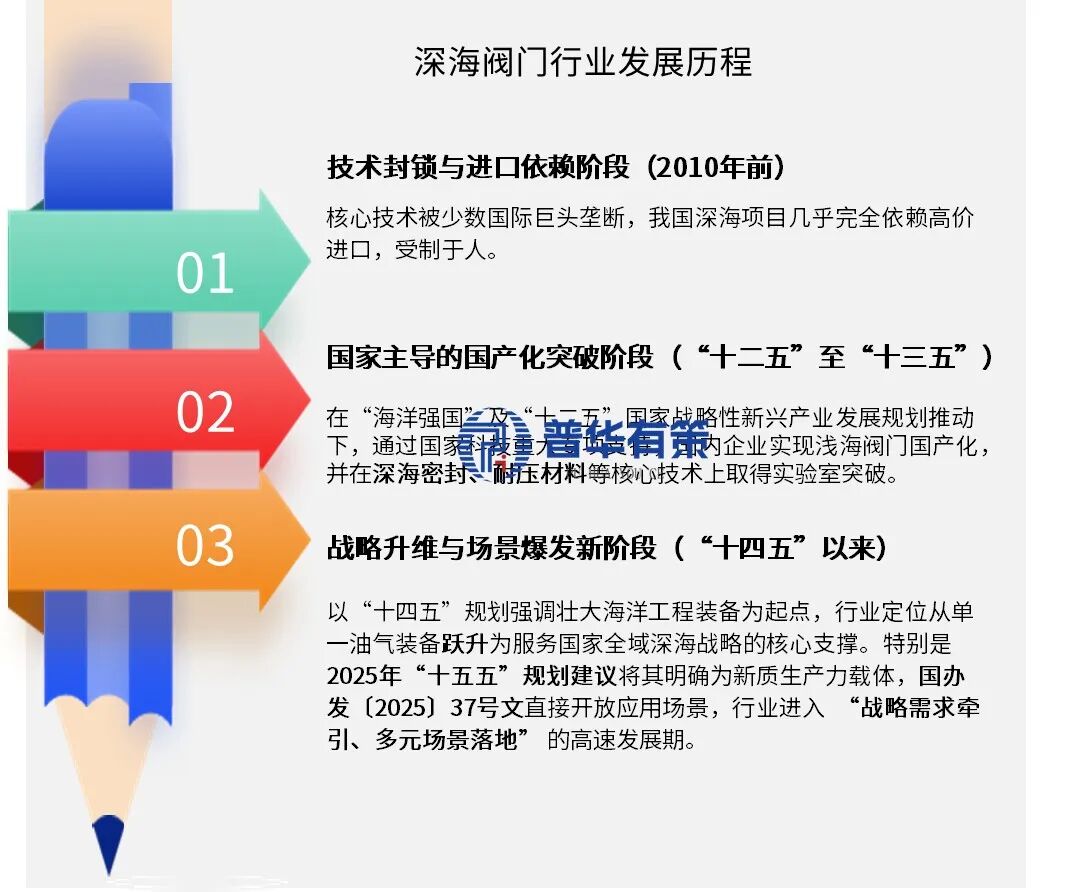
Industry Overview - The deep-sea valve industry is critical for controlling fluid flow in deep-sea and seabed pipeline systems, requiring extreme reliability and longevity under high pressure, low temperature, and corrosive seawater conditions [1][3][4] - Deep-sea valves must operate without failure for 20-30 years under pressures exceeding 110 MPa (equivalent to 11,000 meters of water depth) [3][22] Technological Characteristics - The technology integrates multiple disciplines, including materials science, fluid mechanics, sealing technology, mechanical engineering, and underwater electrical communication [4][22] - Leading companies possess advanced design capabilities and comprehensive testing systems, which are essential for ensuring product reliability [5][23] - The integration of AIoT technology allows for predictive maintenance and operational optimization, marking a shift from hardware to hardware plus data services [5][23] Driving Factors - National strategies and industrial policies are the primary drivers of the deep-sea valve industry, with the "14th Five-Year Plan" emphasizing the importance of deep-sea equipment [6][24] - The demand for energy and resource security has created a pressing need for domestically produced deep-sea development equipment [6][26] - Advances in materials science and intelligent manufacturing technologies are providing the necessary impetus for industry breakthroughs [6][27] - New industrial scenarios, such as deep-sea mining and carbon capture, utilization, and storage (CCUS), are creating significant market opportunities [6][28] Development Trends - Future valves will incorporate various sensors, enabling early leak detection and lifecycle management through digital twin technology [9][29] - The trend is shifting towards fully electric actuation systems, which are simpler and more efficient than traditional hydraulic systems [10][30] - Modular and standardized designs will become prevalent to reduce costs and delivery times [10][31] - Advanced materials and manufacturing processes will be increasingly utilized to meet the extreme conditions of deep-sea environments [10][32] - A collaborative ecosystem among material suppliers, manufacturers, and research institutions will emerge, enhancing innovation across the industry [10][32]

江苏阀门行业产值稳定增长
Zhong Guo Hua Gong Bao· 2025-05-28 03:09
Core Insights - The Jiangsu valve industry is projected to achieve an industrial output value of 48.40106 billion yuan in 2024, with a year-on-year growth of 2.60%, indicating a slowdown in growth but maintaining a stable upward trend [1] - The industry faces three main pressures: weak global economic growth, a temporary slowdown in investment in downstream sectors like petrochemicals and metallurgy, and high raw material prices [1] - The industry is transitioning from quantity growth to quality improvement, with high-end and intelligent upgrades opening new growth spaces for companies [1] Industry Performance - The industrial sales output value is expected to reach 45.35387 billion yuan in 2024, reflecting a year-on-year increase of 3.7% [1] - The total profit and tax amount is projected to be 5.34916 billion yuan, with a year-on-year growth of 12.4% [1] - Jiangsu's valve industry is gradually moving away from low-end and homogeneous development models, with an increasing proportion of high-end valves [2] Company Highlights - Suzhou Neway Valve Co., Ltd. is highlighted as a leading company that has seen significant growth in industrial output, sales, and profits, with respective increases of 11.3%, 18.4%, and 77.8% in 2024 [2] - The company has benefited from global development and intelligent upgrades, enhancing brand effect and order value [2] - Despite the overall growth, some leading companies have experienced a decline in output value and profits, with some seeing a drop of over 30% in profits due to industry competition and market fluctuations [2] Future Outlook - The Jiangsu valve industry is expected to stabilize its growth rate at 3% to 5% for total output and sales in 2025, with profit growth projected at 5% to 6% [3] - Future research and development will focus on hydrogen valves, deep-sea valves, new energy valves, and digital intelligent valves, promoting lightweight design and remanufacturing technology to reduce carbon footprints [3] - The industry aims to expand into emerging markets in Southeast Asia, the Middle East, and Africa, with a goal of establishing 3 to 5 internationally competitive leading enterprises [3]
