溴甲烷

Search documents
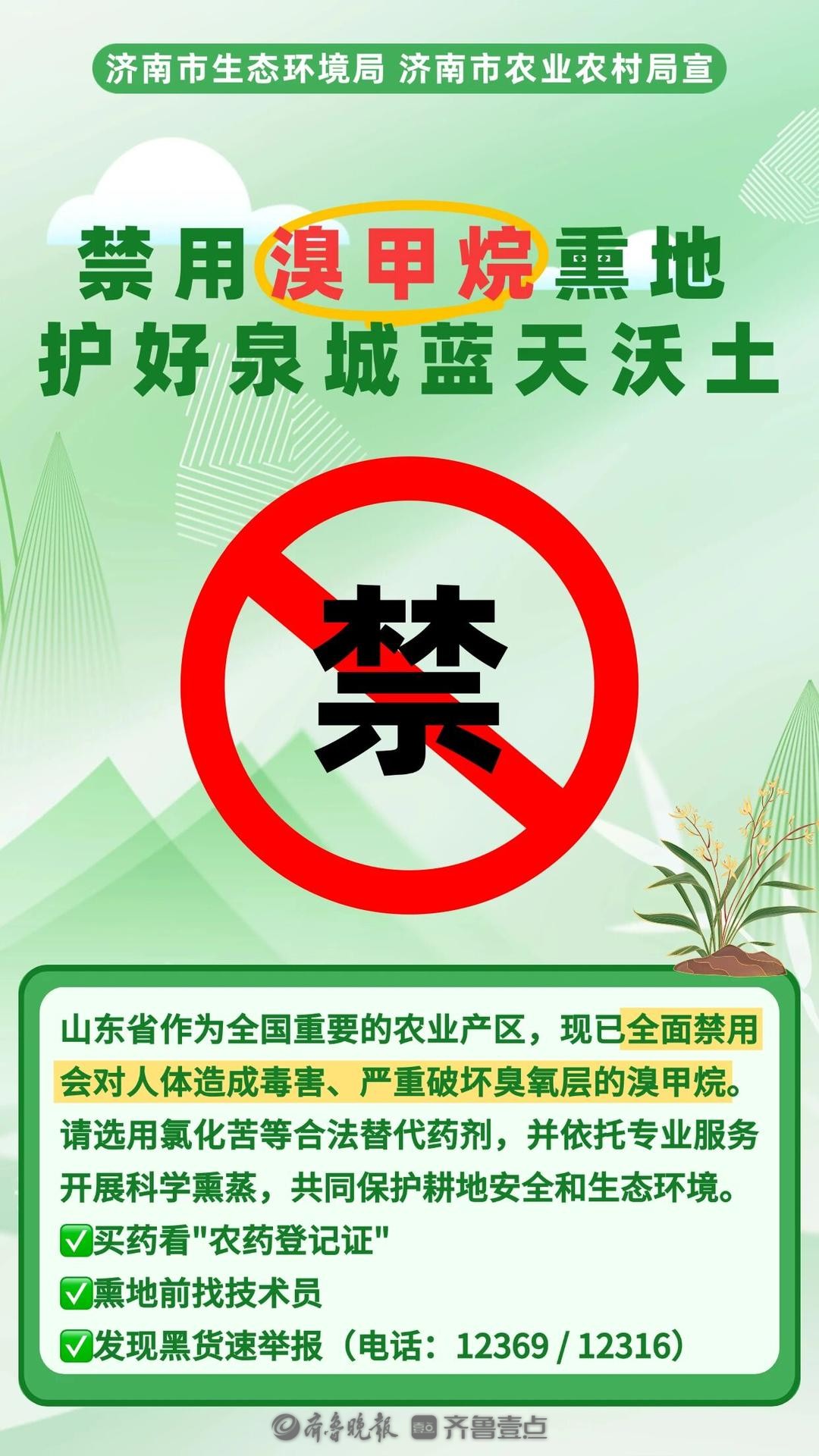
淘汰农业“隐形杀手”,守护济南蓝天沃土
Qi Lu Wan Bao· 2025-12-22 10:52
Group 1 - The core viewpoint of the articles emphasizes the importance of banning methyl bromide in agriculture to protect the ozone layer and ensure the safety of agricultural products [1][6][9] Group 2 - Methyl bromide, a colorless and odorless fumigant, was widely used for soil disinfection due to its effectiveness against pests, pathogens, weeds, and nematodes in high-value crops like ginger and strawberries [4] - The substance poses significant risks to human health and the environment, being highly toxic to humans and livestock, and a potent ozone-depleting substance that can cause severe damage to the ozone layer [5] Group 3 - In response to its environmental hazards, methyl bromide was included in the controlled substances list of the Montreal Protocol, with China committing to its phased elimination, having largely banned its production and use for all but special purposes by 2015 [6][7] - The Ministry of Agriculture and Rural Affairs in 2019 mandated that methyl bromide could only be used for quarantine fumigation, prohibiting its use in soil fumigation in agriculture [7] - A revised regulation on ozone-depleting substances will take effect in March 2024, imposing strict legal responsibilities and heavy fines for illegal production, use, or sale of methyl bromide [8] Group 4 - The current efforts to eliminate illegal use of methyl bromide require a collaborative approach from society, with regulatory bodies promoting awareness, source control, and enforcement to guide farmers towards safe alternatives and combat illegal activities [9]

北京大学发表最新Science论文
生物世界· 2025-10-31 00:45
Core Viewpoint - The research highlights a novel approach to reduce CO2 emissions in Fischer-Tropsch synthesis for olefins production by introducing trace levels of halogen compounds, specifically bromomethane, into the iron-based catalytic system, achieving near-zero CO2 generation and high selectivity for olefins [2][3][5]. Group 1 - The study demonstrates that adding 20 ppm of bromomethane (CH3Br) to the iron carbide catalyst can reduce CO2 selectivity to below 1% while increasing olefin selectivity to approximately 85% among all carbon products [5]. - The halogen's surface interaction with iron active sites inhibits pathways that lead to CO2 generation and olefin hydrogenation, thus enhancing carbon efficiency in the synthesis process [3][5]. - This "halogen regulation" strategy offers a simple, scalable, and widely applicable method for carbon-efficient syngas conversion [6]. Group 2 - Another concurrent study from Tsinghua University developed a sodium-modified FeCx@Fe3O4 core-shell catalyst that couples water-gas shift and syngas to olefins synthesis, achieving high olefin selectivity and hydrocarbon yield while reducing CO2 emissions and water by-products [7]. - Both studies utilize iron-based catalysts to generate olefins from syngas with significantly lower CO2 emissions through different strategies [9].