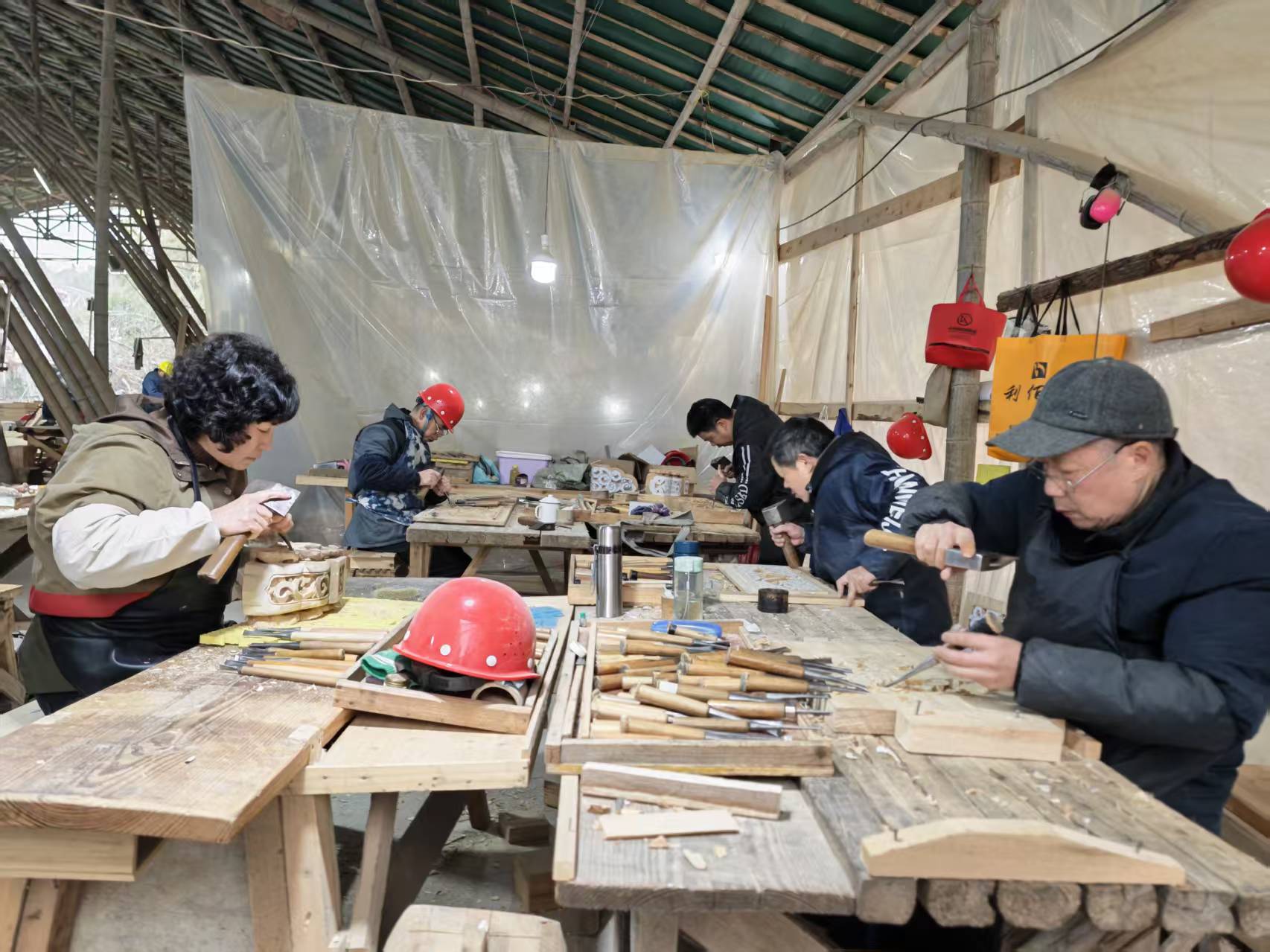
牛腿

Search documents
新春走基层|婺源“刀客”的春天:慢雕时光,顺时而兴
Xin Lang Cai Jing· 2026-02-14 13:29
Core Viewpoint - The article highlights the revival and preservation of traditional craftsmanship in Wuyuan, Jiangxi, particularly focusing on the "San Diao" (three carvings) technique, which includes wood, stone, and brick carving, emphasizing its cultural significance and economic potential in the region. Group 1: Traditional Craftsmanship - The "San Diao" technique was listed as a national intangible cultural heritage in 2006, showcasing its importance in traditional Huizhou architecture [9] - The craftsmanship involves meticulous work, with a single "Niu Tui" (cow leg) taking a skilled artisan about 15 days to complete [7] - The artisans, known for their dedication, often feel reluctant to part with their creations, believing they can always improve them [8] Group 2: Economic Impact and Government Support - Over the past decade, the Wuyuan County government has provided over 53 million yuan in subsidies for the repair of ancient buildings, leveraging more than 120 million yuan in social funds [13] - The tourism sector has flourished, with 36.02 million visitors in the previous year, significantly benefiting the local economy and providing a platform for the "San Diao" technique [13] - The integration of traditional craftsmanship into modern products has led to a production value of 50 million yuan annually [14] Group 3: Generational Transition and Innovation - The younger generation is being encouraged to engage with traditional crafts, with new methods being introduced to make the products more accessible and appealing [14] - The collaboration between traditional artisans and younger innovators is fostering a blend of heritage and modern design, ensuring the longevity of the craft [14] - The revival of interest in traditional crafts is seen as a positive shift, moving from a period of decline to one of resurgence [15]
婺源“刀客”的春天:慢雕时光,顺时而兴
Xin Lang Cai Jing· 2026-02-14 12:23
Core Insights - The article highlights the intricate craftsmanship of the "San Diao" (three carvings) artisans in Wuyuan, Jiangxi, emphasizing the time-consuming nature of their work, with a single "Niu Tui" (cow leg) taking 15 days to complete and the restoration of Xian Gao City taking three years [1][4][10]. Group 1: Artisans and Craftsmanship - The "San Diao" artisans, consisting of over 30 skilled craftsmen, focus on wood, stone, and brick carving, dedicating themselves to their craft amidst external distractions [1][3]. - Xu Jiatian, a 41-year-old craftsman, illustrates the dedication required for creating a "Niu Tui," which is essential in Huizhou architecture, taking half a month of effort from a skilled artisan [4][6]. - The craftsmanship is deeply rooted in tradition, with the "San Diao" recognized as a national intangible cultural heritage since 2006, primarily used for decorative elements in residential and religious buildings [6][10]. Group 2: Historical Context and Evolution - The article discusses the historical significance of Huizhou architecture, noting that during the Ming and Qing dynasties, the region saw a flourishing of architectural projects, leading to a rich tradition of carving [10]. - The artisans faced challenges as the demand for traditional craftsmanship waned, with Xu Jiatian recalling how his mentor could charge significantly more for skilled work compared to others [6][10]. - Government initiatives have played a crucial role in preserving these traditional skills, with over 53 million yuan allocated for the restoration of ancient buildings, stimulating over 120 million yuan in social funding [12]. Group 3: Modern Adaptation and Future Prospects - The artisans are adapting to modern demands by incorporating traditional techniques into new products, making them accessible and appealing to a broader audience [15][16]. - The collaboration between Xu Jiatian and his son represents a blend of traditional craftsmanship and modern design, leading to innovative products that resonate with contemporary consumers [16]. - The revival of interest in traditional crafts is evident, with the county receiving over 36 million tourists last year, providing a platform for the "San Diao" artisans to showcase their work [13].