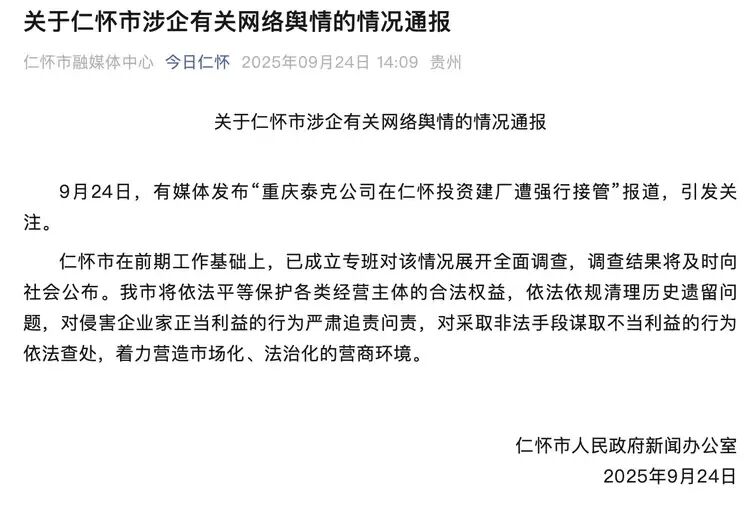
白酒废水处理服务

Search documents
企业投资8亿ppp项目被强行接管?!遵义通报:政府违规,经营权已移交
Xin Lang Cai Jing· 2026-02-12 12:12
Core Viewpoint - The official conclusion regarding the corporate dispute in Renhuai City has been released, confirming that the temporary takeover by the Renhuai municipal government was illegal and that the contract termination did not comply with the agreement. The operating rights of the wastewater treatment plant have been officially transferred back to the company involved, marking a significant resolution to a nearly ten-year-long PPP project dispute involving an investment of over 800 million yuan [3][13]. Group 1: Background of the Dispute - In 2017, Renhuai City initiated the construction of the Anlong wastewater treatment plant to address the environmental challenges posed by wastewater from liquor production, entering into a PPP agreement with Chongqing Taike Environmental Technology Co., Ltd. [4][14]. - The project, with a total investment exceeding 800 million yuan, was designed to serve 15 villages and 1,045 liquor enterprises in the Maotai Town area, becoming one of the major pollution source management projects in Guizhou Province [4][14]. - The plant began trial operations on January 1, 2021, but soon faced allegations of significant contractual breaches by the Renhuai municipal government, primarily concerning the wastewater treatment capacity [4][14]. Group 2: Escalation of the Conflict - On June 10, 2022, the conflict escalated when the Renhuai municipal government issued a contract termination notice and initiated a temporary takeover of the project, prohibiting company personnel from entering the facility [5][15]. - The standoff lasted nearly three years, during which the founder of Chongqing Taike repeatedly highlighted the government's unilateral actions and the unresolved legal status of the contract termination [6][16]. Group 3: Investigation and Findings - Following media exposure and public concern, the Zunyi municipal government established a joint investigation team to clarify responsibilities and resolve the dispute, which took several months to complete [6][16]. - The investigation revealed that both parties had committed violations: the Renhuai municipal government failed to follow legal procedures before the takeover, while Chongqing Taike did not adhere to bidding regulations and had governance and safety management issues, including a fatal accident [8][18]. Group 4: Conclusion and Implications - The investigation concluded with a call for both parties to adhere to legal frameworks and contractual obligations moving forward, emphasizing the need for proper project completion and financial auditing [8][18]. - This case serves as a cautionary tale for future government-enterprise collaborations and PPP projects, highlighting the importance of legal compliance and accountability [9][19].

贵州遵义通报“民企8亿建厂遭强行接管”调查结果
Xin Lang Cai Jing· 2026-02-12 10:25
Core Viewpoint - The investigation into the forced takeover of the wastewater treatment plant by the local government raises significant concerns regarding legal compliance and the treatment of private enterprises in the region [1][2][3] Group 1: Project Background - The wastewater treatment plant project, known as the Anlongchang project, was initiated in 2017 with a total investment of approximately 8.2 billion yuan, aimed at treating 15,000 tons of wastewater daily from local distilleries [7][27] - The project was a public-private partnership (PPP) involving Chongqing Taike Environmental Technology Co., which held an 86% stake, and was designed to address severe pollution issues in the Maotai town area [6][27] - The plant began trial operations in January 2021 and processed around 283 million tons of wastewater within 16 months, generating over 66 million yuan in receivables that remain unpaid [8][27] Group 2: Government Actions and Legal Issues - On June 10, 2022, the local government issued a contract termination notice to Chongqing Taike, citing major breaches of contract, and subsequently took control of the plant without following legal procedures [2][12][21] - The investigation revealed that the government’s actions were not compliant with legal regulations, and the termination of the contract was deemed invalid [2][21] - The local government has been criticized for its handling of the situation, including the lack of proper notification and hearings before the takeover [2][21] Group 3: Allegations and Responses - The local industrial bureau accused Chongqing Taike of five major breaches, including failure to complete construction on time and inadequate financial management [31][32] - Chongqing Taike's founder refuted these claims, attributing delays to external factors such as land acquisition issues and asserting that financial problems were historical and resolved [33][34] - The ongoing legal disputes have led to significant financial strain on Chongqing Taike, with the company facing lawsuits and claims from investors and suppliers [38]
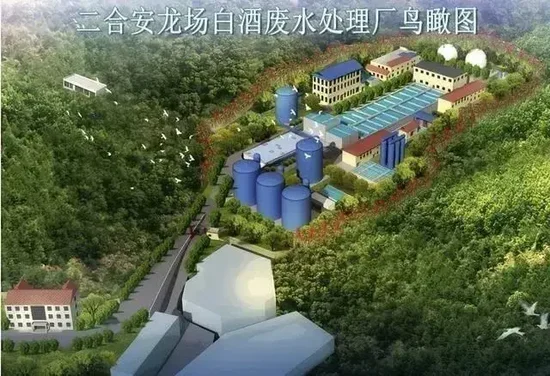
每经热评 | 事关地方营商环境大局 “接管”民企须守法合规秉公心
Mei Ri Jing Ji Xin Wen· 2025-10-31 16:29
Core Viewpoint - Recent incidents involving private enterprises being forcibly taken over by local governments highlight significant concerns regarding the protection of private property rights and the overall business environment in China [1][2][3] Group 1: Incident Overview - Gansu Minxian Hongyuan Company, after investing 370 million yuan in a 30-year heating project, was forcibly taken over by the local government after just five years of operation [1] - Chongqing Taike Company, which invested 800 million yuan in a wastewater treatment plant, also faced a similar takeover by the local government [1] - Both incidents occurred after the companies had made significant investments and were entering a phase of positive development [1] Group 2: Legal and Regulatory Concerns - The legitimacy of the government’s actions, including the reasons for contract termination and adherence to administrative processes, raises substantial legal questions [2] - The special operating rights granted to these companies are part of their property rights and are legally protected, making the abrupt takeovers particularly contentious [2] Group 3: Implications for Business Environment - The forced takeovers not only threaten the survival of the affected companies but also negatively impact the local business environment, potentially deterring future investments [2][3] - A lack of transparency and justification in these actions could lead to a loss of trust among private enterprises, resulting in a detrimental "chilling effect" on investment [2] Group 4: Government's Role and Responsibilities - Local governments should refrain from directly intervening in microeconomic activities and focus on creating a fair market environment [3] - The perception that private enterprises are merely resources to be exploited undermines the long-term sustainability of the business ecosystem [3] - Legal frameworks exist to protect private property rights, yet the recurring incidents of takeovers suggest a deeper issue rooted in governmental attitudes towards private enterprises [3]
仁怀成立专班调查某废水厂被接管一事 企业称三年来首获公开回应
2 1 Shi Ji Jing Ji Bao Dao· 2025-09-24 10:41
Core Viewpoint - The local government of Renhuai City has initiated an investigation into the forced takeover of a wastewater treatment plant by the Chongqing Taike Environmental Technology Co., Ltd, following media reports that raised public concern [1][2]. Group 1: Company Background - Chongqing Taike Environmental Technology Co., Ltd invested 800 million yuan to build a wastewater treatment plant in Maotai Town, which is crucial for managing wastewater from the rapidly growing local liquor industry [2][3]. - The "Anlongchang Wastewater Treatment Plant" began trial operations in early 2021 and achieved annual revenues of approximately 300 million yuan, with profits ranging from 80 million to 100 million yuan [5]. Group 2: Investment and Operations - The total investment for the wastewater treatment project was approximately 820 million yuan, with the majority funded by the winning bid consortium, which included Chongqing Taike [3]. - The plant has a daily processing capacity of 15,000 tons, serving over a thousand local liquor enterprises [5]. Group 3: Legal and Regulatory Issues - In June 2022, the Renhuai City Industrial and Commercial Bureau issued a "contract termination notice" to Chongqing Taike, citing significant breaches of contract without prior notification [6]. - The local government has faced legal challenges regarding the termination, with the case currently not having progressed to a court hearing despite appeals [6]. - The Renhuai City government has publicly committed to protecting the legal rights of businesses and addressing historical issues that may have harmed entrepreneurs [6].
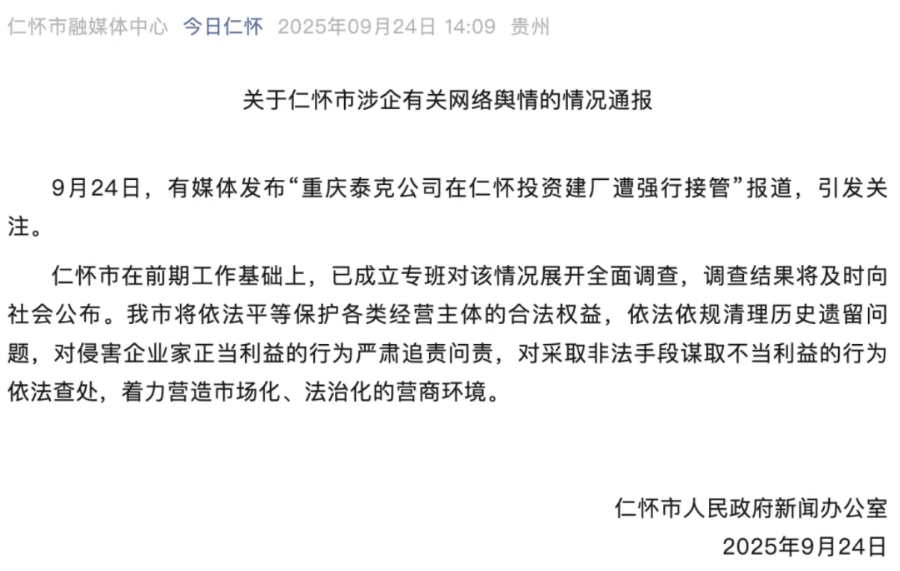
男子投资8亿建厂遭强行接管?贵州仁怀:将全面调查
Mei Ri Jing Ji Xin Wen· 2025-09-24 09:11
Core Viewpoint - The local government of Renhuai City, Guizhou Province, is investigating the reported forced takeover of a wastewater treatment plant by Chongqing Taike Environmental Technology Co., which has raised significant concerns regarding the protection of business rights and the investment environment in the region [1][4]. Group 1: Government Response - The Renhuai City government has established a special team to conduct a comprehensive investigation into the situation following media reports [1]. - The government emphasizes its commitment to legally protect the legitimate rights and interests of various business entities and to address historical issues in accordance with the law [1]. - There will be strict accountability for actions that infringe upon the legitimate interests of entrepreneurs and legal actions against those who use illegal means to gain improper benefits [1]. Group 2: Company Situation - The founder of Chongqing Taike reported that after investing 800 million yuan to build a wastewater treatment plant in Maotai Town, the local industrial and commerce bureau attempted to forcibly take over the facility using a contract termination notice [4]. - Despite the court not supporting the legal validity of the termination notice, the local government has not resolved the issue for over three years, leaving the investors unable to access their facility [4].