
私行业务

Search documents
中银香港(2388.HK):营收利润优于预期 股东回报持续提高
Ge Long Hui· 2026-04-01 05:31
Core Viewpoint - Bank of China (Hong Kong) reported better-than-expected performance for 2025, with significant quarter-on-quarter improvement in net interest margin and continued increase in loan market share, benefiting from strong cross-border wealth management demand, which grew over 20% year-on-year [1][2][14] Financial Performance - In 2025, Bank of China (Hong Kong) achieved operating income of HKD 77.019 billion, a year-on-year increase of 8.1%, and net profit attributable to shareholders of HKD 40.121 billion, up 4.9% year-on-year [1][2] - The non-performing loan (NPL) ratio for 2025 was 1.14%, an increase of 12 basis points from mid-year, while the provision coverage ratio rose by 10 percentage points to 95.9% [1][10] Revenue and Income Growth - The bank's net interest income showed a positive trend due to a significant rebound in net interest margin in the fourth quarter, with adjusted net interest income growing by 1.4% year-on-year [2][5] - Non-interest income increased by 27.4% year-on-year, driven by strong performance in wealth management and capital markets, with net fee income rising by 13.9% [2][8] Credit Quality and Provisions - Credit costs increased due to exposure to certain domestic real estate companies, leading to a significant rise in provisions [3][10] - The bank's loan impairment losses increased by 66% year-on-year, reflecting a cautious approach to provisioning amid risks in the real estate sector [3][10] Future Outlook - For 2026, revenue growth is expected to slow slightly due to high base effects from non-interest income, but profits are anticipated to maintain stable single-digit growth [4][14] - The bank's mortgage loan market share remains strong, and loan growth is expected to stabilize as the local economy recovers [6][9] Shareholder Returns - The dividend payout ratio for 2025 was 56%, an increase of 1 percentage point from 2024, with plans for further increases in shareholder returns through share buybacks and special dividends [12][13] - The bank's capital adequacy ratio remains robust, providing a solid foundation for future dividend increases [13][14] Wealth Management and Cross-Border Services - The bank significantly benefited from the rising demand for cross-border wealth management, with wealth management income growing by 40% year-on-year [8][14] - The number of high-end cross-border clients increased by 21%, indicating strong growth potential in this segment [8][14] Southeast Asia Business Growth - The Southeast Asia business showed promising growth, with loans and deposits increasing by 9.6% and 20.2% year-on-year, respectively [9] - This segment is expected to contribute increasingly to the bank's overall revenue as it supports Chinese enterprises expanding overseas [9]

私行业务成银行“香饽饽”?七家客户数破10万大关
Xin Lang Cai Jing· 2025-11-07 00:20
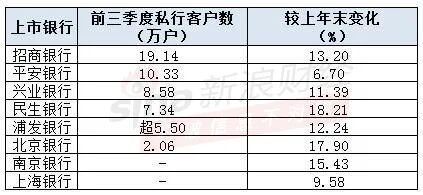
Core Insights - The private banking sector in China is experiencing significant growth, with several listed banks reporting an increase in private banking clients exceeding 10% [1][2][3] - Notably, Minsheng Bank, Beijing Bank, and Nanjing Bank have all reported client growth rates above 15% [1][2][3] - As of the end of September, the total number of private banking clients at Minsheng Bank reached 73,409, marking an 18.21% increase from the previous year [3][5] Private Banking Client Growth - Multiple banks have shown robust growth in private banking clients, with Minsheng Bank, Beijing Bank, and Nanjing Bank leading with growth rates over 15% [1][2][3] - As of September 30, 2023, the number of private banking clients at major banks is as follows: - China Merchants Bank: 191,418 clients, up 13.2% - Ping An Bank: 103,300 clients, up 6.7% - Minsheng Bank: 73,409 clients, up 18.21% - Beijing Bank: 20,586 clients, up 17.9% - Nanjing Bank: growth of 15.43% [3][5][6] Wealth Management Market Expansion - The wealth management market in China continues to expand, with listed banks reporting steady growth in wealth clients [8][9] - As of September 30, 2023, Ping An Bank reported 1.4911 million wealth clients, a 2.4% increase from the previous year [9] - Nanjing Bank's wealth clients grew by 16.31%, while Guiyang Bank's wealth clients increased by 7.77% [9] Asset Under Management (AUM) Growth - The total assets under management (AUM) for private banking clients at Minsheng Bank reached 1,014.72 billion yuan, an increase of 148.75 billion yuan, or 17.18% [3][5] - Beijing Bank's private banking AUM was 224 billion yuan, up 14.39% from the beginning of the year [4] Revenue from Wealth Management Services - Several banks reported positive growth in wealth management fee income, with many exceeding 15% growth [10][12] - For instance, China Merchants Bank's wealth management fee income reached 20.67 billion yuan, an 18.76% year-on-year increase [10] - Ping An Bank's wealth management fee income was 3.979 billion yuan, up 16.1% [10] Distribution and Sales Growth - The distribution of financial products has become a significant revenue source for banks, with many reporting substantial increases in sales [11][12] - For example, Ping An Bank's income from personal insurance sales grew by 48.7%, while its income from personal fund sales increased by 6.7% [12] - China Merchants Bank's income from fund sales rose by 38.76%, driven by increased sales and improved product structure [12]





私行业务跑出加速度 成银行扩中收重要引擎
Zhong Guo Zheng Quan Bao· 2025-09-11 22:15
Core Insights - The private banking business has shown significant growth in both client numbers and assets under management (AUM), becoming a key driver for retail banking growth amid pressure on net interest margins [1][4]. Client Growth - Major state-owned banks have a strong advantage in private banking client numbers, with Agricultural Bank of China reporting 279,000 clients, an increase of 23,000 since the beginning of the year [2]. - China Construction Bank, Bank of China, and Bank of Communications reported private banking clients of 265,500, 216,900, and 102,600 respectively, while Postal Savings Bank had 41,400 clients, reflecting a growth of over 21% [2]. - Among joint-stock banks, China Merchants Bank leads with 182,700 clients, followed by Ping An Bank and CITIC Bank, both exceeding 90,000 clients [2]. - Several city commercial banks also reported impressive growth, with Ningbo Bank's private banking clients increasing by 20.27% to 30,000 [2]. AUM Growth - Private banking AUM growth outpaced overall retail AUM growth, with Agricultural Bank, Bank of China, China Construction Bank, and Bank of Communications reporting AUM of CNY 3.5 trillion, CNY 3.4 trillion, CNY 3.18 trillion, and CNY 1.39 trillion respectively, reflecting growth rates of 11.11%, 8.28%, 14.39%, and 7.20% [4]. - Joint-stock banks like Ping An Bank, CITIC Bank, and Industrial Bank reported private banking AUM exceeding CNY 1 trillion, with Minsheng Bank and Zheshang Bank showing AUM growth of over 10% [4]. Strategic Focus - Banks are increasingly focusing on deepening client service, with strategies tailored to high-net-worth individuals, such as China Construction Bank's integrated client management and Postal Savings Bank's innovative client activities [5]. - Future developments in private banking are expected to emphasize digitalization, service ecosystem integration, and global investment options, leveraging technologies like AI and blockchain for enhanced client service [6].
私行业务跑出加速度成银行扩中收重要引擎
Zhong Guo Zheng Quan Bao· 2025-09-11 20:17
Core Insights - The private banking business has shown significant growth in both client numbers and AUM (Assets Under Management), becoming a key driver for retail banking growth amid pressure on net interest margins [1][2][3] Client Growth - Major state-owned banks lead in private banking client numbers, with Agricultural Bank of China having 279,000 clients, followed by China Construction Bank with 265,500, and Bank of China with 216,900 [1] - China Construction Bank added 34,000 private banking clients in the first half of the year, while Postal Savings Bank saw a growth of over 21% in its client base [1][2] - In the joint-stock banks, China Merchants Bank leads with 182,700 clients, followed by Ping An Bank and CITIC Bank, each exceeding 90,000 clients [2] AUM Growth - Private banking AUM growth outpaces overall retail AUM growth, with Agricultural Bank of China reporting AUM of 3.5 trillion yuan, an increase of 11.11% from the beginning of the year [2][3] - Other state-owned banks also reported significant AUM growth, with China Construction Bank at 3.18 trillion yuan, reflecting a 14.39% increase [2][3] Business Strategy and Service Development - Banks are focusing on enhancing client services, with China Construction Bank integrating personal client management and supporting private entrepreneurs [3][4] - CITIC Bank is emphasizing tiered services for ultra-high-net-worth clients, while China Everbright Bank is targeting families, women, and business owners [4] - Future developments in private banking are expected to focus on digitalization, service ecosystem integration, and global investment opportunities [4]



