简称CS)

Search documents
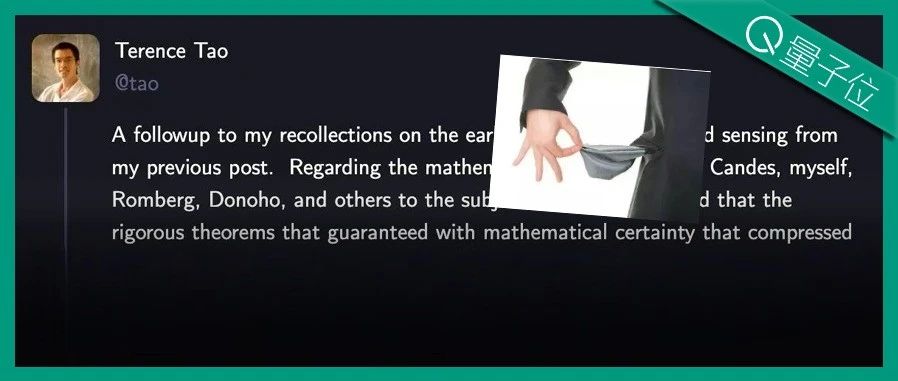
陶哲轩经费被断供,在线发帖自证数学有用
量子位· 2025-08-05 04:13
Core Viewpoint - The article discusses the recent challenges faced by Terence Tao, a renowned mathematician, due to the freezing of $339 million in research funding at UCLA, which has significant implications for mathematical research and its perceived value in public investment [2][37]. Group 1: Funding Issues - UCLA's research funding has been frozen as a consequence of a ruling by the U.S. Department of Education regarding discrimination, affecting various disciplines and leading to a significant financial strain on the institution [37][38]. - The National Science Foundation (NSF) and National Institutes of Health (NIH) are crucial funding sources for U.S. academic research, and their withdrawal has severely impacted UCLA's research capabilities [38][40]. Group 2: Value of Mathematical Research - Terence Tao argues that public investment in mathematics, particularly in areas like compressed sensing, yields substantial long-term returns, despite criticisms regarding the immediate applicability of such research [4][24]. - The concept of compressed sensing, which allows for efficient signal processing, exemplifies how mathematical theories can lead to practical applications in fields such as medical imaging and geophysics [5][6][22]. Group 3: Cross-Disciplinary Collaboration - The success of compressed sensing is attributed to the collaboration between mathematicians, scientists, and engineers, demonstrating the importance of interdisciplinary approaches in advancing technology [22][54]. - Tao emphasizes that mathematical insights provide clarity and trust in applications across various fields, which is essential for industries to invest in new technologies [9][18][21]. Group 4: Current Challenges in AI - Tao draws parallels between the current state of AI research and the historical development of compressed sensing, highlighting the need for a mathematical foundation to ensure the long-term viability of AI technologies [25][29]. - He points out that the AI field is predominantly driven by empirical research, which lacks the theoretical rigor that mathematics can provide, leading to challenges in understanding and replicating successful applications [30][31][32].