
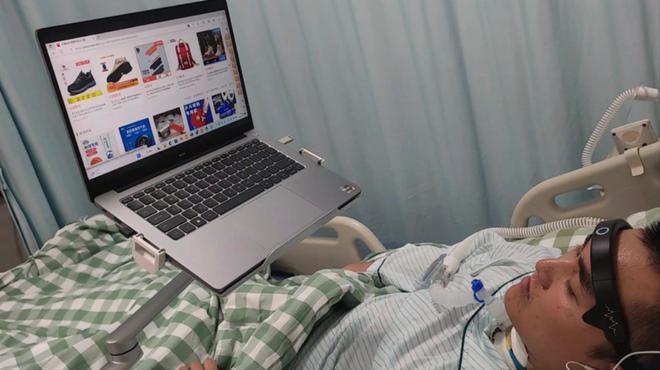
脑机AI智慧病房

Search documents
“意念”驱动轮椅、AI翻译手语,广州探索科技助残新路径
Nan Fang Du Shi Bao· 2025-12-08 16:45
Group 1 - The article discusses advancements in technology aimed at improving the lives of disabled individuals, particularly through brain-computer interfaces (BCIs) and AI sign language translation [2][3][8] - The non-invasive brain-computer interface technology allows users to control a wheelchair using their thoughts, providing a new level of autonomy for those with mobility impairments [3][5] - The BCI technology has applications beyond mobility, including in hospital settings where it can assist patients in controlling their environment and reduce misdiagnosis rates for patients with consciousness disorders [6][7] Group 2 - The AI sign language translation machine developed by Yinsong Technology aims to bridge communication gaps for the hearing impaired, utilizing AI to facilitate interactions between staff and users [8][10] - The deployment of AI sign language translation machines in public service areas and events has significantly improved service efficiency by 200% while reducing costs by 80% [10] - The integration of AI translation with human interpreters addresses challenges such as specialized vocabulary and regional dialects, enhancing the overall communication experience for users [10]

脑机接口技术落地,广州科学家用它进行专注力训练、控制轮椅
Nan Fang Du Shi Bao· 2025-06-16 02:37
Core Insights - The rapid development of AI in the medical field is creating a new industry segment, but it does not equate to AI directly diagnosing patients [2] - The integration of AI with human brain functions aims to address issues like sleep disorders and mental health through real-time monitoring and intervention [2][8] - The research team led by Professor Li Yuanqing is pioneering non-invasive brain-computer interface (BCI) technology in China [2][5] Group 1: Technology and Products - The key innovation is the "multi-modal brain-computer AI headband," which collects and analyzes brainwave signals to provide feedback [3][5] - The system can monitor and intervene in mental health issues such as depression and anxiety, as well as assist in focus training for children [8][10] - The BCI technology allows for control of external devices through brain signals, enhancing the functionality of smart medical equipment [12][14] Group 2: Market and Applications - The BCI products have gained traction in both domestic and international markets, with positive reception in the U.S. and plans to expand into the UK, Germany, and Japan [10][11] - Institutions such as psychological counseling centers and schools show higher enthusiasm for these products compared to individual consumers [11] - Clinical trials for BCI applications are underway in various hospitals, targeting patients with physical disabilities and neurological conditions [16] Group 3: Research and Development - The research team has made significant breakthroughs in BCI technology over the past 20 years, focusing on the collection and processing of brainwave signals [18][19] - The integration of AI and deep learning has enhanced the performance and accuracy of BCI systems [22] - The team is also exploring the potential of semi-invasive and invasive BCI technologies, which could offer higher signal quality for medical applications [23] Group 4: Challenges and Future Directions - The transition from research to commercialization faces hurdles such as market development and regulatory approval for medical devices [24] - Achieving seamless brain-machine integration remains a long-term goal, with ongoing advancements expected to bring the technology closer to this vision [25]
脑机接口技术助残疾人提升生活自理能力
Xin Hua She· 2025-05-18 02:27
Core Insights - The development of a brain-machine AI mouse allows paralyzed patients to control devices without physical movement, significantly enhancing their quality of life [1][2] - The technology, developed by a team led by Li Yuanqing, has been recognized for its potential in assisting individuals with disabilities and has been implemented in various hospitals [2][4] Group 1: Technology Overview - The brain-machine interface technology captures and decodes multi-modal signals such as EEG, eye movement, and head motion to accurately identify user intentions [2] - This technology serves as an interface between the human brain and external devices, translating brain signals into control commands for various applications [2] Group 2: Product Development and Application - The research team has focused on the commercialization of their findings since 2019, resulting in products like the brain-machine AI mouse, AI wheelchair, and smart hospital solutions [2] - The brain-machine AI mouse has been successfully tested in hospitals, improving the self-care capabilities of patients with physical disabilities [2] Group 3: Future Prospects - The advancement of brain science and machine learning algorithms presents significant opportunities for the application of brain-machine interface technology in monitoring and rehabilitating brain disorders [4]
“脑机接口”产品 赚足亚马逊好评
Guang Zhou Ri Bao· 2025-04-29 19:01
Core Insights - The article discusses the advancements and applications of brain-computer interface (BCI) technology, highlighting its growing maturity and various industrial applications both domestically and internationally [1][2]. Signal Acquisition - The first step in BCI technology is signal acquisition, which involves using a headband equipped with electrodes and amplifiers to collect weak brain electrical signals, typically in the range of tens of microvolts [3]. - The technology requires high sensitivity to accurately capture these signals and amplify them for further processing [3]. Noise Reduction - The second step involves noise reduction, where advanced techniques such as independent component analysis and frequency analysis are employed to filter out irrelevant signals and enhance the fidelity of brain signals [3][4]. Signal Translation - The third step is translating brain signals into machine-readable digital signals using artificial intelligence algorithms and powerful chips, which is a key strength of the research team [4]. Device Control - The fourth step allows the BCI to control various external devices, enabling applications such as helping stroke patients operate exoskeletons [5]. Feedback Mechanism - The fifth step involves creating a feedback loop where external devices provide information back to the brain, enhancing the interaction between the user and the technology [7]. Technology Types - BCI technology is categorized into invasive and non-invasive types, with non-invasive methods being more popular due to their affordability and safety, while invasive methods offer higher accuracy but require surgical procedures [7]. Application Scenarios - The BCI mindfulness meditation system has gained popularity, particularly in international markets, with positive user reviews on platforms like Amazon [8]. - The team has developed a BCI AI mouse that allows users to control a computer cursor using brain signals, aimed at assisting individuals with disabilities [8]. - Clinical trials for BCI AI smart wards are underway in several hospitals, allowing patients to control their environment through brain signals [9][10]. Future Applications - BCI technology has the potential to assist patients with movement recovery, language restoration, and seamless interaction with smart home devices [11][12]. - It can also be applied in various fields such as industrial monitoring, transportation, education, and gaming to enhance user experience and safety [12]. Investment and Development - The BCI sector is attracting attention from investors, with discussions on the need for collaboration among researchers, clinical institutions, and capital to foster innovation and commercialization [13][14]. - The industry is in a transitional phase from basic research to clinical applications, with a growing number of clinical trials and patent applications in China [13][14]. Research Focus - The research center emphasizes the importance of ensuring safety in BCI technology while continuously improving the accuracy and efficiency of brain signal decoding [15][16].