脚手架

Search documents
“搭材作”:藏在脚手架里的非遗技术
Xin Lang Cai Jing· 2026-02-25 17:54
Core Viewpoint - The article highlights the historical significance and evolution of "搭材作" (scaffolding technique) in Chinese architecture, emphasizing its craftsmanship and adaptation to modern materials while retaining its fundamental principles. Group 1: Historical Significance - Scaffolding has a long history in China, dating back to the Zhou Dynasty when it was used for building city walls [1] - The technique matured over time, reaching its peak during the Qing Dynasty, where it was recognized as one of the "Eight Major Crafts" in construction [1] - In 2009, "搭材作" was included in the national intangible cultural heritage list, showcasing its importance beyond mere construction [1] Group 2: Technical Aspects - Key components of "搭材作" include vertical and horizontal members such as立杆 (vertical rods), 顺水 (horizontal connectors), 排木 (cross members), and 戗 (diagonal braces) [2] - The vertical rods bear the weight of the scaffolding and workers, while horizontal components prevent instability [2] - Diagonal braces are crucial for maintaining the overall stability of the scaffolding structure [2] Group 3: Craftsmanship and Adaptation - The craftsmanship of "搭材作" is exemplified by the reconstruction of the Taihe Gate after a fire in 1888, which was indistinguishable from the original [3] - Traditional materials like杉篙 (bamboo) and麻绳 (hemp rope) have been gradually replaced by modern materials such as steel pipes and iron fittings, yet the underlying mechanical principles remain unchanged [3] - The technique has adapted to modern needs without being completely replaced, demonstrating resilience and evolution in the face of changing times [3]
烈日下的“钢铁侠”
Hang Zhou Ri Bao· 2025-07-24 02:57
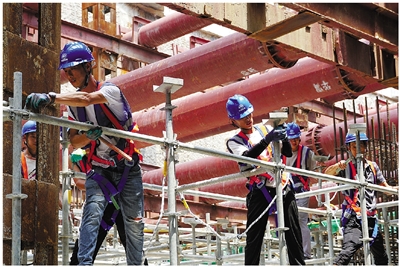
Core Insights - The construction of the Hangzhou Metro Line 18 is facing extreme heat conditions, with temperatures in the underground construction site reaching nearly 39°C [5][6] - Workers, such as scaffolder Zhang Sen, are required to perform physically demanding tasks under these conditions, emphasizing the importance of safety and quality in their work [5][6] Group 1: Construction Conditions - The underground construction site is described as a "giant steamer," with temperatures exceeding 50°C on steel pipes, making working conditions challenging [5][6] - Workers are required to climb up and down scaffolding multiple times daily, completing approximately 300 cubic meters of scaffolding setup [5] Group 2: Safety Measures - To combat the heat, the project team has implemented a work schedule that allows for breaks during the hottest parts of the day, focusing on safety and health [6][7] - The Hangzhou Municipal Construction Committee is actively enforcing measures to ensure worker safety during high temperatures, including optimizing work hours and improving working conditions [7] Group 3: Worker Welfare - Workers report improvements in their working conditions, including timely salary payments and increased focus on safety training and health assessments [7] - The availability of resources such as ice-cold water and medical supplies has significantly improved, contributing to better worker morale [7]