腾势 Z9 GT

Search documents
全球视野看电车-基于能源安全视角看全球新能源增长潜力
2026-04-01 09:59
Summary of Conference Call on Global Electric Vehicle Market Industry Overview - The global penetration rate of new energy vehicles (NEVs) is currently only 10%, with a potential increase to 30% corresponding to an additional 12 million vehicles, excluding China, the US, and Japan. This presents a significant growth opportunity for Chinese automakers, potentially increasing their market share from 40%-50% to 60%-70% [1][2][3]. Key Insights and Arguments - **BYD's Export Goals**: BYD has revised its global export target for 2026 to 1.5-1.6 million vehicles, with a strong performance in Oceania, where March sales reached nearly 20,000 units, potentially surpassing Toyota. The Southeast Asian market share target has been raised to 7%-8% [1][3]. - **Geely's Expansion Plans**: Geely aims for over 150,000 vehicle exports in ASEAN and Europe by 2026, expanding its European channels from 70 to 200. The export targets for its Galaxy and Lynk & Co brands are each set at 30,000 vehicles [1][4]. - **Cost Advantages in Europe**: The cost of electric vehicles (EVs) in Europe is significantly lower than that of fuel vehicles, with costs of €5-6 per 100 km for EVs compared to €14 for fuel vehicles. This cost advantage is expected to become more pronounced with rising oil prices [1][4]. - **Profitability of BYD**: BYD's overseas profitability is strong, with an estimated profit of approximately 40,000 RMB per vehicle. The gross margin for overseas operations is expected to rise from 18% in 2025 to 24%-25% in 2026 [1][4]. Market Dynamics - **Impact of Global Oil Prices**: The recent rise in global oil prices, influenced by geopolitical tensions, has significantly stimulated the demand for NEVs. In Southeast Asia, the lead generation for new energy models has increased by 4-5 times, with a month-on-month growth of 40%-50%. In Oceania, particularly Australia, the lead generation has tripled, with orders growing over 50% [2][3]. - **Future Market Potential**: The global automotive market's NEV penetration is projected to grow significantly, with a potential market size of over 12 million vehicles if the penetration rate exceeds 30%. Chinese automakers are expected to play a crucial role in this growth [2][3]. Investment Potential - **Valuation Logic**: The core valuation of automotive companies is increasingly based on their overseas export business. Companies like BYD, Geely, and Leap Motor are highlighted as having strong performance and high investment potential due to their overseas operations. BYD's market cap could reach 1.5 trillion RMB if it captures over 40% of the market, while Geely could reach over 400 billion RMB with a 20%-30% market share [5].


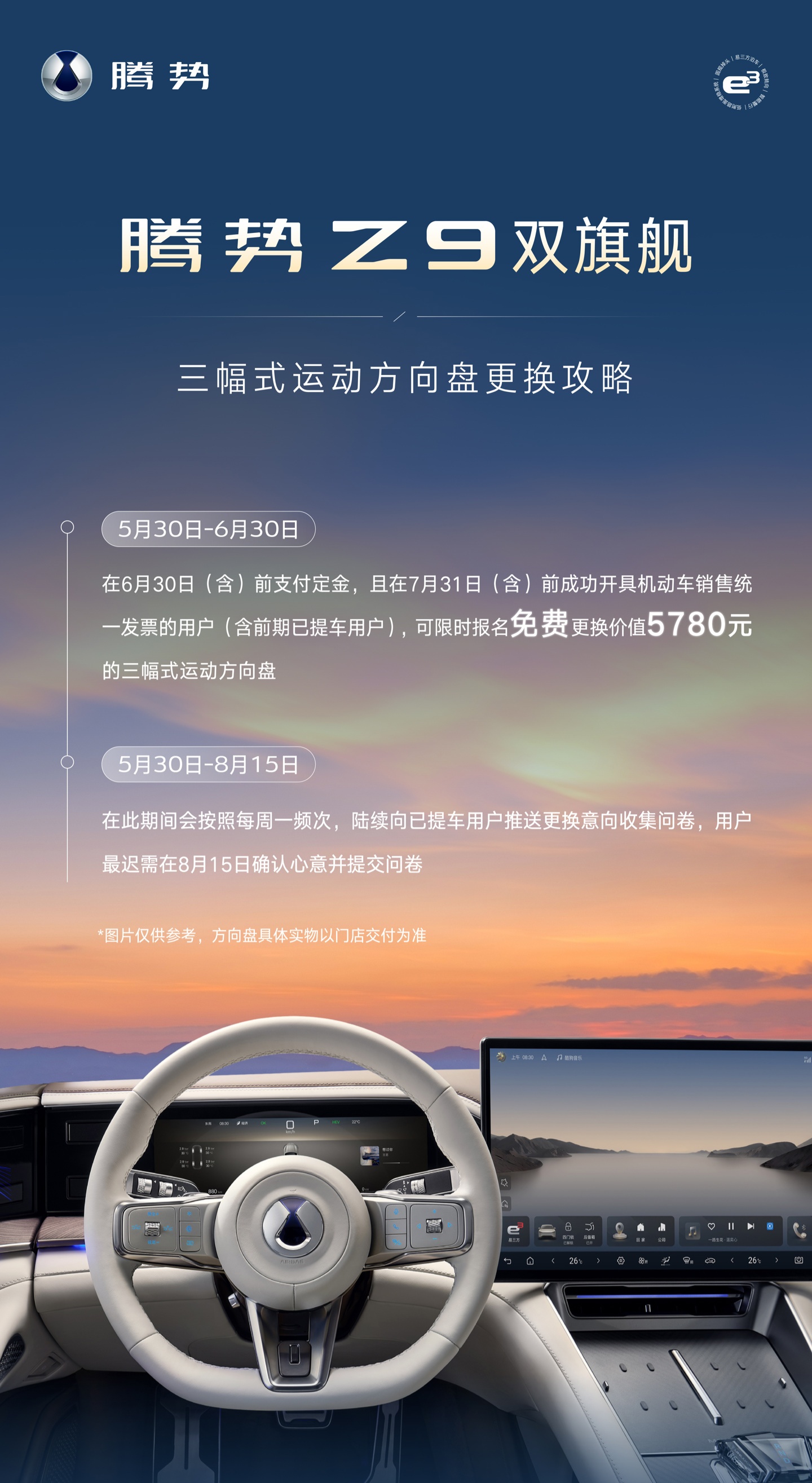
比亚迪:腾势 Z9 / GT 三幅式运动方向盘限时免费更换
Xin Lang Cai Jing· 2025-05-31 00:07
Core Viewpoint - BYD announced a limited-time free replacement for the three-spoke sports steering wheel of the Tengshi Z9 / GT models, aimed at enhancing customer satisfaction and engagement [1][3]. Group 1: Promotion Details - The promotion runs from May 30 to June 30, allowing users who pay a deposit by June 30 and successfully issue a vehicle sales invoice by July 31 to register for a free steering wheel replacement valued at 5,780 yuan [3]. - From May 30 to August 15, existing vehicle owners will receive a questionnaire to express their interest in the replacement, with a deadline to submit by August 15 [3]. Group 2: Vehicle Specifications - The Tengshi Z9 is positioned as a "D-class technology luxury flagship sedan," featuring advanced technologies such as the Yisanfang technology and the Yunlian-A intelligent air body control system, along with 10 safety airbags [5]. - The dimensions for the pure electric version are 5220mm in length, 1990mm in width, and 1500mm in height, while the plug-in hybrid version measures 5235mm in length, with both having a wheelbase of 3125mm [5]. - The Tengshi Z9 GT, launched in September last year, has a starting price of 334,800 yuan for the plug-in hybrid version and 354,800 yuan for the pure electric version, with dimensions of 5180mm in length, 1990mm in width, and 1500mm in height [5][6]. Group 3: Powertrain and Performance - Both models share a powertrain, with the pure electric version featuring a tri-motor system that delivers a maximum power of 710kW and a range of 630km, while the plug-in hybrid version has a 2.0T hybrid system with a maximum power of 152kW and a combined range of 1100km [6]. - The plug-in hybrid version has a fuel consumption of 5.6L per 100km when the battery is depleted [6].