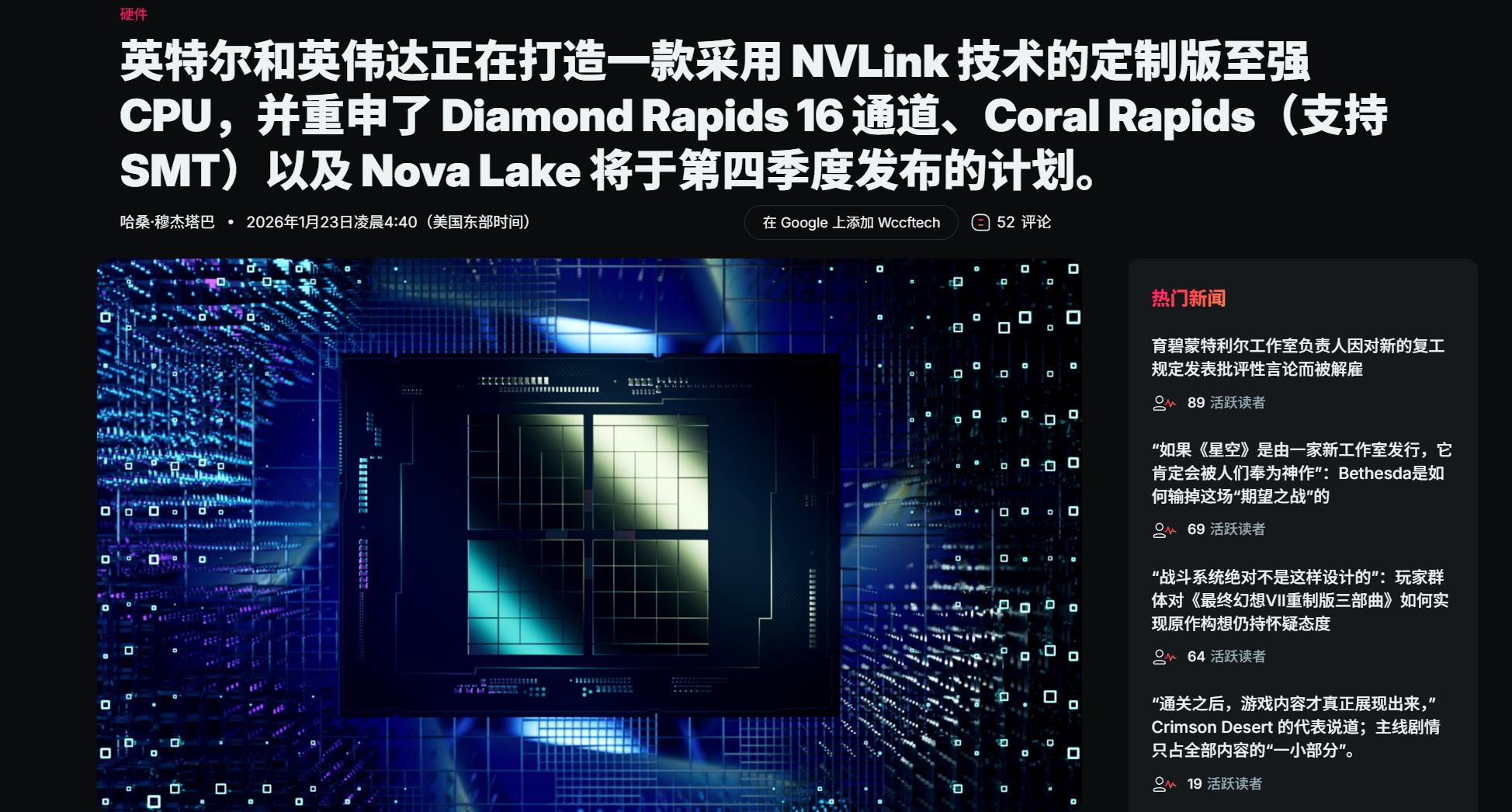
至强Xeon处理器

Search documents
英特尔联手英伟达:定制Xeon集成NVLink,真要和老黄“搭伙过日子”了?
3 6 Ke· 2026-02-04 08:40
Core Viewpoint - Intel is collaborating with NVIDIA to develop a custom Xeon processor integrated with NVLink technology, aimed at enhancing AI performance and addressing competitive pressures from AMD and NVIDIA [1][3][4]. Group 1: Collaboration Details - Intel's new CEO, Chen Lifeng, announced the partnership with NVIDIA during a recent earnings call, marking a significant shift in strategy for Intel [1][3]. - This collaboration is the first substantial hardware partnership since NVIDIA's $5 billion investment in Intel last year [3]. - The custom Xeon processor will be designed specifically for AI applications, leveraging NVIDIA's GPU capabilities [1][4]. Group 2: Technical Specifications - The upcoming Xeon processor is expected to be based on the existing sixth-generation Xeon technology, with a focus on high core counts to compete with AMD's multi-core advantages [5][7]. - The flagship Xeon 6900P will feature up to 128 high-performance cores, enhancing memory bandwidth and PCIe connectivity [7]. - The integration of NVLink technology will allow for direct communication between GPUs and CPUs, significantly improving data transfer speeds and reducing latency [9]. Group 3: Market Context - Intel's decision to partner with NVIDIA reflects its current market challenges, particularly against AMD, which has gained significant market share in data centers [10][13]. - AMD's market share in data centers has approached 40%, with major cloud service providers increasingly favoring AMD over Intel [13][21]. - The collaboration aims to counteract AMD's competitive edge by offering a tailored solution that maximizes GPU performance for AI workloads [14][23]. Group 4: Implications for the Industry - This partnership may lead to a shift in how hardware is bundled, with potential for more customized solutions like "Intel + NVIDIA" packages versus "AMD all-in-one" solutions [23][26]. - The collaboration could also enhance consumer products, allowing for improved performance in gaming and content creation through optimized CPU and GPU integration [25][26]. - AMD will need to strategize effectively in response to this new competitive landscape created by the Intel-NVIDIA alliance [27].