
荣耀200 Lite

Search documents
传音越来越“小米”了
Hua Er Jie Jian Wen· 2025-12-03 08:36
Core Viewpoint - The consumer electronics sector is witnessing an influx of companies aiming for A+H listings, with Transsion Holdings and Anker Innovations recently submitting their IPO applications to the Hong Kong Stock Exchange. Transsion is facing significant challenges, including a nearly halved net profit, as it competes against Chinese rivals like Xiaomi and Honor in its core African market [2][4][10]. Group 1: Financial Performance - Transsion Holdings reported a revenue of 49.543 billion yuan and a net profit of 2.148 billion yuan for the first three quarters of 2025, reflecting year-on-year declines of 3.33% and 44.97% respectively [2][6]. - The company's gross margin fell to 18.59% in Q3 2025, marking the lowest quarterly figure in five years, partly due to rising storage costs [8][11]. Group 2: Market Competition - Despite maintaining a leading position in Africa with over 10 million mobile units shipped and a market share of 51% in Q3 2025, Transsion's growth rate was only 25% year-on-year, while competitors Xiaomi and Honor experienced growth rates of 34% and 158% respectively [7][8]. - Xiaomi's strategy includes launching localized products like the REDMI 15C smartphone, which features a 6000mAh battery to address local power supply issues, and bundling sales with local telecom operators [8]. Group 3: Strategic Initiatives - Transsion is diversifying its product offerings beyond smartphones by developing an AIoT ecosystem, which includes home appliances, computers, and smart glasses, similar to Xiaomi's approach [3][12]. - The company is also venturing into the electric vehicle market in Africa, launching two-wheeled and three-wheeled electric vehicles to capture the motorcycle market [3][12]. Group 4: IPO and Future Prospects - The upcoming IPO marks Transsion's first equity financing since its 2019 listing on the STAR Market, aimed at bolstering its competitive edge and enhancing its international brand image [4][9]. - The company plans to utilize the funds from the IPO to address supply chain pressures and expand its presence in Southeast Asia, where it faces stiff competition from Samsung and Xiaomi [9][10].

非洲手机市场竞争升级,传音控股如何破解增长焦虑?
Guo Ji Jin Rong Bao· 2025-12-01 11:08
Core Viewpoint - Transsion Holdings, known as the "King of Mobile Phones in Africa," maintains a strong market presence in Africa despite increasing competition from other Chinese brands, focusing on enhancing its competitive advantages and brand differentiation strategies [1][3]. Group 1: Market Position and Performance - Since its listing in 2019, Transsion has seen an increase in its smartphone market share in Africa, remaining the market leader with over 40% share for five consecutive years [2][3]. - In the first nine months of 2023, the company reported a slight revenue decline of 3.3% year-on-year, totaling 49.54 billion yuan, while net profit dropped significantly by 44.97% to 2.15 billion yuan [2]. - The third quarter of 2023 showed a revenue rebound, achieving 20.466 billion yuan, a year-on-year increase of 22.6%, although net profit continued to decline by 11.06% to 0.935 billion yuan, indicating a "revenue growth without profit growth" scenario [2]. Group 2: Competitive Landscape - In Q3 2025, Transsion led the African smartphone market with a shipment of 11.6 million units, holding a 51% market share, while competitors like Xiaomi and Honor are rapidly increasing their market presence [3][4]. - Xiaomi's market share reached 13% with a 34% year-on-year growth, while Honor experienced a remarkable 158% growth, indicating a shift in competitive dynamics [3][4]. Group 3: Strategic Initiatives - Transsion plans to strengthen its competitive edge in Africa by focusing on refined operations, differentiated brand building, and establishing a robust "moat" through systematic capabilities [1][5]. - The company is also expanding its product categories beyond mobile phones, including digital accessories and home appliances, while implementing a multi-brand strategy to cater to emerging market demands [5].

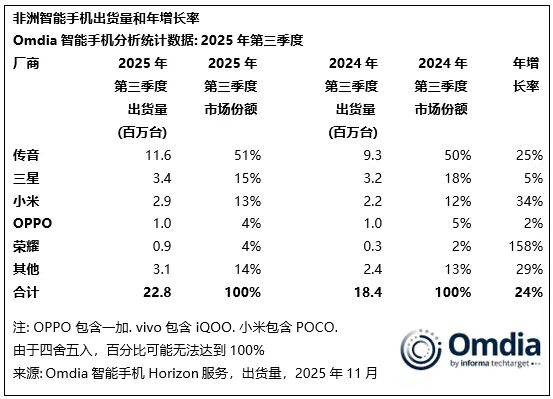
Omdia: 2025年第三季度,非洲智能手机市场出货量同比增长24%,重现双位数增长,传音继续领跑,荣耀仍保持三位数最大增幅
Canalys· 2025-11-28 01:04
Core Insights - Omdia's latest research indicates that smartphone shipments in Africa will surge by 24% year-on-year in Q3 2025, reaching 22.8 million units, marking a rebound after five consecutive quarters of slowdown, driven by increased market demand, currency stability, enhanced financing usage, and improved retail activities [1] Group 1: Regional Performance - North Africa and Sub-Saharan Africa experienced double-digit growth in smartphone shipments, with Nigeria and Egypt each accounting for 14% of regional shipments; Nigeria's market surged by 29% due to stable naira exchange rates and an updated portfolio of models priced below $150, while Egypt saw a 19% increase [1] - South Africa led with a 31% growth, benefiting from the acceleration of prepaid models in the low and mid-range markets, new model launches, and increased retail promotions [2] - Kenya's market grew by 17%, driven by the rising penetration of installment payment plans, which have become a significant driver of smartphone sales [2] Group 2: Market Dynamics - The shipment of smartphones priced below $100 increased by 57%, the fastest growth rate in three quarters, while models above $500 grew by 52%; the entry-level market's rapid growth was primarily driven by Transsion, which saw a 25% year-on-year increase in shipments supported by strong demand in Algeria, Egypt, Morocco, Nigeria, Kenya, and South Africa [5] - Major brands like Samsung dominated the high-end market with strong demand for Galaxy S24 and S24 FE 5G in South Africa, Senegal, and Algeria, although overall market growth remained moderate at 5% due to consumer preference for cost-effective models [5] Group 3: Competitive Landscape - Xiaomi is accelerating its long-term strategy in Africa, planning to enter over 15 new markets in the coming months and has opened its first self-operated flagship store in Morocco; its strong sales in the sub-$150 segment account for half of its shipments [6] - OPPO is consolidating its market position in North Africa with a focus on Egypt, while Honor is maintaining steady growth in South Africa through high-cost-performance models like Honor 200 Lite [6] Group 4: Future Outlook - Omdia forecasts a 6% decline in the African smartphone market by 2026 due to rising supply-side pressures, including increased BOM costs, tight memory supply, and ongoing currency weakness, which will particularly impact the low-end 4G market that constitutes the majority of demand in Africa [8] - These pressures are expected to raise average selling prices, especially in the $80 to $150 range, presenting new payment challenges for consumers; manufacturers will need to strengthen financing partnerships, optimize channel inventory, and localize more effectively to navigate this environment [8]
