谷歌AI语音助理眼镜

Search documents
AI眼镜赛道再迎巨头入场
Xin Lang Cai Jing· 2025-12-10 06:34
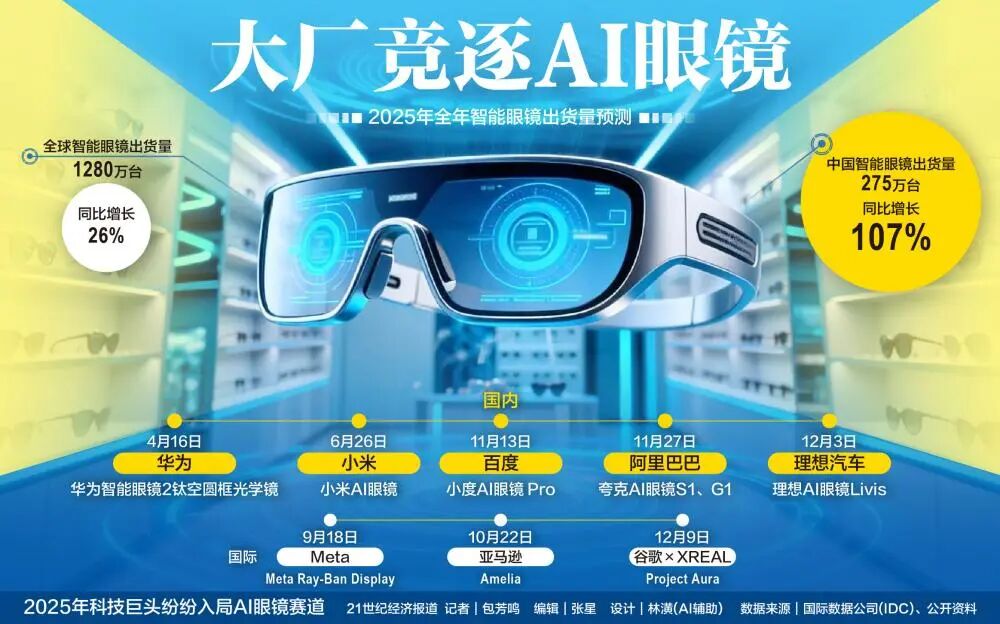
Core Insights - Google is set to launch its first AI glasses in 2026, showcasing a significant commitment to the AI glasses market [1][12] - The company is developing two types of AI glasses: one for voice assistant functions and another with display capabilities [1][12] - Google aims to challenge Meta in the next-generation computing platform competition, leveraging its advanced AI models and the Android ecosystem [1][12] Product Development - The AI glasses include a voice assistant model that integrates speakers, microphones, and cameras for hands-free interaction with Gemini [1][12] - The display model will present information directly on the lenses, allowing users to access navigation and real-time translations without disturbing their surroundings [1][12] - Google is collaborating with Chinese AR company Xreal on a project called "Project Aura," which will be the first wired XR device running on the Android XR platform [1][12] Strategic Shift - Google is returning to the smart eyewear market after its initial failure with Google Glass in 2012, shifting its strategy from a simple camera to an AI-native interaction interface [4][5] - The Android XR platform is designed to support diverse hardware forms, enhancing user experience by allowing customization based on individual preferences [5][15] - The introduction of "digital avatars" technology aims to enhance social interaction during video calls by capturing and replicating users' facial expressions and gestures [5][15] Market Competition - Google is targeting Meta, which currently holds a significant market share in smart glasses, with Meta's products projected to capture 73% of the market by mid-2025 [6][15] - Unlike Meta's vertical integration approach, Google focuses on empowering the industry through its software platform, aiming to create an ecosystem that rivals Meta's success in the smartphone sector [6][16] - Google plans to integrate its high-frequency applications like Maps, Search, and Translation with Gemini, bringing AI capabilities directly to users [6][16] Industry Outlook - The smart glasses market is expected to experience significant growth, with projections indicating that global shipments could exceed 23.7 million units by 2026, including 4.9 million units in China [9][19] - Analysts believe that the industry is on the verge of a breakthrough, driven by advancements in AI models and the emergence of AIoT (Artificial Intelligence of Things) [8][19] - Despite the optimistic outlook, challenges such as privacy concerns, design aesthetics, and the lack of killer applications remain barriers to widespread adoption [10][20]