
象限仪座流星雨

Search documents
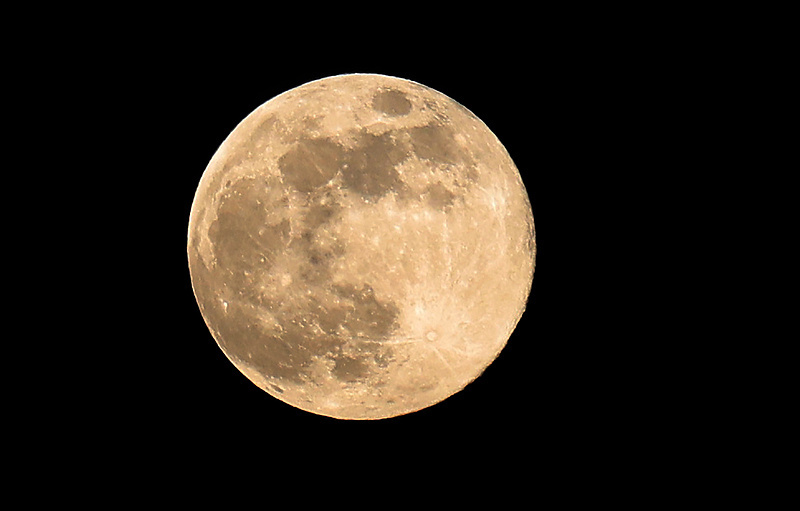
抬头看!2026年首个“超级月亮”现身夜空
Xin Lang Cai Jing· 2026-01-04 00:25
Core Points - The first "supermoon" of 2026 appeared on January 3, characterized by a full moon occurring near the moon's perigee, making it appear larger and brighter than usual [3][7] - In 2026, there will be two supermoons, with the second one on December 24, which is expected to be the largest full moon of the year [7] - The supermoon can be observed with the naked eye, and its appearance changes as it rises, transitioning from a warm red to a cool gray color [7] Group 1 - The term "supermoon" refers to a full moon that occurs when the moon is near its closest point to Earth [3] - The supermoon phenomenon is not rare; there were three supermoons in 2025 [7] - The brightness of the moon increases as it reaches its highest point in the sky, minimizing atmospheric interference [7] Group 2 - The Quadrantids meteor shower, the first of 2026, will peak on the morning of January 4, coinciding with the supermoon [9][10] - Observers are encouraged to watch for fireballs during the meteor shower, which can be seen from the night of January 3 to the morning of January 4 [10]

今晚2026首轮满月与流星雨同框
Huan Qiu Wang Zi Xun· 2026-01-03 01:58
Group 1 - The first "supermoon" of 2026 will appear in the night sky on the night of January 3, remaining full and round into the early morning of January 4 [1] - The first meteor shower of 2026, the Quadrantids, will reach its peak on the morning of January 4, providing an opportunity for enthusiasts to observe from the night of January 3 to the early morning of January 4 [1] - The Quadrantids meteor shower is known for its fireballs, which are bright meteors that can be particularly spectacular [1]
木星冲日+流星雨领衔!一起打开2026年天象剧场丨1月追星日历
Xin Lang Cai Jing· 2025-12-31 06:33
Group 1 - The article highlights the astronomical events occurring in January 2026, including significant celestial phenomena such as the Quadrantids meteor shower, conjunctions of Jupiter and the Moon, and the opposition of Jupiter [2][3][4][5]. - The Quadrantids meteor shower on January 4 is noted for its high activity but will be adversely affected by moonlight due to the full moon [2]. - The highlight of the month is the Jupiter opposition on January 10, where Jupiter will be at its brightest, making it an ideal time for observation and photography [3]. Group 2 - On January 23, Saturn will be in conjunction with the Moon, providing a visually appealing event, although Saturn's rings may not be prominently visible this year [4]. - The month concludes with Jupiter accompanying the Moon on January 31, offering a more accessible viewing opportunity for stargazers [5]. - The article encourages social gatherings under the night sky to celebrate the new year and make wishes, emphasizing the beauty and wonder of the universe [5].
