跨境第三方收款服务

Search documents
全球跨境第三方收款服务市场快速增长,万里汇市占率第一
Sou Hu Cai Jing· 2025-10-29 10:15
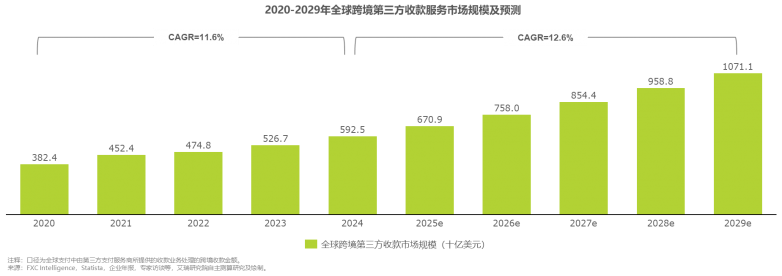
Core Insights - The global cross-border e-commerce market is expanding, with a steady increase in the share of goods trade, and China remains a dominant player in this sector [1] - The global cross-border payment market is transitioning into an era of real-time payments, stablecoins, and digital currencies, with significant growth in the market size [1] - The report by iResearch highlights the competitive landscape and development opportunities in the cross-border third-party payment service market [1] Market Growth - The global cross-border third-party payment service market is expected to grow from nearly $600 billion in 2024 to over $1 trillion by 2029 [2] - China's cross-border export third-party payment service market is projected to increase from $400 billion in 2024 to nearly $700 billion by 2029 [2] Competitive Advantages - Cross-border third-party payment service providers outperform traditional channels in operational experience, transaction speed, currency support, and value-added services [4] - The demand for flexible, efficient, and compliant cross-border payment services is increasing due to the diversification of trade entities and the complexity of overseas local settlement methods [4] Service Comparison - Traditional channels require cumbersome processes and have slower transaction speeds, while third-party payment service providers offer user-friendly online platforms with faster transaction times [6] - Third-party providers typically support a wider range of local currencies and offer various value-added services, resulting in lower overall costs and more transparent fee structures [6] Market Concentration - The market for cross-border third-party payment services is showing significant concentration, with leading firms expanding their competitive advantages through global service networks and enhanced regulatory capabilities [7] - WorldFirst holds the largest market share in China's cross-border third-party payment service market, exceeding the second-largest competitor by nearly 10% [8] Future Outlook - Cross-border payment service providers are crucial participants in the cross-border trade ecosystem, fostering deep connections with merchants and addressing their needs [10] - There is potential for these providers to empower cross-border businesses through vertical and horizontal expansion, offering services related to foreign exchange, tax, and fund management [10]

2025年全球跨境支付服务行业洞察报告
艾瑞咨询· 2025-09-02 00:03
Core Insights - The global cross-border e-commerce market is expanding, with a steady increase in the share of goods trade, and China remains a dominant player in the global cross-border e-commerce landscape, reinforcing an export-oriented structure [1][11][17] - The global cross-border payment market has entered an era characterized by real-time payments, stablecoins, and digital currencies, with a steady market expansion driven by small, high-frequency transactions [1][26] - The value of cross-border third-party payment services is becoming increasingly prominent, particularly in China's rapidly growing cross-border export third-party collection service market [1][26][33] Global Cross-Border Trade Market Data - From 2020 to 2024, global import and export trade is expected to achieve an average annual compound growth rate of approximately 8%, reflecting strong industrial resilience and policy regulation capabilities [7] - The global trade landscape is shifting towards emerging economies, with Asia and Oceania leading growth, while developed economies face low or zero growth by 2024 [2][7] China Cross-Border Trade Market Scale - China's goods and services import and export trade is projected to maintain an average annual growth rate of about 8% from 2020 to 2024, with a stable global trade share of around 11% [7][17] - The diversification of China's export markets is evident, with significant growth in Asia, Europe, North America, and emerging markets like Latin America and Africa [7][17] Global Cross-Border E-Commerce Market Data - The global cross-border e-commerce market is expected to grow at an average annual compound growth rate of 17% from 2020 to 2024, driven by consumer demand for diverse products and the digital transformation of traditional trade [11][17] - The rise of social e-commerce and digital platforms is reshaping user acquisition paths and decision-making processes [11] Global Cross-Border Payment Market Size and Forecast - The global cross-border payment market is projected to grow from approximately $141.1 trillion to nearly $194.6 trillion from 2020 to 2024, with personal cross-border payments experiencing rapid growth [26] - By 2029, the personal cross-border payment market is expected to significantly increase, driven by the demand for diverse, small, and high-frequency payment needs [26] Cross-Border Third-Party Payment Service Value - Cross-border third-party payment service providers are increasingly recognized for their value in enhancing operational experience, transaction speed, currency support, and value-added services compared to traditional channels [28][29] - The market for cross-border third-party collection services is expected to grow from nearly $600 billion in 2024 to over $1 trillion by 2029, driven by the diversification of trade participants [33] Competitive Landscape of Cross-Border Third-Party Payment Services - The market for cross-border third-party payment services is showing significant concentration, with leading firms expanding their competitive advantages through global service networks and regulatory compliance [38] - The ability to provide flexible, modular payment solutions and integrate with specific business processes is becoming a key competitive barrier for payment service providers [39][40] Emerging Market Opportunities and Risks - The expansion of China's cross-border e-commerce into emerging markets such as Southeast Asia, Latin America, and Africa presents both opportunities and challenges, requiring enhanced local payment capabilities [47][49] - Key countries to focus on include Singapore, Indonesia, Thailand, Brazil, Mexico, Saudi Arabia, UAE, Nigeria, and South Africa, each with unique market dynamics [49][51]