车削刀具

Search documents
2026-2032年中国切削刀具制造市场深度调查与投资方向研究报告
Sou Hu Cai Jing· 2026-02-06 05:18
Group 1 - The core viewpoint of the article highlights the rapid growth of China's cutting tool manufacturing industry, which is transitioning from high-speed steel tools to carbide tools, although the shift is still insufficient, with a predominance of low-end products [2][3] - The report titled "2026-2032 China Cutting Tool Manufacturing Market Deep Dive Investigation and Investment Direction Research Report" consists of nine chapters, covering market development environment, operational status, competitive landscape, key enterprise analysis, and industry trends and investment forecasts [2][3] - The data in the report is primarily sourced from national statistics, customs data, survey data, and databases from the Ministry of Commerce, with macroeconomic data from the National Bureau of Statistics [2][3] Group 2 - The cutting tool manufacturing industry in China is characterized by rapid development and is expected to reach new historical highs [2] - The report provides a comprehensive analysis of the cutting tool manufacturing industry's development status, including overall industry characteristics, operational efficiency, profitability, and supply-demand balance [4][5] - The report also examines the import and export market conditions for the cutting tool manufacturing industry, detailing overall import and export situations and product structures [4][5] Group 3 - The report includes a detailed analysis of the cutting tool manufacturing industry's market environment, including policy, economic, trade, and technological factors [3][4] - It discusses the competitive landscape of the international cutting tool market, including the development status and competition among foreign enterprises in China [4][5] - The report analyzes the demand for cutting tools across various downstream industries, such as automotive manufacturing, mold industry, and aerospace, highlighting the specific requirements and trends in these sectors [6][8] Group 4 - The report outlines the regional distribution of the cutting tool manufacturing industry in China, analyzing production and sales conditions in key regions [7][9] - It provides insights into the operational status of leading enterprises in the cutting tool manufacturing sector, including their organizational structure, product offerings, and market strategies [8][10] - The report concludes with an analysis of future trends and investment characteristics in the cutting tool manufacturing industry, offering recommendations for enhancing product value and technological innovation [11]


IPO雷达|森泰英格时隔四年“卷土”冲击北交所,此前未结刑事案件曾被问询
Sou Hu Cai Jing· 2025-12-21 08:44
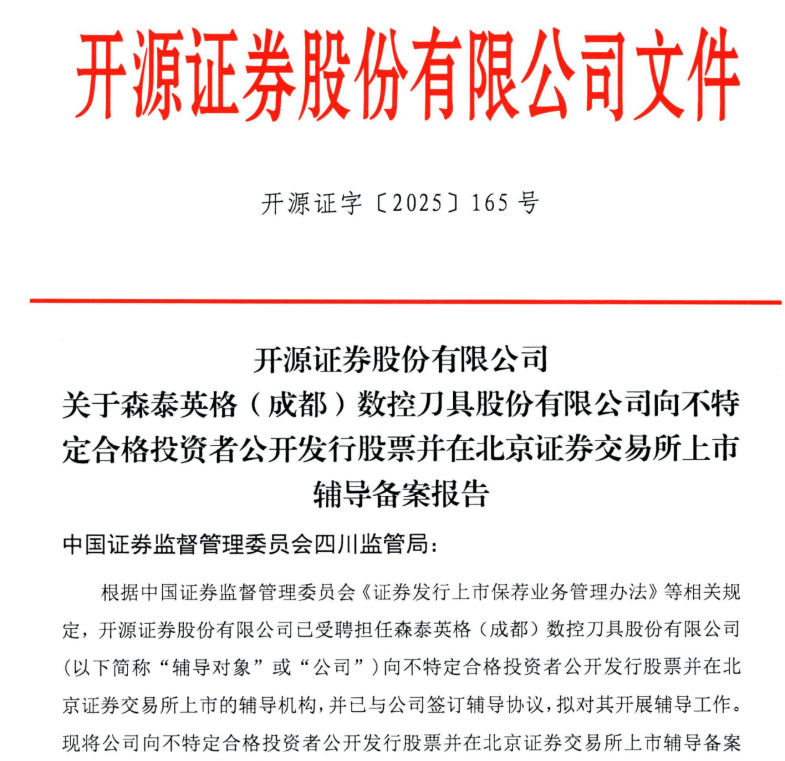
Group 1 - The China Securities Regulatory Commission (CSRC) disclosed that 17 companies received domestic IPO counseling filings this week, including Sentai Yingge (Chengdu) CNC Tool Co., Ltd., which plans to list on the Beijing Stock Exchange with the counseling agency being Kaiyuan Securities [1] - Sentai Yingge previously applied for an IPO on the Sci-Tech Innovation Board in November 2020 but withdrew its application in March 2021 after the Shanghai Stock Exchange terminated its review [5] - The company, established on July 15, 1997, is recognized as a national-level "little giant" enterprise focusing on the research, production, and sales of CNC machine tool core accessories and tools, with applications in automotive, aerospace, and engineering machinery sectors [5] Group 2 - For the fiscal years 2023 and 2024, Sentai Yingge's projected operating revenues are 297 million yuan and 330 million yuan, respectively, while net profits are expected to be 47.72 million yuan and 32.49 million yuan, with gross profit margins of 43.1% and 37.49% [5][6] - The company’s weighted average return on equity is projected to be 7.67% for 2024, down from 12.25% in 2023, indicating a decline in profitability [6] - The actual controllers of the company, Xia Yongkui and Liu Min, collectively hold 51.25% of the voting rights, and the company is currently fulfilling its borrowing obligations [6]