
达芬奇腔镜手术机器人

Search documents
国产手术机器人走过行业重启年
Xin Lang Cai Jing· 2026-01-31 08:21
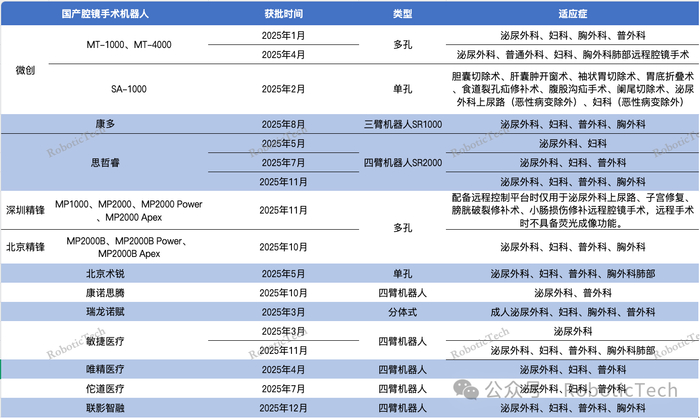
Core Viewpoint - The orthopedic surgical robot company Tianzhihang has released a performance forecast, expecting revenue of 270 million to 300 million yuan in 2025, representing a year-on-year growth of 50.97% to 67.75% [1] - The industry is witnessing significant growth, with competitors like MicroPort Robotics also projecting substantial revenue increases, indicating a competitive landscape in the surgical robotics market [1][8] Industry Overview - Surgical robots are considered a "gem" in the high-end medical device sector, with laparoscopic and orthopedic surgical robots being the most mature and largest segments [1] - The domestic sales figures for these segments from January to November 2025 are projected to be 1.823 billion yuan and 654 million yuan, respectively, with sales of 119 and 86 units [1] Market Dynamics - The penetration rates for robot-assisted laparoscopic surgeries in China and the U.S. are 0.7% and 21.9%, respectively, indicating significant room for growth in the domestic market [2] - High prices, often exceeding millions, are a major barrier to the widespread adoption of surgical robots [3] Competitive Landscape - The market is becoming increasingly competitive, with more products receiving approval and entering clinical applications, leading to aggressive pricing strategies among manufacturers [3][5] - The number of approved laparoscopic surgical robots in China is expected to reach 13 by the end of 2025, with major players like United Imaging entering the market [3] Pricing and Policy Changes - The National Healthcare Security Administration has introduced a unified pricing guideline for surgical robots, which will help clarify costs for hospitals and encourage adoption [10][13] - The pricing structure will be linked to the level of participation and clinical value provided by the surgical robots, promoting their use in complex surgeries [12][13] International Expansion - Leading companies are actively exploring overseas markets to enhance their performance, with MicroPort Robotics reporting significant growth in international sales [8] - The challenges of international expansion include varying regulatory requirements and the need for localized service and support systems [9] Future Outlook - The domestic market for surgical robots is expected to see increased competition and potential price adjustments in the coming years, particularly for laparoscopic robots [5] - The overall market environment is improving, with a rise in bidding opportunities for orthopedic surgical robots, contributing to revenue growth for companies like Tianzhihang [9]


医疗手术机器人观点汇报电话会
2026-01-16 02:53
Summary of Medical Surgical Robots Conference Call Industry Overview - The medical surgical robot market in China is in its early stages, with a market size of less than 100 billion RMB, but is experiencing rapid growth due to improvements in policies, payment systems, and hospital demand [1][2][5] - The laparoscopic surgical robot segment is a major focus, with a global market size of approximately 10.2 billion USD and a compound annual growth rate (CAGR) of 17%. The domestic market size is around 4 billion RMB, with a CAGR of 15% [1][3] Key Companies and Market Dynamics - Major players in the laparoscopic surgical robot market include Intuitive Surgical's Da Vinci system, which has a penetration rate in the U.S. of 5,800 units and nearly 10,000 globally, while domestic installations are below 500, indicating significant room for growth [3] - In the orthopedic surgical robot sector, Tianzhihang is a leading domestic company with a high market share, focusing on trauma, spine, and joint surgeries. The market is expected to grow rapidly due to improved policies and clinical demand [1][2][3] Technological Advancements - Significant advancements in surgical robot technology have been made, including breakthroughs in hardware and software systems. The integration of brain-machine interfaces is becoming essential, driving the industry towards high mobility and high-speed automation, significantly enhancing efficiency [4] - The Da Vinci system has achieved a mature status with multi-port and single-port systems, completing over a million cases in the U.S. and achieving a penetration rate of 22% [4] Policy Impact - Recent policy changes have clarified service operation projects and pricing mechanisms, promoting rationalization of service prices and enhancing hospitals' willingness to purchase and use surgical robots. This is expected to accelerate industry development [5] - The payment system is gradually improving, with more hospitals adopting relevant fee structures, which will enhance effective charging capabilities at the terminal level [5] Market Trends and Future Outlook - The demand for surgical robots is strong, particularly for cardiovascular and neurosurgery applications, with companies like Huake Precision capturing significant market shares [8] - Domestic companies are competing with imported brands and are moving towards multi-functional platforms. Tianzhihang has developed a technology platform that covers multiple surgical areas [7] - The overseas market for domestic companies is approaching 10 billion RMB, indicating potential for significant growth in international markets [7] Notable Companies in the Market - Tianzhihang is recognized as a leading orthopedic surgical robot company, with products covering spine, trauma, and joint surgeries, and has received EU CE certification [9][10] - MicroPort Medical is one of the strongest domestic companies, with a product range that includes laparoscopic and orthopedic robots, and has received significant orders [11] - Jingfeng Medical focuses on multi-port and single-port laparoscopic robots, with strong sales performance and a growing presence in international markets [12] - Sanyou Medical is developing a spine surgical robot expected to be launched in 2026, enhancing safety in complex procedures [13] Conclusion - The medical surgical robot industry in China is poised for rapid growth driven by technological advancements, supportive policies, and increasing clinical demand. Domestic companies are making significant strides in both the local and international markets, positioning themselves competitively against established global brands [1][2][5][7][8]
