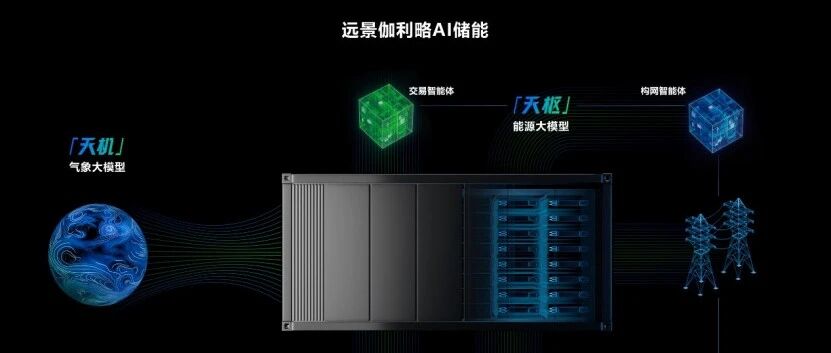
远景伽利略AI储能系统

Search documents
远景发布伽利略AI储能,“交易”+“构网”智能体驱动价值实现
中关村储能产业技术联盟· 2025-10-20 09:04
Core Viewpoint - The article emphasizes that artificial intelligence (AI) is not merely a tool but a主体, with a new paradigm defined as "physical artificial intelligence," which deeply integrates AI with physical laws, system boundaries, and knowledge graphs. The core competition in future energy systems will shift from asset-based to AI-based assets [2][4]. Group 1: AI Storage System - The launch of the Envision Galileo AI Storage System is a significant development, which utilizes two main intelligent agents: the trading agent and the grid construction agent, to establish a stable foundation for new power systems [2][4]. - The trading agent acts as an "economic brain," enabling automated trading through the Envision Tianji weather model and the Envision Tianshu energy model, achieving a 21.91% increase in project lifecycle returns based on stable operational data [4][5]. - The grid construction agent functions as a "stability nerve," utilizing super-perception and adaptive capabilities to gain insights from grid node signals, significantly enhancing AI model adaptation efficiency by five times [4][5]. Group 2: AI Empowerment Across the Value Chain - AI capabilities span the entire asset lifecycle, with precise forecasting being a prerequisite for revenue generation. The system demonstrates high accuracy in power and weather forecasting, providing reliable decision-making support [5]. - AI diagnostics enhance asset health by offering deep insights into equipment status, leading to a significant reduction in operational costs [5]. Group 3: Industry Transformation - The AI storage system, supported by dual intelligent agents, is crucial for maximizing the potential of renewable energy. The core competitiveness of the storage industry is shifting from the equipment itself to the embedded "AI assets" [6]. - The integration of physical artificial intelligence will drive the green energy transition, enabling the construction of new power systems and ending the homogeneous competition in the industry, leading to rational prosperity [6].