
人工智能资产

Search documents
“物理人工智能”有望重构能源系统
Zhong Guo Jing Ji Wang· 2025-10-22 14:54
Core Insights - The core argument presented is that artificial intelligence (AI) is not merely a tool but a transformative entity that will redefine the future energy system into an "intelligent agent" ecosystem, shifting the competitive focus from traditional physical assets to AI assets [1][3] Group 1: Concept of Physical AI - The concept of "Physical AI" is introduced, which integrates AI with physical laws and system boundaries, enhancing its reliability in real-world applications [2] - By combining data intelligence with physical laws such as energy conservation and fluid dynamics, traditional AI limitations can be overcome, leading to more effective applications in the energy sector [2] Group 2: Technological Advancements - The "Tianji" meteorological model developed by the company significantly improves the accuracy of medium to long-term weather forecasts, which is crucial for the reliable operation of renewable energy [2] - The "Tianshu" energy model, which utilizes vast amounts of data, enhances energy storage and wind turbine profitability, optimizes electricity trading, and informs investment decisions [2] Group 3: Future Competitiveness - Future competitiveness in the energy sector will pivot from installed capacity and asset scale to the scale of AI assets, emphasizing the importance of AI model intelligence and computational power [3] - The company aims to lead the transformation of the energy system through "Physical AI," which is expected to drive the green energy transition and foster a more rational and prosperous industry environment [3]
远景发布伽利略AI储能,“交易”+“构网”智能体驱动价值实现
中关村储能产业技术联盟· 2025-10-20 09:04
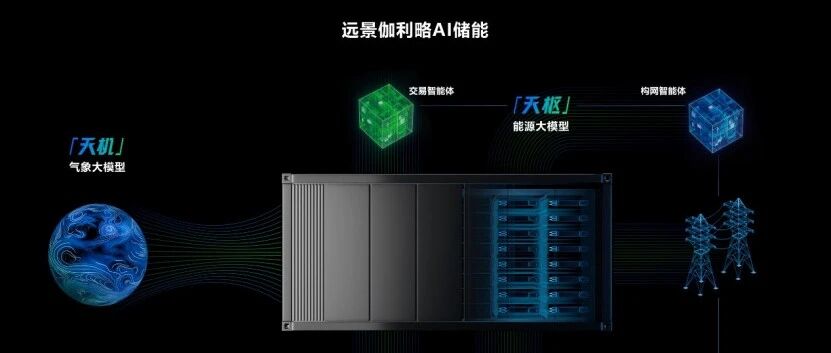
Core Viewpoint - The article emphasizes that artificial intelligence (AI) is not merely a tool but a主体, with a new paradigm defined as "physical artificial intelligence," which deeply integrates AI with physical laws, system boundaries, and knowledge graphs. The core competition in future energy systems will shift from asset-based to AI-based assets [2][4]. Group 1: AI Storage System - The launch of the Envision Galileo AI Storage System is a significant development, which utilizes two main intelligent agents: the trading agent and the grid construction agent, to establish a stable foundation for new power systems [2][4]. - The trading agent acts as an "economic brain," enabling automated trading through the Envision Tianji weather model and the Envision Tianshu energy model, achieving a 21.91% increase in project lifecycle returns based on stable operational data [4][5]. - The grid construction agent functions as a "stability nerve," utilizing super-perception and adaptive capabilities to gain insights from grid node signals, significantly enhancing AI model adaptation efficiency by five times [4][5]. Group 2: AI Empowerment Across the Value Chain - AI capabilities span the entire asset lifecycle, with precise forecasting being a prerequisite for revenue generation. The system demonstrates high accuracy in power and weather forecasting, providing reliable decision-making support [5]. - AI diagnostics enhance asset health by offering deep insights into equipment status, leading to a significant reduction in operational costs [5]. Group 3: Industry Transformation - The AI storage system, supported by dual intelligent agents, is crucial for maximizing the potential of renewable energy. The core competitiveness of the storage industry is shifting from the equipment itself to the embedded "AI assets" [6]. - The integration of physical artificial intelligence will drive the green energy transition, enabling the construction of new power systems and ending the homogeneous competition in the industry, leading to rational prosperity [6].

远景发布“能源大模型” 张雷提出“物理人工智能”将重构能源系统
Zheng Quan Ri Bao Wang· 2025-10-20 06:15
Core Insights - The core argument presented by Zhang Lei, Chairman of Envision Technology Group, is that artificial intelligence (AI) is evolving from a mere tool to a主体, fundamentally transforming the energy sector into an "intelligent agent" ecosystem rather than just a collection of physical assets [1][2][4] Group 1: AI's Role in Energy Systems - AI is seen as a revolutionary force that can handle the increasing complexity and market uncertainties associated with high proportions of renewable energy in the grid [2][3] - The concept of "Physical AI" is introduced, which integrates AI with physical laws and knowledge graphs, enhancing its reliability in real-world applications [2][3] Group 2: Technological Advancements - Envision has made significant breakthroughs in large models, particularly with the "Tianji" meteorological model, which improves medium to long-term weather forecasting accuracy, crucial for the reliable operation of renewable energy [3] - The "Tianshu" energy model, capable of real-time control through advanced algorithms, is successfully applied to optimize energy trading and asset investment decisions [3] Group 3: Future Competitiveness - The future competitiveness of energy companies will shift from traditional metrics like installed capacity to the scale of "AI assets" [3][4] - The industry is urged to focus on the intelligence of their models and the scale of their AI capabilities, marking a significant transition from physical to intelligent assets [3]
远景张雷:能源行业竞争将转向“人工智能资产”
2 1 Shi Ji Jing Ji Bao Dao· 2025-10-19 14:16
Core Insights - The article highlights the launch of a new energy model driven by artificial intelligence technologies, including the Envision Galileo AI Wind Turbine and Envision Galileo AI Energy Storage [1] - Zhang Lei, Chairman of Envision Technology Group, asserts that the core competitiveness of future energy companies will shift from installed capacity and asset scale to the depth of their "artificial intelligence assets" [1] - Zhang also emphasizes that artificial intelligence is a crucial tool to end the current "involution" in the renewable energy sector [1] Company Developments - Envision has introduced cutting-edge technologies and products aimed at revolutionizing the power system [1] - The focus on AI-driven solutions indicates a strategic pivot towards enhancing operational efficiency and competitiveness in the energy market [1] Industry Trends - The energy sector is experiencing a transformation where traditional metrics of success are being redefined by technological advancements, particularly in artificial intelligence [1] - The mention of "involution" suggests a competitive landscape that is becoming increasingly complex, necessitating innovative approaches to maintain market relevance [1]