通行费收入

Search documents
交通运输2026年投资策略-高速公路-高股息再入配置区间-静待政策催化
2026-03-01 17:23
Summary of Highway Industry Investment Strategy 2026 Industry Overview - The highway industry is characterized by state-owned enterprises and regional monopolies, with 95% of listed companies being central or state-owned enterprises. Most provinces have only one listed platform, highlighting the scarcity and weak substitutability of road networks [1][4]. - The industry has entered a mature phase of stock operation, with investment and growth slowing down. The national highway mileage is expected to grow by only 4% in 2024, and fixed asset investment has declined for two consecutive years [1][5]. Key Financial Metrics - The highway sector exhibits "bond-like" characteristics due to its heavy assets, high depreciation, strong cash flow, and low cyclicality. The operating cash flow has maintained a ratio of 35%-45% of revenue over the past five years, reaching nearly 43% in the first half of 2025 [1][6]. - Toll revenue is a core focus, measured by "revenue per kilometer," primarily driven by traffic volume. The location choice is crucial, particularly proximity to core cities and main corridors [1][6]. Investment Strategy - The investment strategy for 2026 emphasizes high-dividend companies, with dividend yields rebounding to an attractive range of 4%-5.5%. The key factors for further price increases include market style shifts and potential revisions to toll road management regulations [2][3][9]. - Companies with stable operations focused on toll roads are prioritized, while those with significant fluctuations in auxiliary business profits may not enhance ROE [1][7]. Growth and Expansion - Growth opportunities arise from upgrades and acquisitions. Upgrades can extend toll collection periods, while acquisitions can increase mileage. The revision of toll road management regulations may alleviate issues related to insufficient investment returns [3][10][11]. Cost Considerations - Key cost factors include construction costs, project return rates, and financial expenses. High construction costs, particularly in developed regions, can significantly impact long-term project returns [7][8]. - The financial expense ratio has generally declined, providing profit elasticity due to lower interest rates [8][9]. Market Dynamics - The highway sector's stock price performance is closely linked to market style, with a preference for investment during market downturns to achieve better excess or absolute returns [9][10]. - The defensive nature of the sector is attributed to stable dividends, which contribute significantly to long-term returns, especially during market declines [10]. Policy Implications - Revisions to toll road policies are expected to address core bottlenecks, such as extending toll collection periods and standardizing differential pricing, which could enhance long-term returns for the industry [11][12]. - The timeline for policy revisions is uncertain, but the urgency for legislative changes is increasing as more road assets approach expiration in the next five years [12][13]. Stock Selection Criteria - The stock selection framework prioritizes companies based on location advantages, growth potential, and dividend yield. Key companies to focus on include Shandong Highway, Wantong Highway, and Ninghu Highway, while second-tier stocks like Sichuan Chengyu and Central Plains Highway are noted for their low valuations and improving fundamentals [13].
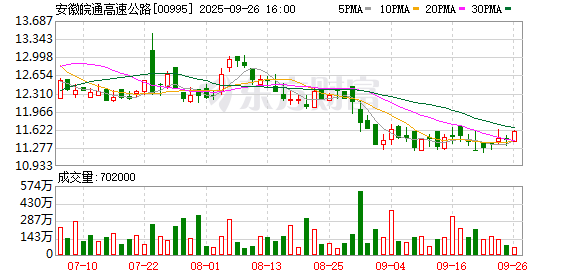
安徽皖通高速公路:2025年中期净利润9.61亿元 同比增长4.14%
Zhong Guo Zheng Quan Bao· 2025-09-26 12:25
Core Viewpoint - Anhui Wantuo Expressway (00995) reported a revenue of 3.741 billion yuan for the first half of 2025, reflecting a year-on-year growth of 11.72% and a net profit attributable to shareholders of 961 million yuan, up 4.14% year-on-year [4] Financial Performance - The company achieved a net cash flow from operating activities of 1.407 billion yuan, a decrease of 6.84% year-on-year [4] - Basic earnings per share were reported at 0.5776 yuan, with an average return on equity of 7.65% [4][26] - The price-to-earnings ratio (TTM) is approximately 10.56 times, the price-to-book ratio (TTM) is about 1.51 times, and the price-to-sales ratio (TTM) is around 2.41 times based on the closing price on September 26 [4] Revenue and Profit Trends - The revenue for the first half of 2025 was 3.741 billion yuan, with a historical revenue growth rate of 11.72% [16] - The net profit for the same period was 961 million yuan, with a historical net profit growth rate of 4.14% [16] Asset and Liability Changes - As of the first half of 2025, fixed assets increased by 77.7% compared to the previous period, while intangible assets rose by 20.97% [34] - Long-term borrowings increased by 53.63%, and bonds payable surged by 133.35% [37] - The current ratio was reported at 1.82, and the quick ratio was 1.81 [40]