酒便利20分钟送达服务

Search documents
51%股权待转酒便利缘何沦为烫手山芋
Bei Jing Shang Bao· 2025-12-08 11:56
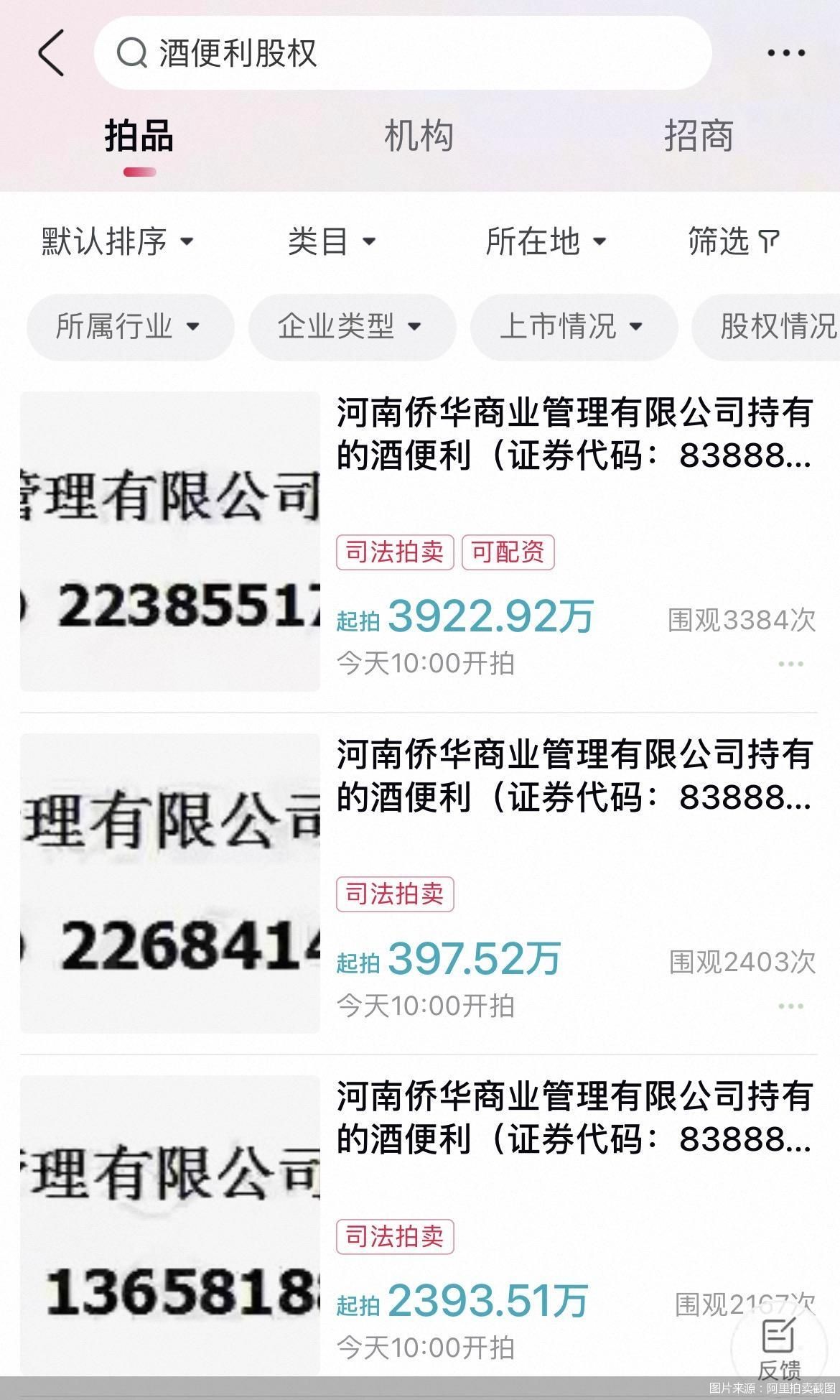
Core Viewpoint - Jiu Bian Li, once a star in the O2O liquor distribution industry with significant investments, is now facing a judicial auction of its controlling stake, indicating potential changes in its ownership and management structure [1][4]. Group 1: Shareholder and Auction Details - The controlling shareholder, Henan Qiaohua, is auctioning off 51% of Jiu Bian Li's shares, which are divided into three separate lots with a total starting price of 67.12 million yuan, approximately 70% of their market valuation [4][5]. - If the auction is successful, Henan Qiaohua's stake will reduce to 1.98%, leading to a change in the controlling shareholder and actual controller of Jiu Bian Li [4][5]. - The auction process is still in the public notice stage, with uncertainty regarding the outcome and potential implications for the company's governance [4][6]. Group 2: Company Performance and Financials - Jiu Bian Li's revenue has shown a downward trend, with figures of 9.4 billion yuan in 2022, 17.45 billion yuan in 2023, and a projected 16.79 billion yuan in 2024, alongside net losses in multiple years [9][10]. - The company is experiencing liquidity issues, with only 14 million yuan in cash and a significant inventory of 160 million yuan, indicating financial strain [9][10]. - The shift from direct sourcing to distributor procurement has increased costs and compressed profit margins, further impacting overall profitability [9][10]. Group 3: Industry Context and Challenges - The liquor distribution industry in China is facing intense competition, with over 12 million entities involved and a market size nearing 2 trillion yuan [10][11]. - Jiu Bian Li's rapid expansion has not translated into sustainable competitive advantages, as it has not developed a unique operational model to adapt to the evolving market landscape [11][12]. - Future potential investors in Jiu Bian Li will need to possess capabilities in cash flow recovery, access to premium liquor allocations, and digital operational skills to navigate the current challenges [12].