非合金钢

Search documents
中国非合金钢行业产业链全景图谱、领先企业分析及投资前景预测报告(2025版)
Sou Hu Cai Jing· 2025-08-15 04:22
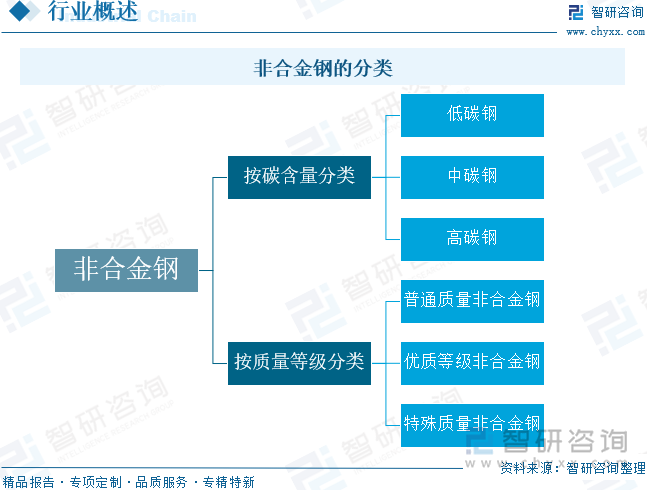
Core Insights - The non-alloy steel industry, also known as carbon steel, is experiencing steady growth and quality improvement, with China's production expected to rise from 33.11 million tons in 2015 to 43.71 million tons in 2024, reflecting a compound annual growth rate (CAGR) of 3.14% [1][4]. Industry Overview - Non-alloy steel is primarily composed of iron (Fe) and carbon (C), with a carbon content not exceeding 0.8% according to ISO standards. It is categorized into low carbon (<0.25%), medium carbon (0.25%-0.60%), and high carbon (0.60%-0.80%) steel [3][4]. - The industry is supported by national policies that promote rapid development and technological advancements, leading to continuous upgrades in production processes [3]. Production and Market Structure - The production of non-alloy steel is focused on mid to low-end products, with non-alloy steel accounting for 27% of the special steel production in 2024 [5]. - Major companies in the non-alloy steel sector include Fushun Special Steel Co., Ltd., Jiangsu Shagang Group Co., Ltd., and Ansteel Group Co., Ltd., among others [5][11]. Market Trends - The non-alloy steel industry is shifting towards high-performance and high-value-added products to meet the demands of advanced manufacturing and emerging sectors [5]. - Driven by carbon neutrality goals, the industry is accelerating green process innovations to reduce energy consumption and emissions [5]. - Digitalization and smart technologies are being integrated into the entire production process to enhance efficiency and quality stability [5].

趋势研判!2025年中国非合金钢行业相关政策、产业链、产量、重点企业及发展趋势分析:非合金钢产业升级加速,2024年产量达4371万吨[图]
Chan Ye Xin Xi Wang· 2025-08-13 01:17
Core Viewpoint - The non-alloy steel industry in China plays a crucial role in national economic construction, showing steady growth and quality improvement through optimized smelting processes and innovative heat treatment technologies [1][15]. Industry Overview - Non-alloy steel, also known as carbon steel, is primarily composed of iron and carbon, with a carbon mass fraction not exceeding 0.8% [4]. - The production of non-alloy steel in China increased from 33.11 million tons in 2015 to 43.71 million tons in 2024, with a compound annual growth rate (CAGR) of 3.14% [1][15]. - The industry is expected to accelerate production process innovation and product structure optimization under the "dual carbon" goals and green manufacturing concepts [1][15]. Policy Environment - The non-alloy steel sector is supported by national policies aimed at promoting high-performance special steel and optimizing the steel product structure [6][7]. - Recent policies include the "2024-2025 Energy Saving and Carbon Reduction Action Plan" and guidelines for upgrading equipment in key industrial sectors [6][7]. Industry Chain - The upstream of the non-alloy steel industry includes raw material supply such as iron ore and coke, which directly impacts the performance of final products [9]. - The midstream focuses on the production processes, including ironmaking, steelmaking, continuous casting, and rolling, which are critical for value creation [9]. - The downstream applications are diverse, serving sectors like construction, transportation, machinery manufacturing, and petrochemicals [9]. Market Dynamics - The market for iron ore in China is projected to grow, with production increasing from 763 million tons in 2018 to 1.042 billion tons in 2024, reflecting a CAGR of 5.33% [11]. - The construction industry in China is also expanding, with total output value expected to rise from 21.39 trillion yuan in 2017 to 32.65 trillion yuan in 2024, a CAGR of 6.22% [13]. Key Companies - Major companies in the non-alloy steel industry include Fushun Special Steel, Jiangsu Shagang Group, and Tianjin Steel Group, among others [2][3][19]. - Fushun Special Steel reported a revenue of 8.373 billion yuan in 2024, focusing on high-temperature alloys and high-strength steel [21]. - Fangda Special Steel's revenue in 2024 was 21.177 billion yuan, with a focus on rebar and automotive components [23]. Development Trends - The industry is shifting towards high-performance and high-value-added products to meet the demands of high-end manufacturing and emerging fields [25]. - Green and low-carbon transformations are being prioritized, with an increase in the use of short-process electric furnaces and recycling technologies [26]. - Digitalization and intelligent technologies are being integrated into the production process to enhance efficiency and product quality [27].