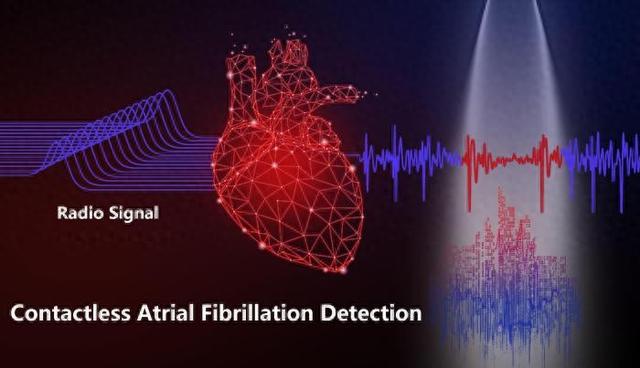
非接触式房颤检测系统

Search documents
雷达+AI:我国学者开发出非接触式房颤检测系统,精准监测心脏异常
生物世界· 2025-05-21 09:39
Core Viewpoint - The article discusses a groundbreaking non-contact atrial fibrillation (AF) detection system developed by a research team from the University of Science and Technology of China, which utilizes radio technology and artificial intelligence to detect AF without the need for physical contact or equipment [2][4]. Group 1: Technology Overview - The new system employs AI and radar technology to monitor heart movements via radio waves, achieving AF detection without any physical contact or operational requirements [4][11]. - The system's performance is comparable to traditional ECG methods, with a sensitivity of 0.844 and specificity of 0.995, based on tests conducted on 6,258 outpatient patients, including 229 AF patients [7]. Group 2: Practical Applications - The system has been validated in real-life scenarios, successfully detecting AF in two out of 27 subjects before clinical diagnosis during sleep [7][9]. - It shows potential for lifelong proactive monitoring of AF progression, integrating seamlessly into daily life activities such as sleep or work [11]. Group 3: Innovations and Methodology - Key innovations include a millimeter-wave radar designed to capture minute heart movements and the use of knowledge transfer techniques to train AI models based on existing ECG datasets [9][11]. - The system aims to enhance existing AF screening and diagnostic workflows, promoting personalized and proactive management strategies in cardiovascular healthcare [11].


中国团队研发出非接触式房颤检测系统 助心律失常早发现早干预
Huan Qiu Wang Zi Xun· 2025-05-21 07:52
Core Insights - A new non-contact atrial fibrillation (AF) detection system has been developed by a team of Chinese scientists, utilizing radar sensing and artificial intelligence (AI) technology to monitor arrhythmia symptoms wirelessly, potentially allowing for earlier detection and intervention compared to traditional clinical methods [1][3]. Group 1: Technology and Methodology - The system captures sub-millimeter heart movements remotely using radio signals and employs a knowledge transfer-driven AI framework to identify AF patterns from electrocardiogram (ECG) diagnostics [3]. - The innovative approach establishes a mapping between cardiac electrical activity and mechanical motion, leveraging validated ECG signal features to assist neural networks in recognizing abnormal mechanical fluctuations specific to AF [3]. Group 2: Clinical Evaluation - The research team evaluated the non-contact AF detection system using data from 6,258 outpatient patients, including 229 AF patients, and found that the system's sensitivity and specificity in detecting AF were comparable to that of ECG [3]. - Further testing on 27 patients during regular sleep demonstrated the system's potential in detecting the presence and episodes of AF [3][4]. Group 3: Future Implications - The non-contact AF detection system shows promise for deployment in everyday life, which could facilitate large-scale early screening and proactive management of AF patients [4].