
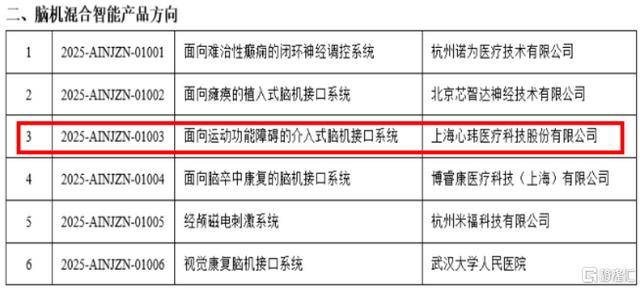
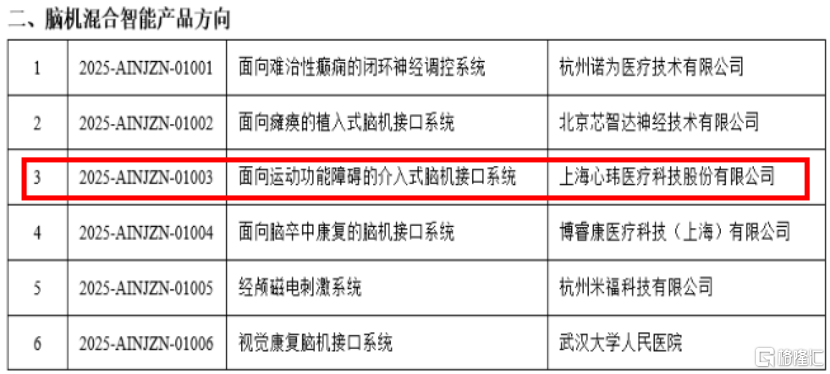
面向运动功能障碍的介入式脑机接口系统

Search documents
脑机接口风口下的价值重估,心玮医疗-B的技术卡位与资本进阶
Sou Hu Cai Jing· 2026-01-08 10:16
Core Insights - Elon Musk's Neuralink plans to start large-scale production of brain-machine interface devices in 2026, indicating a shift from clinical trials to commercialization in the industry [1] - The domestic brain-machine interface sector is experiencing favorable policies and market conditions, including the establishment of medical service pricing and discussions on insurance coverage for invasive procedures [1] - Xinwei Medical's subsidiary, Weina Zhiliang, has officially settled in Shanghai's brain-machine interface industrial cluster, focusing on R&D and clinical application of brain-machine interface technology [1] Industry Trends - The global competition in the brain-machine interface sector is fundamentally a contest of technological routes and clinical implementation capabilities [3] - Neuralink's invasive approach has precision advantages but is limited by surgical risks, while Xinwei Medical's interventional route mitigates these risks and aligns with its expertise in neuro-intervention [3] - Xinwei Medical's project for an interventional brain-machine interface system targeting motor function disorders has been selected for national AI medical device innovation support, positioning the company as a leader in the field [3] Market Potential - The global brain-machine interface market is projected to reach $12.4 billion by 2034, with a compound annual growth rate of 17% from 2025 to 2034 [7] - Xinwei Medical's technology addresses critical issues of accessibility and payment feasibility in high-value medical technology, aligning with the growing demand from patients with conditions like Parkinson's and post-stroke motor disorders [7] - The company's recent establishment in Shanghai's industrial cluster enhances its ability to connect with cutting-edge resources in talent, technology, and clinical applications [7] Financial Performance - Xinwei Medical's revenue for the first half of 2025 reached 186 million yuan, a year-on-year increase of 44.39%, marking a return to profitability [13] - The company's gross margin improved to 68.2%, driven by a robust business structure in ischemic and hemorrhagic stroke interventions [13] - The management's capital actions, including share buybacks and executive stock purchases, reflect confidence in the company's long-term value [10][11] Strategic Initiatives - Xinwei Medical has initiated an A-share IPO process, aiming to leverage its financial data from 2025 to enhance its capital platform and support ongoing business expansion [15] - The IPO is expected to improve market liquidity, reduce financing costs, and enhance brand credibility, facilitating the entry of its interventional devices into hospitals [17] - The company is positioned to capitalize on the growing neuro-regulation market, leveraging its technological advantages in brain-machine interfaces [17] Conclusion - Xinwei Medical's stock price has rebounded significantly, reflecting the convergence of its technological strategy, capital actions, and financial performance [18] - The company is well-positioned to seize opportunities in the brain-machine interface market, supported by its strategic initiatives and solid performance metrics [21] - Long-term value reassessment for Xinwei Medical is just beginning, as it stands at the intersection of industry growth and its own development trajectory [22]

脑机接口风口下的价值重估,心玮医疗-B(6609.HK)的技术卡位与资本进阶
Ge Long Hui· 2026-01-08 09:32
Core Insights - Elon Musk's Neuralink plans to start large-scale production of brain-machine interface devices in 2026, indicating a shift from clinical trials to commercialization in the industry [1] - The domestic brain-machine interface sector is benefiting from favorable policies, including the introduction of medical service pricing and discussions on insurance coverage for invasive procedures [1] - Shanghai-based WeBrain, a subsidiary of Xinwei Medical, is focusing on the research and clinical application of brain-machine interface technology, marking a significant step in the commercialization of this technology [1] Industry Trends - The competition in the global brain-machine interface market is fundamentally a contest of technological routes and clinical application capabilities [2] - Neuralink's invasive approach has precision advantages but is limited by surgical risks, while Xinwei Medical's interventional approach mitigates these risks and aligns with its expertise in neurointervention [2][4] - The interventional brain-machine interface system developed by Xinwei Medical is expected to complete its first human clinical enrollment by the end of 2026 and achieve market launch by 2027, positioning it among the leading companies in the domestic sector [2] Market Potential - The global brain-machine interface market is projected to reach $12.4 billion by 2034, with a compound annual growth rate of 17% from 2025 to 2034 [6] - Xinwei Medical's technology addresses critical issues of accessibility and payment feasibility in high-value medical technology, aligning with the industry's growth potential [6] Company Developments - Xinwei Medical's recent establishment in Shanghai's brain-machine interface industrial cluster enhances its connections with academic, research, and clinical resources, providing a competitive edge in technology development and commercialization [6] - The company has made significant capital movements, including executive stock purchases and share buybacks, reflecting management's confidence in long-term value [8][9][10] - In 2025, Xinwei Medical reported a revenue of 186 million yuan, a year-on-year increase of 44.39%, marking its entry into a phase of scalable profitability [12] Strategic Initiatives - Xinwei Medical has initiated an A-share IPO process, aiming to leverage its financial data from 2025 to enhance its capital platform and support ongoing expansion in high-value medical sectors [14] - The IPO is expected to improve liquidity, reduce financing costs, and enhance brand credibility, facilitating market penetration and product expansion [14][15] Conclusion - The brain-machine interface market is on the verge of significant growth, with Xinwei Medical's interventional approach poised to capture market opportunities due to its safety and accessibility advantages [20] - The company's strategic capital actions, solid performance, and clear growth plans position it favorably within the industry, suggesting that its intrinsic value may be in the early stages of reassessment [20]
心玮医疗成立脑机接口子公司 介入式脑机接口项目入选国家级“揭榜挂帅”名单
Zheng Quan Shi Bao Wang· 2026-01-08 02:37
Core Viewpoint - The establishment of Shanghai Weinao Intelligent Technology Co., Ltd. marks a significant step in the strategic deployment of Xinwei Medical in the brain-computer interface (BCI) sector, transitioning from planning to practical implementation [1][2] Group 1: Company Developments - Xinwei Medical's subsidiary, Weinao Intelligent, has completed its business registration and is now located in the Shanghai Brain-Computer Interface Future Industry Cluster [1] - The company aims to focus on the research and clinical application of BCI technology, facilitating the transition from basic research to clinical treatment [1][2] - The establishment of Weinao Intelligent signifies a new phase of independent and specialized operations for Xinwei Medical in the BCI business [2] Group 2: Technological Innovations - The BCI project submitted by Xinwei Medical utilizes an innovative minimally invasive approach, implanting electrode stents into brain blood vessels without the need for craniotomy, significantly reducing surgical trauma [2] - This new method effectively avoids complications associated with traditional invasive surgeries, such as intracranial infections and long-term rejection reactions [2] - The intravascular electrodes can closely adhere to blood vessel walls, achieving a balance between high-quality neural signal acquisition and long-term stability [2] Group 3: Strategic Initiatives - Xinwei Medical's BCI project was selected for the 2025 Artificial Intelligence Medical Device Innovation Task, highlighting its strong innovation capabilities and potential for technology transfer [1] - The initiative aims to promote breakthroughs in AI medical devices and facilitate the practical application of products, with 16 BCI projects being selected [1]