领克新能源车型

Search documents
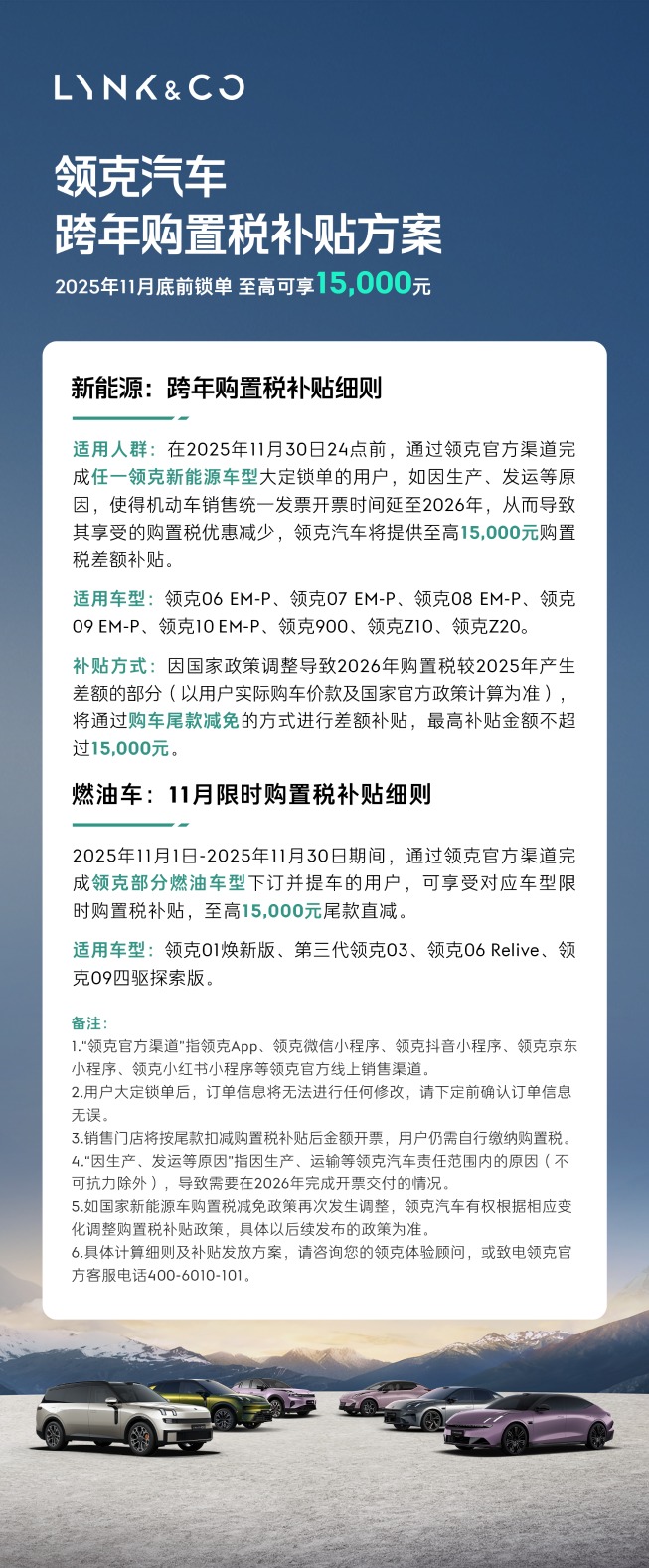
至高1.5万元 领克推新能源车“跨年购置税补贴方案”
Mei Ri Jing Ji Xin Wen· 2025-11-11 04:43
Core Viewpoint - Lynk & Co has launched a "Year-End Purchase Tax Subsidy Plan" specifically for its new energy vehicle models, aimed at mitigating potential tax benefits loss for customers due to delays in invoice issuance [1] Group 1: New Energy Vehicle Subsidy - Customers who place a substantial order for any Lynk & Co new energy vehicle model through official channels by November 30, 2025, will receive a tax subsidy if the invoice issuance is delayed until 2026 [1] - The subsidy amount will be calculated based on the actual purchase price and national policy, with a maximum subsidy of 15,000 yuan per vehicle [1] Group 2: Fuel Vehicle Subsidy - From November 1 to November 30, customers who order and take delivery of specific fuel models, including Lynk & Co 01, third-generation Lynk & Co 03, Lynk & Co 06 Relive, and Lynk & Co 09 four-wheel drive exploration version, will benefit from a limited-time purchase tax subsidy [1] - The maximum subsidy for these fuel models is also set at 15,000 yuan [1]
购置税减免政策“退坡”倒计时!多家车企自掏腰包补差额
Nan Fang Du Shi Bao· 2025-11-03 10:49
Core Viewpoint - The countdown for the reduction of the new energy vehicle purchase tax exemption policy is less than two months, prompting several automakers to offer subsidies to encourage hesitant customers to place orders [1][6]. Group 1: Company Actions - Lynk & Co has launched a year-end purchase tax subsidy program, offering up to 15,000 yuan in subsidies for customers who place orders by the end of November [1][6]. - Other automakers such as Zeekr, GAC, Aito, Changan, Chery, NIO, and Xiaomi have also introduced similar "bottom-line" policies to secure potential year-end demand [6][7]. Group 2: Policy Context - The new energy vehicle purchase tax exemption policy has undergone three extensions, with the latest plan reducing the tax exemption from 30,000 yuan to no more than 15,000 yuan starting January 1, 2026 [7]. - From January 1, 2026, only vehicles that meet the new national standard technical requirements will be eligible for the purchase tax exemption, which may affect older models' eligibility [7][8]. Group 3: Market Implications - The "bottom-line" subsidies are seen as a response to the "last train effect" of the policy reduction, aiming to alleviate customer concerns about missing out on tax benefits due to production and delivery timelines [6][7]. - For consumers still on the fence, the current subsidies may represent the last opportunity to fully benefit from the tax exemption before the policy changes take effect [7][8].