领英AI招聘工具

Search documents
数据驱动,AI加速,口碑深耕,2026中小企业出海走向精细化
Huan Qiu Wang Zi Xun· 2026-01-16 09:13
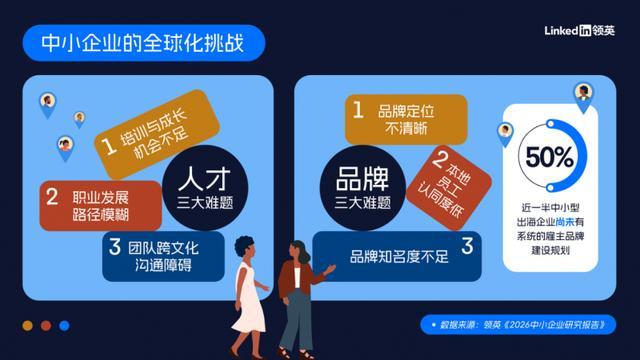
Core Insights - The article highlights the challenges and strategies of small and medium-sized enterprises (SMEs) in globalizing their operations, particularly in the context of increasing competition and market fragmentation post-pandemic [3][4]. Group 1: Globalization Challenges - The global economic outlook is mixed, with the U.S. expected to perform better due to AI capital expenditure, while risks are rising for 2026, leading to a more fragmented opportunity landscape for Chinese enterprises [3]. - The global talent market remains sluggish, with significant declines in recruitment demand in Europe, particularly in France, Germany, and the Netherlands, where demand has dropped over 20% compared to 2019 [3][4]. Group 2: Talent Acquisition Strategies - SMEs face intense competition for talent, necessitating a focus on hiring individuals with cross-border e-commerce skills and digital tool proficiency, which are scarce in the domestic market [4]. - The use of LinkedIn's AI recruitment tools has enabled companies to shorten hiring cycles and find candidates with multilingual capabilities and cross-border experience [4]. Group 3: Business Strategies - In response to increasing financing difficulties and consumer segmentation, companies are adopting a light-asset model, reducing SKU counts, shortening delivery chains, and enhancing cash flow management [4]. - The strategy of "template market + repeat customers" is being employed, where products are first validated in Singapore before being expanded to Malaysia and Thailand, with decisions driven by data metrics such as cash return cycles and customer lifetime value [4]. Group 4: Growth Engines - Digital technologies, particularly AI, are accelerating productivity for SMEs, with AI being used for generating advertising content, handling customer inquiries, and predicting inventory needs [6]. - Despite the advantages of AI, brand reliability and trust remain crucial for success in overseas markets, necessitating effective storytelling and value communication to build long-term consumer trust [6]. Group 5: Survival Strategies - The survival rule for 2026 emphasizes a balance between expansion and contraction, as well as speed and stability, requiring SMEs to rely on data, technology, and networks to create replicable growth models [6]. - Globalization is shifting from a "big and complete" approach to a "small and beautiful" strategy, focusing on building trust and accumulating benefits through steady progress in targeted markets [6].