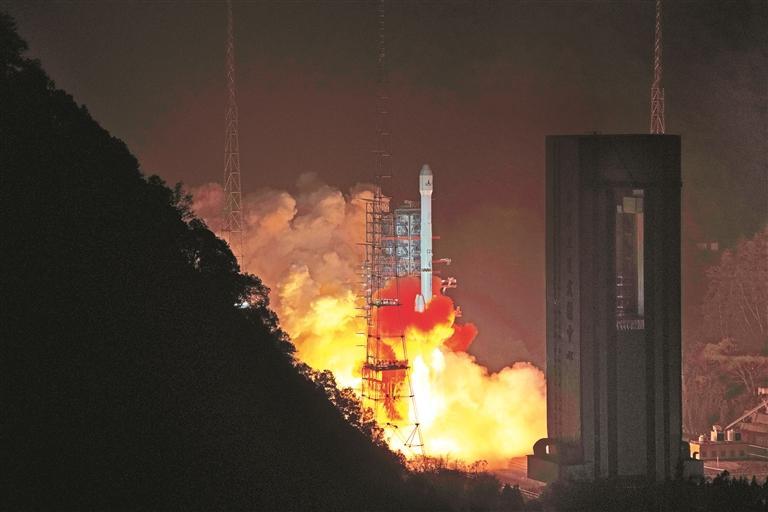
风云四号03星(风云四号C星)

Search documents
追“风”逐“云” 我国气象卫星家族新添“葫芦娃”
Xin Lang Cai Jing· 2025-12-27 22:49
Core Insights - The successful launch of the Fengyun-4C satellite enhances China's meteorological satellite family, which now includes over 20 satellites with advanced observational capabilities [1] Group 1: Technological Advancements - Fengyun-4C satellite is equipped with four different remote sensing instruments and two solar observation instruments, achieving a significant upgrade in observational capabilities, data transmission, and detection elements [2] - The advanced geostationary radiation imager reduces full-disk imaging time from 15 minutes to 5 minutes, capable of detecting temperature changes of one-fiftieth of a degree Celsius from thousands of kilometers away [2] - The interferometric infrared detector has improved spatial resolution from 12 kilometers to 8 kilometers, completing temperature and humidity detection in China within one hour [2] Group 2: Unique Innovations - The multi-band ultraviolet ionospheric imager achieves high-spectral ionospheric detection in the extreme ultraviolet band for the first time in China, filling a significant gap in solar monitoring and forecasting [3] - The lightning imager can capture 500 frames per second and identify lightning events from a data stream of 30 Gbps, demonstrating advanced capabilities in real-time data processing [3] - The design of the "vector adjustment mechanism + small thrust Hall thruster" enhances the satellite's maneuverability, improving precision by over ten times [3] Group 3: Collaborative Observational Network - The addition of Fengyun-4C supports inter-satellite collaboration and high-speed data transmission, forming a more efficient observational network alongside previous satellites [4] - This network enhances China's capabilities in weather forecasting, disaster prevention, space weather monitoring, and ecological environment monitoring [4] - The deployment of multiple geostationary and low-orbit meteorological satellites aims to create a "data highway" in space, moving towards the goal of "discovery equals observation, observation equals service" [4]

追“风”逐“云”气象卫星家族添了“葫芦娃”!
Xin Lang Cai Jing· 2025-12-27 22:49
Core Viewpoint - The successful launch of the Fengyun-4C satellite enhances China's meteorological satellite capabilities, contributing to a robust network of over 20 Fengyun satellites, which are crucial for weather forecasting and disaster prevention [2][6]. Group 1: Satellite Capabilities - Fengyun-4C satellite is equipped with four different ground remote sensing instruments and two solar observation instruments, showcasing advanced capabilities in multi-channel imaging, atmospheric three-dimensional detection, and high-frequency lightning detection [2][5]. - The advanced geostationary radiation imager can now achieve full-disk imaging in 5 minutes, improving the detection of atmospheric temperature changes to one-fiftieth of a degree Celsius [3]. - The interferometric infrared detector has improved spatial resolution from 12 kilometers to 8 kilometers, allowing for temperature and humidity detection across China within one hour [3]. Group 2: Technological Innovations - Fengyun-4C introduces several innovative technologies that fill domestic and international gaps, including a high-spectral ionospheric detection capability in the extreme ultraviolet band [4][5]. - The lightning imaging instrument can capture 500 frames per second and identify lightning events from a data stream of 30 Gbps, demonstrating significant advancements in data processing and observation [5]. Group 3: Collaborative Observation Network - The addition of Fengyun-4C supports inter-satellite collaboration and high-speed data transmission, enhancing the overall observational network for weather forecasting, disaster prevention, and ecological monitoring [6]. - The integration of multiple geostationary and low-orbit meteorological satellites aims to create a "data highway" in space, moving towards the goal of immediate observation and service [6].